A Literary Essay · On the Novel
The Brother Who Came Back
Martin and the Christ Pattern in Give Them Unquiet Dreams.
Listen while you read
J. S. Bach, The Well-Tempered Clavier, Book I: Prelude and Fugue No. 17 in A-flat major, BWV 862. Kimiko Ishizaka, piano. Public-domain recording (CC0), Wikimedia Commons.
I. The Question
Readers of Give Them Unquiet Dreams tend to come away calling Martin a Christ figure, and the instinct is sound. The novel never says so, though, and the reading has to be earned from the text rather than assumed. This essay argues that Martin is a Christ figure in a precise and limited sense. The novel gives him the actions of Christ, in Christ’s order: he gives his life, returns, raises the fallen, absolves, heals, and promises to remain. It withholds from him the character of Christ, and it never certifies that any of those actions really happened. The shape is sacred. The claim is never made. That double movement is the novel’s theology, and it is the reason the reading is more interesting than it first appears.
II. The Death: A Life Given for Another
The case begins with plot rather than imagery, which is where it is strongest. Caught in a riptide at Nantasket, Aiden is drowning, and the narration gives his brother a single, unadorned act: “Martin swam towards me.” Two sentences later the act is complete: “Martin was about ten feet away and then he disappeared.” Aiden is pulled out alive by a lifeguard; Martin is not. “Two days later, Martin’s body washed up.”
Nothing in these sentences is religious in vocabulary. Their structure is nevertheless the structure of the Gospel’s definition of love: “Greater love hath no man than this, that a man lay down his life for his friends” (John 15:13). Martin does not die near his brother or alongside him. He dies because he swam toward him. The novel takes care to place the death in the direction of the rescue, so that Aiden’s survival and Martin’s loss are one event seen from two sides.
The prose here is flat, almost reportorial, and the flatness is deliberate. A writer who wanted the parallel noticed could have reached for sacrificial language. This one gives only the direction of a swimmer and the distance at which he vanished, and leaves the reader to supply the verse.
III. The Emblem: The Pelican in Her Piety
If the death supplies the pattern, the pelican supplies the sign. The pins are Martin’s, brought home from a visit, and the novel stops to explain them in his presence: “A pelican is a symbol of Jesus. Aunt Clarise said a mother pelican will wound herself, striking her breast with her beak to feed the babies with her blood.” This is the medieval pelican in her piety, carved over church doors and set into hymns: the bird that gives its own blood as food, and therefore an image of the Passion and the Eucharist.
The emblem does not stay in Chapter Two. In Chapter Three the grandmother identifies the bird’s cry, “It’s the sound of a pelican. A symbol of Christ,” and “crossed herself as in church.” And at the novel’s most solemn moment, as Aiden and his mother carry Martin’s ashes to Keem Bay, “A flock of brown-gray pelicans flew toward the shore.” The bird attached to Martin in life arrives at his committal. The novel never comments on the return. It simply places the Christ emblem over the dead brother’s ashes and moves on.
IV. The Returns: Appearances after Death
The Gospels do not end with a burial. They end with appearances: the risen Christ comes, is recognized, acts, and goes. Martin’s posthumous visits keep that sequence closely.
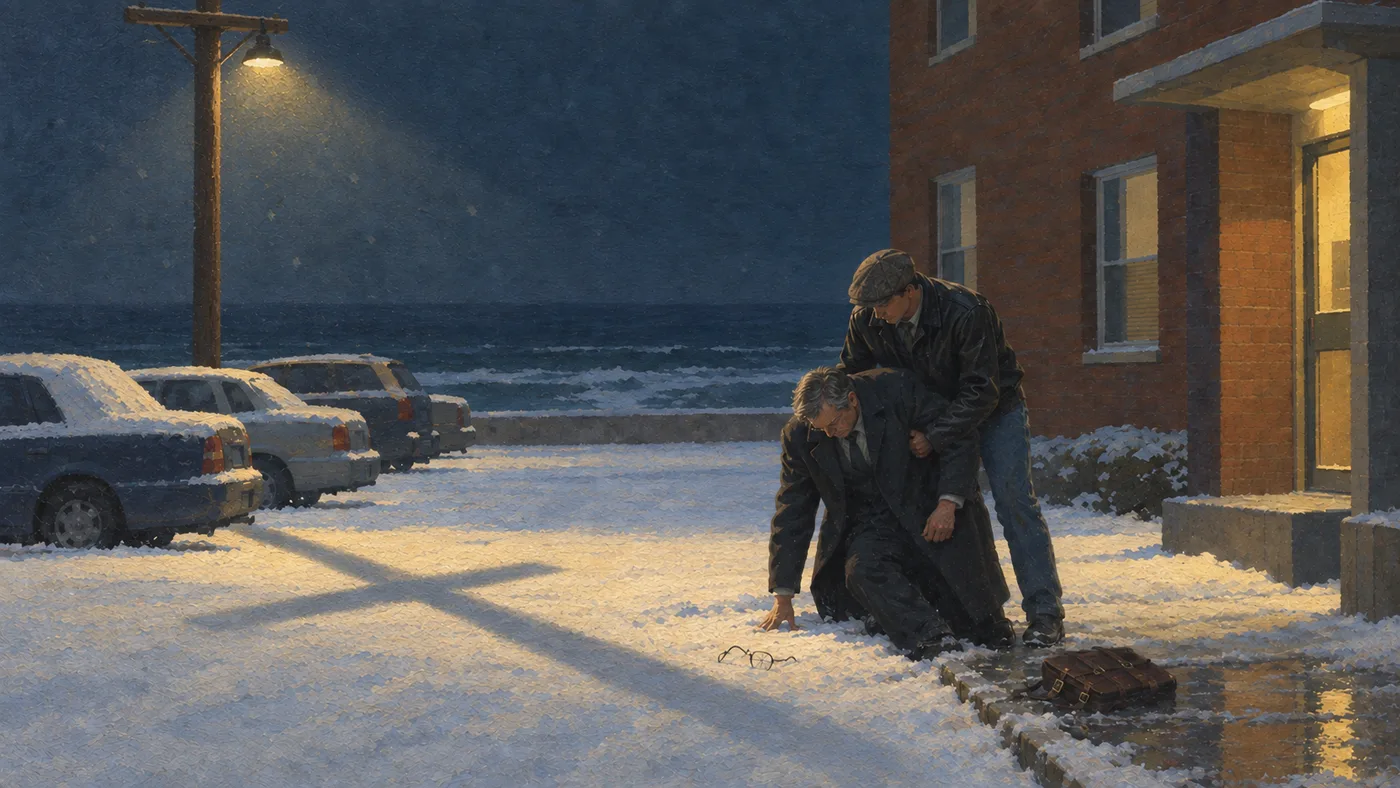
The first comes on an icy curb in Boston. Aiden falls, his glasses fly off, and a voice says, “I got you.” Then, physically: “He put his arms under my chest and lifted me.” Through cracked lenses Aiden recognizes his brother, who says, “I told you I would always have your back,” and then, a single line later, “He was gone.” The movement is the movement of Emmaus, where the disciples’ “eyes were opened, and they knew him; and he vanished out of their sight” (Luke 24:31). Recognition and disappearance arrive together.
The promise Martin keeps here was made in life. In Chapter Ten Aiden recites it: “‘I will always have your back,’” and the dead brother returns to fulfil it in the same words. A risen figure who comes back to keep his word is not a ghost haunting the living. He is a presence completing a covenant.
V. Absolution: “It Wasn’t Your Fault”
The novel’s guilt is Aiden’s, and it is specific. He survived the riptide that took his brother. At Keem Bay, waist-deep in the water, he and his mother pray, and the order of what follows matters: “I began the Our Father and she joined me. At the end, I heard myself say, ‘Martin, please forgive me.’”
The Lord’s Prayer asks the Father to “forgive us our trespasses.” Aiden finishes it and, without a pause the narration marks, addresses the same petition to his brother. In the grammar of the sentence Martin occupies the place to which forgiveness is prayed. His mother answers first, “It wasn’t your fault, Aiden,” but the answer that closes the question comes from Martin himself, at the final bedside, in the same words: “It wasn’t your fault.”
Absolution in the Catholic economy is pronounced by a priest in the person of Christ. Here it is pronounced by the one who died, to the one who lived, and it is the sentence Aiden has needed since Chapter Fifteen.
VI. Healing: The Touch and the Fever
The last visitation adds a second Gospel act to the absolution. Aiden is sick, and wakes in the night to find his brother there: “He had placed his palm against my sore chest.” The next sentence after the visit is clinical: “When I woke, my fever was gone.”
The sequence of a touch, a fever that leaves, and a sufferer who rises is the sequence of one of the earliest healings in Matthew: “And he touched her hand, and the fever left her: and she arose, and ministered unto them” (Matthew 8:15). Aiden rises into a morning the novel describes as new. Nothing names a miracle. The Gospel order is simply followed.
VII. The Promise: “I Never Left You and I Never Will”
Martin’s last words in the novel are the most theologically loaded sentence he speaks: “Go to sleep, brother. It wasn’t your fault. I never left you and I never will.”
The placement recalls the end of Matthew’s Gospel, where the risen Christ’s final words are a promise of presence across all time to come: “lo, I am with you alway, even unto the end of the world” (Matthew 28:20). The wording, however, sits closer to another promise, Hebrews 13:5: “I will never leave thee, nor forsake thee.” The precision matters. Martin does not quote either verse. His sentence fuses Matthew’s position with Hebrews’ phrasing, so that the last words of the returned brother fall where the Gospel puts its last words, in language the Bible uses for God’s faithfulness.
The sentence also does something no verse does. It reaches backward as well as forward. “I never left you” covers the years since the drowning, which Aiden lived as abandonment; “and I never will” covers everything after. The promise revises the past.
VIII. The Counter-Evidence
A reading worth holding has to survive the evidence against it, and the novel supplies that evidence generously.
Martin is not meek. His defence of his brother in the school gym is a beating: “Out of nowhere, Martin appeared. He ran up to the kid and smacked him in the face,” followed by “You mess with my brother again and I’ll beat the living shit out of you!” The novel is aware of the gap. The grandmother, reporting a neighbour’s reproach, dismisses “that shite about Jesus and the other cheek.” The Gospel says “whosoever shall smite thee on thy right cheek, turn to him the other also” (Matthew 5:39). Martin turns no cheeks.
Martin mocks his own emblem. The bearer of the pelican pins is the one who laughs at them: “Imagine if we worshiped a pelican nailed to the cross,” and, a moment later, “How ‘bout a roast pelican.” The Christ symbol is attached to a boy who finds it ridiculous.
The frame of his death is folk, not Christian. As Martin disappears, Aiden hears children’s voices singing Yeats’s “The Stolen Child”: “Come away, O human child!” and then, “Away with us he’s going.” Martin is taken, in the novel’s own imagery, by the faery host of Irish tradition, not called home by God.
There is no empty tomb. The decisive sign of the Resurrection is a body that is not there. Martin’s story inverts it: “Two days later, Martin’s body washed up.” His body returns. His ashes are scattered. Whatever comes back to Aiden, it is not a risen body.
Every return carries its own doubt. After the curb, “The fever was causing hallucinations, I thought.” After the bedside: “Had I dreamt that Martin visited me? Had I hallucinated because I was sick?” The novel never certifies a single appearance.
IX. What the Evidence Establishes
These objections do not dissolve the Christ pattern. They define it. Martin is not an allegorical Christ, a character who stands for the Redeemer and borrows his virtues. He is a profane, funny, violent teenage brother to whom the novel gives the actions of Christ in their Gospel order. He gives his life for another, carries the Passion’s emblem, returns, raises the fallen, absolves, heals, and promises to remain.
Two features of the novel’s method make this reading persuasive rather than merely possible. The first is sequence. Any one of these parallels could be coincidence; seven in the order of the Gospels are not. The second is withholding. The surrounding pages cite Scripture openly: the drawings on Aiden’s table carry Ecclesiastes, Romans and Mark by chapter and verse. Against that labelled Scripture, the Gospel echoes around Martin are left without a single citation. The novel marks its Scripture everywhere except where the emotional climax falls, and there it trusts the reader to hear the echo unaided.
The novel’s own answer to whether the visits were real is the one Aiden gives the morning after the fever breaks: “It didn’t matter.” That is not indifference. It is a claim about what a Christ figure is for. Martin’s significance does not depend on proving that a dead boy came back. It depends on the fact that his brother, who had lived with guilt since the riptide, was lifted, absolved, healed, and promised company, and that the only shape the novel has for such a gift is the shape of the Gospel.
Martin is a Christ figure in function, not in character, and in possibility, not in certainty. The novel gives him the sacred shape and declines the sacred claim. That is the signature of the work as a whole, and in Martin it reaches its most moving form.
X. The Author’s Word
The argument above rests on the text alone, and it was framed as a reading of design rather than of intention. The author has since settled the question of intention, and his answer fits the pattern traced here exactly. “I intended all the evidence and subtextual biblical allusions in Martin’s actions and depictions,” he has said. “They indeed were purposeful. But on the other hand he was simply a loving brother. I do not proselytize.”
Each half of that statement confirms one half of the reading. The first authorizes the Gospel sequence, from the riptide to the bedside, as built rather than found. The second authorizes the counter-evidence: the boy who swears, fights, and mocks the pelican pins is not a flaw in the figure but the condition of it. “I do not proselytize” names the novel’s governing restraint. The Christ pattern is offered to the reader as a shape to be recognized, never as a doctrine to be accepted, which is why every return is shadowed by its own doubt and why Aiden’s last word on the matter is “It didn’t matter.” Martin is purposefully Christ-patterned and simply a loving brother at once, and the novel’s achievement is that neither description cancels the other.
Works Cited
The Holy Bible, King James Version. John 15:13, https://www.kingjamesbibleonline.org/John-15-13/; Luke 24:31, https://www.kingjamesbibleonline.org/Luke-24-31/; Matthew 5:39, https://www.kingjamesbibleonline.org/Matthew-5-39/; Matthew 8:15, https://www.kingjamesbibleonline.org/Matthew-8-15/; Matthew 28:20, https://www.kingjamesbibleonline.org/Matthew-28-20/; Hebrews 13:5, https://www.kingjamesbibleonline.org/Hebrews-13-5/.
Mulhern, James. Give Them Unquiet Dreams. 2019.
Yeats, W. B. “The Stolen Child.” Poets.org, Academy of American Poets, https://poets.org/poem/stolen-child.
Every passage quoted here has been checked verbatim against its published source. Where the connection is inference rather than direct quotation, that is said plainly rather than implied.