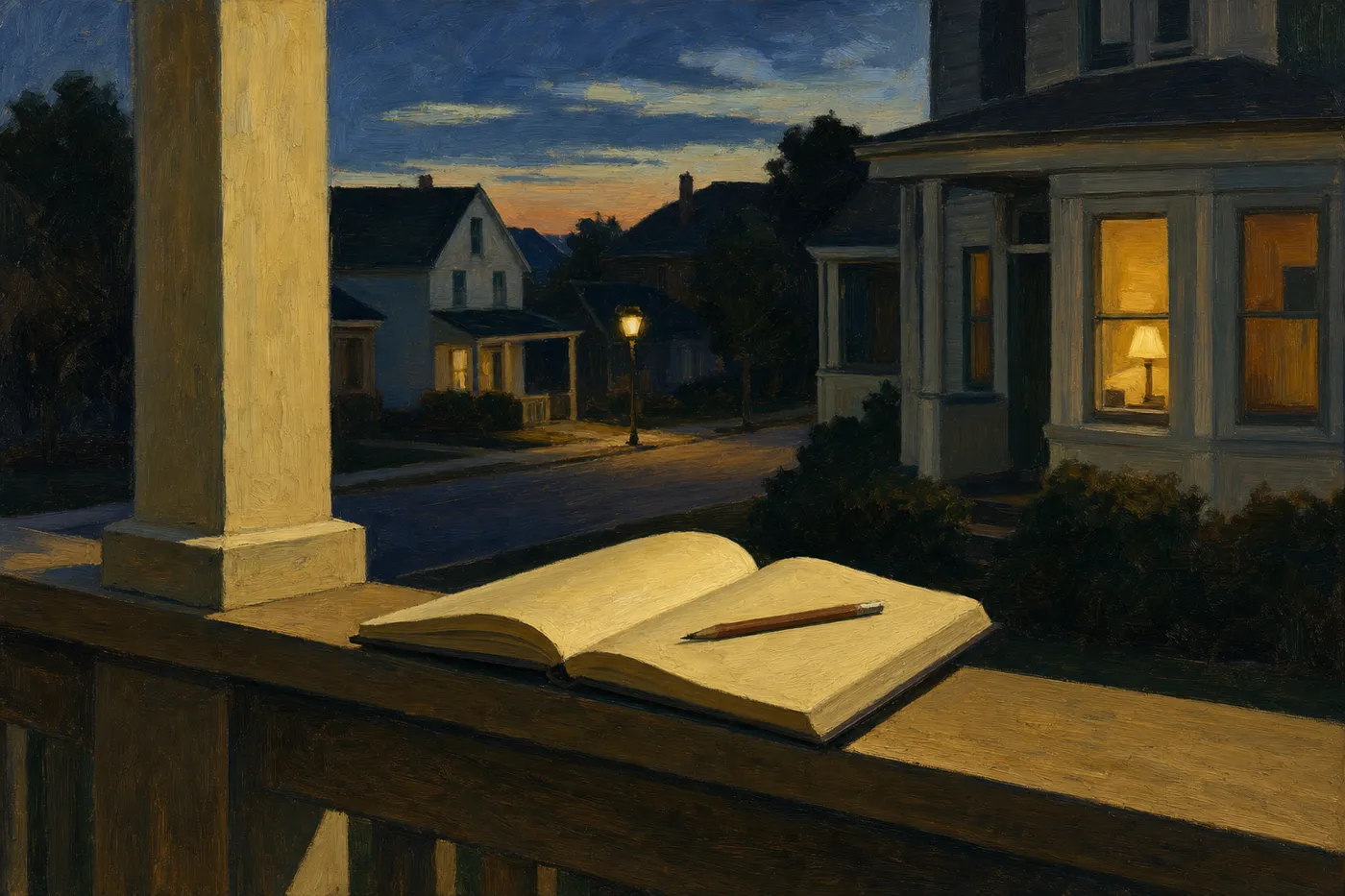
I keep these two on the same shelf, though they never met and would
likely have unsettled each other if they had. Walt Whitman and Emily
Dickinson are commonly named the first great American poets, and I
think the label holds — not because they wrote alike, but because
each, independently and almost simultaneously, broke with English
precedent and invented a native way of hearing. Whitman did it by
knocking down the wall between the poet and the world. Here he is at
the opening of Song of Myself, already refusing the modesty
English verse expected of him:
I celebrate myself, and sing myself,
And what I assume you shall assume,
For every atom belonging to me as good belongs to you.
I loafe and invite my soul,
I lean and loafe at my ease observing a spear of summer grass.
— Walt Whitman, Song of Myself, 1
Dickinson broke the same wall from the opposite direction — not by
enlarging the self until it held everyone, but by narrowing the
aperture until a single perception could not be paraphrased away.
Where Whitman's line runs long, cumulative, and breathing, hers
stops, doubts itself, and starts again on a dash:
I'm Nobody! Who are you?
Are you — Nobody — too?
Then there's a pair of us!
Don't tell! they'd advertise — you know!
How dreary — to be — Somebody!
How public — like a Frog —
To tell one's name — the livelong June —
To an admiring Bog!
— Emily Dickinson, 288
Set side by side, the two techniques could hardly be more opposed.
Whitman writes in long, unrhymed, incantatory lines built on
anaphora and cataloguing — the famous lists of occupations,
landscapes, and bodies that pour down the page until the poem feels
less like a description of America than an act of ingesting it.
His grammar is additive: and, and, and, one clause opening
onto the next, because his premise requires that nothing be left
out. Dickinson writes in the clipped meter of the hymnal — common
meter and ballad meter, the very forms she heard every Sunday in an
Amherst pew — but she interrupts that inherited music with slant
rhyme, eccentric capitalization, and the dash that has generated a
century of scholarly argument. Her grammar is subtractive: she
tells the truth, as she says elsewhere, by telling it slant,
withholding as much as she reveals. Whitman annexes the world line
by line. Dickinson interrogates a single instant until it yields
more than it wants to.
Both are among my favorite poets, and I hold them there for almost
opposite reasons. I love Dickinson for her intellectuality and her
enigmatic lines — the sense that every poem is a locked room with
the key visible but just out of reach, and that rereading her is
less a pleasure than an ongoing negotiation. I love Whitman for
the opposite reason: his expansive self-presentation, his
celebratory tone, the way he seems constitutionally incapable of
closing a door once he has opened it. I find something quietly
ironic in loving them equally, since to love both is to love a
contradiction. And yet the contradiction resolves itself, I think,
at a deeper level, because both poets are, at bottom, iconoclasts
of versification — perseverant and entirely certain of their own
craft, unwilling to write the poems their century expected of
them. They simply arrived at that certainty from opposite
directions. Whitman abolished the line to make room for everyone.
Dickinson fractured the line to make room for the one true thing
she meant. Both are, underneath the technique, evoking the same
American spirit — independence, self-reliance, the conviction
that the poem answers to no authority but the poet's own
perception.
In today's psychological terms, I would call Dickinson an
introvert and Whitman an extrovert, and I do not think the
anachronism does either poet a disservice. Whitman's is a poetics
of merger — he wants to absorb the crowd and be absorbed by it,
to feel the "kelson of the creation" running through every body he
catalogues. Dickinson's is a poetics of withdrawal — her speaker
is most herself alone, at the window, cataloguing not the world
but the mind's report of it. And this is where the two of them stop
being merely a matched pair of nineteenth-century originals and
start speaking, I think, for two permanent strands of American
ideology: the pull toward community and the pull toward being left
alone. Whitman is the poet of the "barbaric yawp," the crowded
ferry, the "I" that dilates until it contains multitudes. Dickinson
is the poet of the shut door, the letter never sent, the self that
insists on its right to remain illegible. America has always
wanted both things at once — the town meeting and the cabin in
the woods — and it is fitting that our two foreparents of poetry
embody the choice so completely that neither one alone would do.
I have a more private reason for returning to Dickinson, one that
has nothing to do with prosody. I lived for five years a few
blocks from her homestead in Amherst, Massachusetts, now a museum,
and I passed it often enough that the house stopped being a
historical marker and became, in my imagination, simply
inhabited. I would look up at her bedroom window and imagine her
at it, looking back down at me. Sometimes I glanced into her
garden and wished, in the frankly impossible way one wishes for
such things, that I could travel back and know her — sit with
her, even briefly, in that garden. But I suspect, as the
biographical criticism consistently suggests, that any approach
of mine would have sent her hurrying back inside, her black dress
billowing behind her like dark contrails, the wake of a speeding
jet. That, too, seems fitting. The poet who wrote "I'm Nobody"
and meant it would hardly have made an exception for an admirer
two centuries early or two centuries late.
I did not always make that walk alone. Often my companion past
the homestead was Kathy Scherpa, one of the kindest people I have
ever known, and I find now that I cherish those unhurried walks
even more than the poetry itself — which is a high bar, since
I love the poetry a great deal. We would pass the same fence, the
same hedge, the same second-floor window, and talk of nothing
urgent, which is to say we talked of everything that mattered.
I did not know then to call those afternoons some of the best
moments of my life. I know it now, plainly, and I suspect Dickinson
— who prized nothing so highly as an afternoon rescued from
the ordinary and made luminous by attention — would have
approved of the accounting, even if she would not have approved
of the company.
Whitman, I suspect, would have done the opposite: seen me on the
path, called out, and insisted I stay for supper. That, in the
end, is the whole difference between them, and the whole reason
American poetry needed both.
❖ ❖ ❖