A Reader’s Essay · With Seamus Heaney in Mind
The Redress of Grief
Reading Crossings with Heaney’s elegiac work in mind — a few modest points of contact in subject and method, and one clear difference: Heaney digs down into ancestral soil, while these poems cross back across the water.
Listen while you read
Ludwig van Beethoven, Piano Sonata No. 7 in D major, Op. 10 No. 3, Largo e mesto. Daniel Veesey, piano. Public-domain recording, Internet Archive.
I. Redress as a Critical Frame
In “The Redress of Poetry,” the opening lecture of his 1995 Oxford series, Seamus Heaney names what poetry does for the bereaved and the displaced. The poetic act, he argues, is “informed by the idea of counterweighting, of balancing out the forces, of redress — tilting the scales of reality towards some transcendent equilibrium.”1 Poetry, on this account, does not merely describe loss; it answers it. It places “a counter-reality in the scales — a reality which may be only imagined but which nevertheless has weight because it is imagined within the gravitational pull of the actual and can therefore hold its own and balance out against the historical situation.”1 The redressing effect, Heaney concludes, “comes from its being a glimpsed alternative, a revelation of potential that is denied or constantly threatened by circumstances.”1
Heaney’s idea offers a helpful way to read what James Mulhern’s Crossings: Selected Poems attempts. Mulhern’s introduction voices a related, more personal conviction: “Memory is an act of attention. We choose what to preserve, which words to carry forward, which silences to honor. I return to thresholds: the doorway where my father asked, ’Everything copacetic?’ The firelit space under a bridge when my brother hugged my shoulder. The west front of St. Theresa’s Church I exited long ago. A hallway where my grandfather touched my head. The hospital room where a face I knew would soon be gone. These are the crossings I carry.”2 And later, more plainly: “My family members are my prayers. My poems are my prayers.”2 Read with Heaney’s lecture in mind, the poems can be seen as small counterweights placed in the scales against what has been lost. To read Crossings this way is not to claim influence, kinship, or equal standing — Heaney is one of the great poets of the age — but to borrow his frame as a reader’s tool, and to notice where a second-generation American’s distance from Ireland gives these poems a different direction.
II. The Ancestral Spade and the Emigrant’s Sack
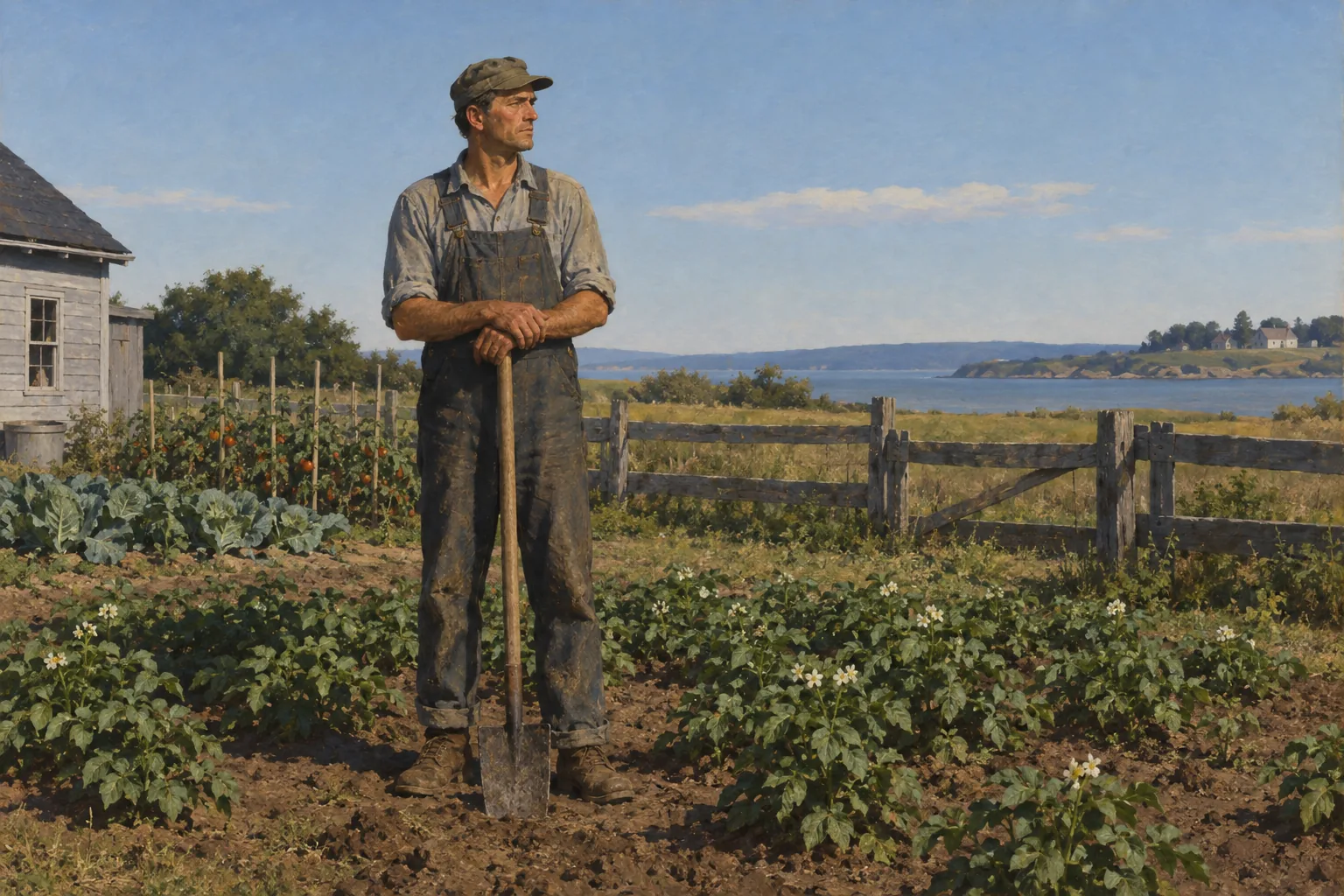
Heaney grounds the poetic vocation in the labor of ancestors and makes that labor the poem’s figure for itself; some poems in Crossings turn to ancestral labor too, in a quieter key. Heaney’s “Digging” opens with the pen already transformed into an instrument of work: “Between my finger and my thumb / The squat pen rests; snug as a gun.”3 The poem then descends through two generations of manual labor — the father “Stooping in rhythm through potato drills,” the grandfather “Nicking and slicing neatly, heaving sods / Over his shoulder, going down and down / For the good turf” — before returning to the pen with the famous resolution: “But I’ve no spade to follow men like them. / Between my finger and my thumb / The squat pen rests. / I’ll dig with it.”3 Poetry, for Heaney, is excavation: the same downward motion as the spade, applied to memory rather than to earth.
The nearest poem in Crossings is “Dark City,” and it moves along a different axis. Where Heaney’s ancestors stay rooted in the same soil — the father in the flowerbeds, the grandfather on Toner’s bog — the grandfather of “Dark City” crosses an ocean. The poem remembers him first as a hallway presence (“blue eyes lit by a slant of kitchen sun”), then withholds its real subject until the final third, where the transatlantic passage arrives etymologically: the ship is the Adriatic, “a name that means, ’dark city.’”2 The ancestor’s labor is not digging but crossing: “You carried courage, a dream, / a canvas sack, your mother’s Bible. / Hardly any money.”2 And the poem’s own act of attention is a pilgrimage rather than an excavation: “I press my palm against the homestead wall, / as you touched my head so many years ago. / I see you move from darkness into light.”2 The difference is structural and consequential. Heaney’s “Digging” moves vertically, down into the peat and the past of a single place; Mulhern’s “Dark City” moves horizontally, back and forth across the Atlantic, and the poem’s closing image is not of going down but of going across — “from darkness into light.” Both poems turn to ancestral labor, but one digs and the other crosses, and that distinction shapes the rest of this reading.
The same crossing appears, politicized, in “A Prayer,” where the great-grandmother Josephine walks “past signs / that read ’No Irish Need Apply,’ / her bony hands clutching / a burlap bag of discarded shoes / for her children’s tender feet.”2 Here the ancestral labor is not the spade but the carrying of what others have discarded — a burlap bag of hand-me-down shoes, an image that will return, transformed, in the later poem “Shoes,” where the speaker slips his grandmother’s “crooked toes” into Doctor Scholls and hears again the story of the mother who “cleaned houses for the rich” and brought home shoes “often small. That’s why they look this way. The toes, I mean.”2 Heaney’s ancestors dig for potatoes and turf; Mulhern’s ancestors carry discarded shoes across an ocean and into the next generation. The object is different, but the impulse is related: the poem takes the humblest, most overlooked material of the family’s past and places it in the scales against the historical situation — “No Irish Need Apply” answered, generations later, by a poem that refuses to let the burlap bag be forgotten.
III. The Folded Object: Grief Without Sentimentality
The clearest point of contact is a reluctance to state grief directly, and a trust in the concrete object to carry what goes unsaid. Heaney’s “Mid-Term Break,” the elegy for his four-year-old brother, is the canonical instance. The poem’s power is almost entirely in what it withholds and what it lets an object do. The father’s grief is registered not by description but by its inversion: “In the porch I met my father crying — / He had always taken funerals in his stride —.”4 The mother’s is registered as sound: “my mother held my hand / In hers and coughed out angry tearless sighs.”4 And the poem closes on the single most devastating image in the elegiac tradition, a measurement that does all the feeling: “He lay in the four-foot box as in his cot. / No gaudy scars, the bumper knocked him clear. / A four-foot box, a foot for every year.”4 There is no line in “Mid-Term Break” that tells the reader how to feel. The box does the telling.
Mulhern’s “Copacetic” attempts something similar, on a smaller scale, with a folded robe. The poem builds an entire elegy for the father around a single borrowed word — “copacetic,” a Marine-slang inheritance from Korea that becomes, across the poem’s short stanzas, a private liturgy between father and son. The father’s dying refusal of hospital Jell-O (“’Don’t want it’”) and the son’s insistence (“’You’ve got to eat, Dad’”) are rendered in the plainest domestic speech, which is precisely what makes the final image land with such force: “By dawn, he’d gone. / His robe, folded, / on the table by the door.”2 In a much smaller way, the folded robe does something like the work of Heaney’s four-foot box: the object, not the adjective, carries the grief, and the reader is trusted to feel its weight. The same discipline governs “Leaves,” where a childhood chore (raking leaves behind a shed) and a late-life ritual (clearing leaves from a grave) are laid side by side with no transitional stanza between them, so that the reader performs the crossing the title promises in the white space itself, and the poem closes on the father’s voice heard again in the present tense: “’We’re done,’ you whisper in my ear.”2 A reader who knows Heaney may recognize a related technique: the dead are not so much mourned as re-enacted.
IV. The Mother and the Sacred Domestic
Another point of contact lies in the poems about the mother, where the sacred is found not in ceremony but in an ordinary domestic act performed beside her. Heaney’s “Clearances,” the sonnet sequence written in memory of his mother, contains the most famous instance: “When all the others were away at Mass / I was all hers as we peeled potatoes. / They broke the silence, let fall one by one / Like solder weeping off the soldering iron: / Cold comforts set between us, things to share / Gleaming in a bucket of clean water.”5 The sonnet’s turn is devastating precisely because it is so quiet — at the mother’s deathbed, while “the parish priest at her bedside / Went hammer and tongs at the prayers for the dying,” the son does not pray but remembers: “I remembered her head bent towards my head, / Her breath in mine, our fluent dipping knives — / Never closer the whole rest of our lives.”5 The peeling of potatoes, not the Mass, is where the two were closest; the sacred domestic act outranks the sacred ceremony.
In Crossings, the nearest poem is “Honeymoon,” where the speaker kneels to rub ointment into his mother’s cracked heel — “I nod and rub ointment against the crack. / Her feet are calloused and rough. / ’That feels good,’ she says” — while a honeymoon photograph of his parents, “young as children,” sits on the table.2 The poem’s redress is explicit and anticipatory: “Someday later, / I’ll hold the photo, / remember this night — / the rain, / her tired face / and hurt feet. / My mother will be waving to me. / I’ll see her eyes, / recall her pain, / and feel her hand in mine.”2 Like Heaney’s “fluent dipping knives,” the rubbing of Aveeno into a calloused foot is where the sacred actually resides; the poem knows, and says, that this is the moment it will return to when the mother is gone. The same knowledge structures “Moving Forward,” where the speaker, watching his eighty-two-year-old mother lose her sight, imagines the future in the body’s own terms: “When she dies, / I’ll see her walker / in the still apartment. / I’ll feel her fingers / softly trace my face / and hear her say, / ’I love you, sweetheart.’”2 In both, the mother’s presence is kept not in doctrine but in remembered touch — the motion of a knife, the tracing of fingers across a face. The likeness to “Clearances” is one of subject and gesture only, set here in a plainer American register.
V. Rootedness and Crossing: The Critical Distinction
Whatever the points of contact, the poems differ from Heaney’s in one clear respect, and that difference is the main point of this essay. Heaney’s redress is vertical. His poems dig — down into the Derry soil, into the bog, into the peat that preserves the past intact. “I’ll dig with it” is not merely a resolution about vocation; it is a statement about the poet’s relationship to place, which is one of rootedness, of going down into the same ground his ancestors worked. Even the bog poems of North — “The Grauballe Man,” “Punishment” — are acts of digging, the poet lowering himself into the earth to retrieve the preserved dead. Even after Heaney moved south and taught abroad, his elegies keep returning to that ground.
Mulhern’s redress is horizontal. His poems cross. The collection’s title names a geography — the Atlantic passage that carries a grandfather from Athlone to Southampton and onto a ship named, with grim irony, for darkness — and a threshold, the doorway where a father asks “Everything copacetic?” until the asking becomes its own answer, and a passage of another order entirely, the moment a body stops being sick and starts being gone. Mulhern’s ancestors did not stay in the soil; they crossed an ocean, and their descendants inherit not rootedness but distance. When the speaker of “Dark City” presses his palm against the homestead wall in Ireland, he is a pilgrim, not a native: “No one lives in the tiny stone house. / Birdsong. / Smell of cut grass. / Sheep amble through the fields.”2 The speaker can only visit the house. That is a descendant’s condition, and it gives these elegies a different shape from Heaney’s — not the downward plunge into preserved peat but the repeated crossing, the movement back and forth across water and across the threshold between the living and the dead, a movement that never quite completes. The collection’s late poem “Water” makes the point briefly: an old man on a dock bends, “cupping his hands / toward the lake below, / reaching for water / that will not rise.”2 Some crossings, finally, do not complete — and it is the unfinished crossing, not the finished dig, that is Mulhern’s subject.
VI. Conclusion: A Different Axis
Read with Heaney in mind, Crossings suggests that the redress of grief has something like a grammar, and that it can be spoken along different axes. The poems share with Heaney’s a few habits: they make the domestic sacred; they refuse sentimentality in favor of the concrete object — the four-foot box, the folded robe, the spade, the burlap bag of shoes; they find the mother’s presence in remembered touch rather than ceremony; and they treat the poem as a counterweight against loss. Where they part is in the axis along which the redress moves. Heaney digs down into the ancestral ground; Mulhern crosses back and forth across the water that separates him from it. Heaney is a great poet of rootedness; these poems are about displacement — and Crossings is, in the end, an American book, an elegy for a family whose defining act was not to stay but to leave, and whose grief is therefore not a matter of going down into the earth but of going back across the water, again and again, toward a home that no longer has anyone in it. The comparison is offered with humility and implies no equal standing; Heaney’s achievement is of another order. Its use is simply that his poems, held in mind, help a reader see more clearly the direction these smaller poems take.
— Silver Current Press
Notes
- 1. Seamus Heaney, “The Redress of Poetry,” in The Redress of Poetry (New York: Farrar, Straus and Giroux, 1995), 3–4. ↩
- 2. James Mulhern, Crossings: Selected Poems (Philadelphia: Silver Current Press, 2026). ↩
- 3. Seamus Heaney, “Digging,” in Death of a Naturalist (London: Faber and Faber, 1966). ↩
- 4. Seamus Heaney, “Mid-Term Break,” in Death of a Naturalist (London: Faber and Faber, 1966). ↩
- 5. Seamus Heaney, “Clearances,” in The Haw Lantern (London: Faber and Faber, 1987). ↩
Works Quoted
Related essays on this site: Crossings at Twenty Poems reads the collection’s sequence; Mapped in Water and Bone reads the same poems thematically; Second Sight Against the Celtic Twilight examines Mulhern’s Irish inheritance from a different angle.
Every passage quoted here has been checked verbatim against its published source. Where the connection is inference rather than direct quotation, that is said plainly rather than implied.