Communion, in James Mulhern’s work, is named most directly in “Teaching at Fifty-Six”: “This is communion, and teaching will be the pond that I bathe in each morning, every new day.” The word appears in a classroom rather than at an altar, but the claim is not that the classroom simply replaces the sacrament. It is that sustained attention to another person’s mind can carry a communal and spiritual seriousness that institutional language alone does not exhaust.
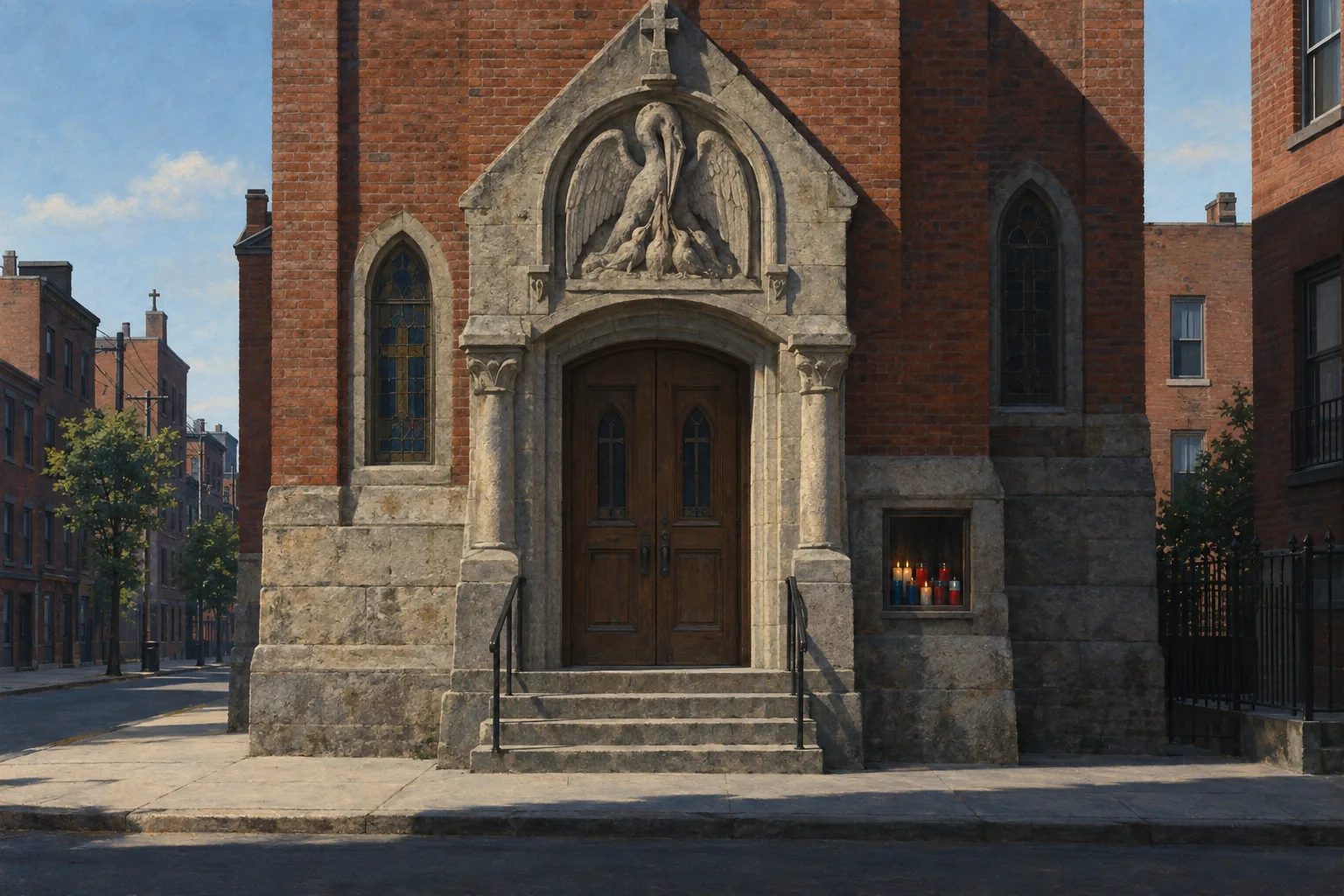
The pelican scene in the novel Give Them Unquiet Dreams offers a clear emblem for this religious vocabulary. A character tells a child that “A pelican is a symbol of Jesus… a mother pelican will wound herself, striking her breast with her beak to feed the babies.” The medieval pelican-in-her-piety is an established Eucharistic image. Mulhern places that image in a child’s hearing as an ordinary piece of family knowledge, where it becomes one instance in a larger practice of passing religious language through domestic talk.
“Assumptions” works at a different scale. On the Feast of the Assumption, under the Marian antiphon Tota Pulchra Es, a family feeds, carries, anoints, covers, and helps Peggy into and out of the water. These actions can suggest sacramental forms, but the story is not arranged as an Order of Mass or a Rosary sequence. Its actual rhythm is irregular and remembered: help is repeated, care passes between people, and no one secures a cure. The point is not to declare a beach trip a liturgy; it is to see how service survives without ceremony.
The Weight of Small Mercies makes this distinction especially clear. Women and family members perform much of the continuing pastoral work: intercession, touch, washing, anointing, feeding, rescue, practical care, and protective silence. Yet ordained men are present. They bless, heal, read scripture, and lead acclamation. The correction matters because the book does not erase clerical ministry; it shows that ceremonial acts do not carry the family’s daily burden of care. Nor does any system of healing — clerical, medical, folk, or domestic — yield a final guarantee.
The collection also works on the reader the way its characters work on one another, and that is where its moral force lives. Each story first invites a verdict and then withdraws it. A woman asks the question the reader has been silently forming: “If you knew my grandmother was lying, why did you let it happen?” A fraud is stated flatly as technique: “Make people feel bad so we can get what we want.” A ghost pronounces the judgment the plot has earned — “Tis an awful thing to do” — and the story still refuses to let the sentence stand. Even the one unambiguous wrong, a father abandoning his son, is softened by the boy’s own mercy: “You don’t hate me, Aiden. You’re angry,” and the boy’s decision to shield his mother from the news. The reader is never allowed to condemn without complication. Every verdict is forced back through need, touch, grief, or rescue until it comes out ambivalent — which is the collection’s actual theology, enacted on the reader rather than stated by a character.
The work extends communion across death, but not by making every dead figure a Christian soul in need of release. In Give Them Unquiet Dreams, second sight is hereditary, good dead return to complete relational work, and the hostile force is the Irish folk pooka. Catholic prayer for the dead and folk belief coexist. The novel’s communion across death is therefore relational and local, not a simple purgatorial mechanism.
The novel earns that ambiguity by controlling exactly when the reader is allowed to doubt. It opens by teaching distrust of the supernatural rather than belief in it — a staged healing at a Mission church that the narrator immediately undercuts: “The priest said some mumbo-jumbo prayer and pushed my chest. I knew I was supposed to fall back but was afraid the old geezers wouldn’t catch me.” Every apparition that follows arrives with an ordinary explanation available in the same scene: fever, a scratched arm, grief, drink, a dream that might only be a dream. The last point in the book where that rational door is still open comes late, after a bedside visitation: “Had I dreamt that Martin visited me?” The final page never answers the question it keeps asking. It closes instead on continuity across the dead and the living — “In this time, at the same time, and for all time” — without declaring whether what came before was vision or grief.
The poems express this practice concisely: “My family members are my prayers. My poems are my prayers. My family members are my poems.” A poem for the dead neither proves redemption nor substitutes for a rite. It continues attention where speech and ordinary repair have ended. Across the corpus, communion names a practice of listening, carrying, feeding, remembering, and refusing to treat a life as finished when its usefulness, health, or ease has failed. The collection that names this most plainly is also the most skeptical. In Useless Things the cross is dismissed as “A useless thing,” and the paradox — that the useless is where the sacred hides — is left open inside the fiction, resolved only in the back-cover copy: “the belief that tenderness, however rough its shape, is never useless.” The reader, not the narrator, must carry the recognition across that gap. Naming, too, is one of these lay sacraments. In The Weight of Small Mercies the grandmother gives her daughter her own mother’s name “to be respectful” and then refuses it — “That was my mother’s name, her formal name. I’ve told you a thousand times to call her Laura” — treating a name as an inheritance that can curse or bless, a baptism she both performed and tried to un-perform. And in the same collection a single star — “A star shone in the twilit sky” — recurs at both versions of the hospital release, joining the December star and the star inside the Watts reproduction into one small, unremarked light that appears at each moment of tenderness, rescue, or release; its being one already encodes the title’s logic of the small and singular accumulating weight. And the mannequin in “The Mannequin” is the sharpest image of the same point: a mock-body assembled from parts, “baptized,” then disassembled — “Oona/Candy’s head came off and rolled down the corridor” — arguing, against the Assumption’s promise of bodily incorruptibility, that the secular body, once severed from that promise, comes apart into parts.
One version of “Blindfolded” leaves out material that another version retains. The complete magazine text includes a chalice sequence and an invented miracle in which a healing is likened to “the water that gushed from the rock at Rephidim and Kadesh,” followed by the congregation’s “Thanks be to God.” The shortened version keeps the plot while omitting this liturgical language. That editorial choice is worth noting, because readers may differ on whether the religious material is detachable from the boy’s errand or helps give it a wider resonance.
Compression offers a related observation. Length is not necessarily what determines whether devotional material appears; genre may matter more. A comic-horror story of sixteen hundred words, epigraphed from Poe, carries no religious material, while a fourteen-line elegy moves from Communion to adulthood in one gesture: a man who says nothing and crosses himself in the light of a dashboard. In these short forms, sacramental material appears more readily in the elegiac mode and not at all in the comic one, suggesting that the habit may be tied more closely to grief than to doctrine.
Who gets to speak this language is itself worth noting. In the stories, sacred speech is not evenly shared. It belongs largely to the old, and to women: a grandmother whose nightly intention is offered for the pope’s, an Italian grandmother who keeps the oaths and the Marian dialect while declining the belief. Younger characters use the vocabulary too, but differently — one calls teaching a vocation, another reads the Prologue of John closely while professing no faith at all. A New Age healer runs the same devotional economy as salesmanship. The language circulates freely; what varies is what each speaker is doing with it.
The crisis scenes may be the more telling evidence. When someone actually dies in these stories, the liturgy tends not to arrive. A collapse in a corridor gets CPR and panic — and one formal gesture that no character makes. The only two sentences in that story beginning with the word “Doors” bracket the death: “Doors opened up and down the hall” as the compressions begin, and “Doors shut all around” once the body is on the stretcher. Seven words and then four, identical subject and opposite verb, with nothing said in between that acknowledges what has happened. That this is the versicle-and-response shape of an office is inference rather than quotation — the story never names a rite — but the shape is there, and the building performs it because no one present will. In another story the rite is improvised out of a pop song: a nurse tells a frightened bystander to keep time by singing, the crowd takes up the chant — “You can do it, Evy! You can do it, Evy!” — and then “The tall black guy stepped forward and sang the lyrics. The crowd joined in.” The form is a responsory, cantor and congregation over a body, and the liturgical book is a disco single. Nobody in the street would call it a rite, and a woman nobody liked is sung over anyway. One death gets a secular last word, another a pop song, another the procedure of police at a scene. Whatever consolation is available comes afterward and in plainer form. The last story ends not with a prayer but with an apology answered by a woman saying she is also responsible — which is, in this collection’s terms, the more dependable article. Sacred speech remains alive throughout; it is simply that attention, admission and careful listening are what the stories trust when the moment is real. And even the plainer consolation is not guaranteed to land. In “A Prayer for Home” the grandmother supplies exactly the sentence the scene calls for — “Everything will be alright, Molly” — and the embrace that should close it, and the narrator strips both of their office in a single clause: “I would like to say that I was comforted, but I wasn’t.” The lay sacrament is performed correctly and does not take. That refusal is the exact counterweight to the ascent of the title story, and it is what keeps the collection’s tenderness from being a mechanism.
The pop song does the work that formal prayer is withheld from doing. During failed resuscitation, someone instructs the crowd directly: “I mean as you are doing chest compressions sing the song in your head. It will give you the correct rhythm.” A hymn would ask for intercession; a Bee Gees chorus supplies only a beat, and the story lets the beat be the only structure the moment gets. Elsewhere, at a much quieter turning point, a song simply arrives as a car idles at a light: “The light changes to green. Bob Dylan sings,” just as a character works up to an apologetic phone call. Neither scene reaches for liturgy. Both let a secular song hold the position liturgy would occupy, timing catastrophe in one case and a small act of repair in the other.