An Essay · On Intellectual Inheritance
Mulhern’s Transcendentalism
Emerson, Thoreau, Whitman, and the Oversoul — how a nineteenth-century American philosophy structures a contemporary Irish-Catholic and Italian-American fictional world.
Listen while you read
J. S. Bach, The Well-Tempered Clavier, Book I: Fugue No. 1 in C major, BWV 846. Kimiko Ishizaka, piano. Public-domain recording, Internet Archive.
I. A Creed Stated, Not Inferred
Criticism ordinarily has to infer a writer’s philosophical commitments from pattern and implication. In “An Artistic Creed,” printed as a companion piece to the “Note from the Author” in The Collected Stories and Poems of James Mulhern (forthcoming), Mulhern identifies his intellectual lineage directly: “I write as a Transcendentalist — in sensibility and in spirit. I came to this not as a doctrine to be argued but as a way of seeing I could not put down. Emerson taught me to trust the inner light and to call the great current of things the Oversoul. Thoreau taught me to look long and closely at the near and the small until they open. Whitman taught me that a single life, honestly told, contains multitudes and belongs to everyone. I am in their debt, and I do not pretend otherwise.”1 The document offers a useful primary source for considering terms that recur in the work: the Oversoul, the inner light, recurrence, and the single life that “belongs to everyone.”
The creed continues into territory that would be heretical in a strictly doctrinal Catholic framework and states it as considered belief rather than accident: “I believe the sacred is not far off but here — in a kitchen, a sickroom, a stretch of shoreline, the face of someone loved and lost. I believe the soul is not sealed within us but joined, through the Oversoul, to every other soul that has been or will be.”1 A companion “Note from the Author” extends the theology of recurrence explicitly: “What looks like repetition is recurrence, and recurrence is how the spirit comes to know itself… This is resurrection — the same old truths rising again and again… And it is the Oversoul’s work as much as mine.”2 Where an essay elsewhere on this site, “The Habit of Return,” treats recurrence primarily as a craft technique, this essay argues that recurrence is, for Mulhern, first a metaphysical claim and only secondarily a compositional method — the method exists because the belief demands it.
II. Emerson and Thoreau in the Classroom: “Drenched to the Bone”
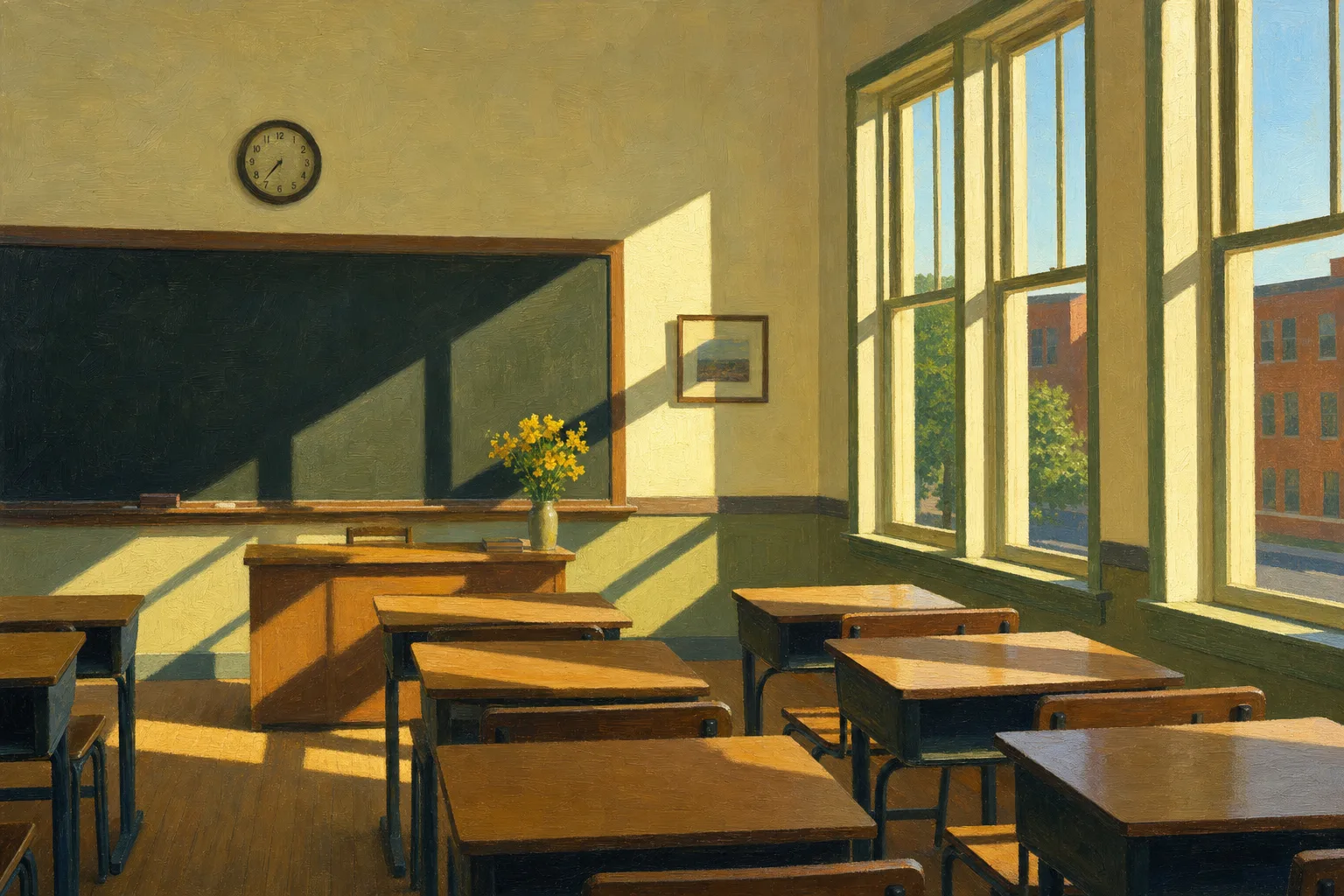
Mulhern’s fiction does not merely allude to Transcendentalism from a distance; it stages the tradition’s actual texts being taught, misheard, and half-understood inside an American public-school classroom, which is itself a Transcendentalist gesture — Emerson and Thoreau surviving their own domestication into curriculum. In “Drenched to the Bone,” the narrator, a Florida high-school English teacher named Jack, reads Thoreau’s “Civil Disobedience” aloud to a restless class and paraphrases its central claim: “Thoreau is talking about an individual’s conscience as being the most important aspect of who we are. You remember Emerson? ‘Nothing is at last sacred but the integrity of your own mind’ and his other quote, ‘What have I to do with the sacredness of traditions, if I live wholly from within?’”3 The direct citation of Emerson’s “Self-Reliance” inside a scene of failing pedagogy is a deliberate irony: the students immediately misunderstand or mishear nearly everything, one asking, “Isn’t he the guy that invented electricity?” (confusing Emerson with Edison), while another calls Marx’s “opium of the people” the “oxycodone of the masses.”3
Yet the scene does not simply mock the students’ ignorance; it dramatizes Transcendentalism working precisely as Emerson intended, on minds untrained to recognize the philosophy by name. Two students, Amelia and Brandi, arrive independently at a lay version of civil disobedience once black roofing dust begins falling from a vent during the lesson: “This school is like a prison,” Amelia says, and moments later, following a real disruption, “This is a type of injustice. We should break a law or something… We should stage some kinda civil obedience… Make a big statement,” a malaprop (disobedience for obedience) that the story allows to stand uncorrected, itself a small Emersonian joke about trusting one’s own garbled formulation of an idea over its received, correct phrasing.3 The scene’s final adversary to Transcendentalist individualism is Mary Grace, a devout evangelical student who denounces Thoreau directly: “You can read all you want but it won’t make you a better person. You need to act in the world, not retire from it like Thoreau. Helping others is what God wants us to do,”3 a critique that lands with real force precisely because the story does not resolve it in either direction — Mary Grace’s subsequent violent breakdown neither vindicates nor refutes her theological objection to Emersonian self-reliance, leaving the tension exactly where Mulhern’s creed leaves it: faith and Transcendentalist self-trust “held in the same hand, neither one permitted to win outright.”4
III. Whitman’s Multitudes: The Single Life That Belongs to Everyone
The creed’s Whitman debt — “a single life, honestly told, contains multitudes and belongs to everyone”1 — supplies the philosophical justification for a device that might otherwise seem simply comprehensive: Mulhern’s insistence, across the introduction to his collected volume, that his work constitutes “one people, gathered and remade” rather than a set of discrete, unrelated character studies.2 The editors’ introduction makes the Whitmanian claim about the volume’s design explicit, describing water as the master symbol precisely because it “is what carries you away from where you were and what returns you, altered, to the place you started,” language that transposes Whitman’s democratic, boundary-dissolving self into Mulhern’s own hydraulic register.5
One textual instance of this Whitmanian claim may be Agnella’s vernacular theology in “A Bath,” where a working-class Irish grandmother, without any exposure to Emerson or Whitman that the text records, describes individual suffering as shared rather than sealed off. Confessing that her own husband hit her, she tells her daughter Grace, “You’re not that horrible word, Gracie. You’re opinionated and strong. I wish I could have been more like you when I was a young woman. I followed the mold. Too afraid to do what I really wanted… To be a competitive swimmer. But we were poor, and poor women had little chance of pursuing such a dream.”6 Nana’s recognition that her daughter’s strength may fulfill a thwarted part of her own life — not a separate person to be judged but a “multitude” she contains — echoes the joined-soul claim the Artistic Creed states directly, in an idiom of whiskey and stepladders rather than philosophy.
The most direct Whitman allusion in the fiction occurs at the close of “The Wrong Way.” After the shovels are leaned against the house, the narrator notices “the beating of my heart and the passing of air into my lungs,” then watches “the smoke of my breath” rise and dissolve “like eddies in a careless sky.”7 The phrasing reworks the second section of “Song of Myself” — “The smoke of my own breath,” “the beating of my heart, the passing of blood and air through my lungs,” the voice “loos’d to the eddies of the wind” — and recalls the poem’s closing declaration, “I depart as air,” “I effuse my flesh in eddies.”8 The borrowing is revisionary rather than celebratory. Whitman makes bodily dissolution an ecstatic merging with the world; “The Wrong Way” reduces that vast confidence to a winter breath visible for an instant. The “careless sky,” with its Emersonian suggestion of a world at once free and indifferent, gives the scene its tonal reserve. The narrator does not become air. He watches the evidence of his own breath disappear into it — the Creed’s debt to Whitman acknowledged in the very act of declining Whitman’s consolation.
The clearest narrative test of the multitude claim may be the Marian names in Molly Bonamici, which behave less like separate characters than like one office passed hand to hand. The novel is dedicated “For my father, for my mother, and for Mary,” and the third name is never attached to a single woman.9 Maria, the mother, is born on the feast of the Visitation; Mrs. Margaret Mary Muldoon is raised from the surf on the feast of the Assumption; Mary Jane Callaghan returns the dead woman’s song from a piano in West Roxbury without knowing whose song it is; Mary Grace delivers a rebuke Molly accepts as true; and Molly herself, as a retired professor of linguistics and theology tells her in a taxi, carries the same name — “Molly is a nickname for both Margaret and Mary” — on the feast of Saint Margaret Mary.9 Each of these women carries the light for the length of one scene and then subsides into an ordinary life: a drunk widow, a sister in a band, a girl who needs medication, a daughter her own mother calls “a weak girl.” Read against the creed, the arrangement is Whitmanian rather than merely Catholic: no single self holds the whole multitude, and no self is disqualified from carrying it, not even a grandmother who is also a murderer and who nonetheless drives an old neighbor to the ocean for a cure she does not believe in.
IV. The Unresolved Seam: Oversoul Against Sacrament
One important critical question this material raises is whether an Emersonian Oversoul, which dissolves the individual soul into “every other soul that has been or will be,”1 is philosophically compatible with the Catholic sacramental theology — confession, communion, the Assumption of Mary — that structures the same body of work, and which other essays on this site have treated as the fiction’s primary theological register. Mulhern’s own language suggests he sees no contradiction, treating the two systems as mutually reinforcing rather than competing: “In art, as in faith, what is laid down is taken up — and it becomes life eternal,”2 a sentence that borrows the vocabulary of the Mass (offertory, elevation) to describe an Emersonian process of recurrence.
But the seam is visible in the fiction, not just smoothed over in the creed. Emerson’s Transcendentalism is famously a philosophy of the sovereign individual conscience, distrustful of inherited institution and “the sacredness of traditions”3; Catholicism, especially the Catholicism of Mulhern’s Irish and Italian grandmothers, is a religion of inherited institution nearly by definition, its authority residing precisely in tradition’s unbroken transmission. The unauthorized-confessor structure examined elsewhere on this site — grandmothers hearing confession with no priestly warrant — can be read as one response to this seam: an institutional sacrament (confession) performed by an individual, uncredentialed conscience (Nana, Peggy, Aiden), which is to say a Catholic form filled with Transcendentalist content. Mulhern’s Boston and Philadelphia interiors can be read as sites of negotiation between two American religious inheritances that rarely speak to each other directly — the immigrant Church of his grandmothers and the native Protestant dissent of Concord — conducted largely without the characters naming the negotiation as such. The Artistic Creed is a useful document for considering that negotiation alongside the fiction.
The Marian material also supplies a grammar for the seam rather than a resolution of it. The Visitation, the feast on which Molly’s mother is born, is the occasion of the Magnificat, whose logic is a reversal: “He has cast down the mighty from their thrones, and has lifted up the lowly” (Luke 1:52).10 That is also the shape of the novel’s vertical axis, which other essays on this site read spatially — an elevator descending, a hospital death, a body rising from the water. Agnella dies watching “two planes… one ascending, one descending, a metaphor for life,” falling “through her universe of lies to the descent of her end”; the orphaned granddaughter, at the close, rises out of the sea unaided. Read through the Magnificat, the axis stops being geometry and becomes justice — and then, characteristically, the novel withholds the verdict that justice would require. Molly feels “great peace” at a deathbed she does not intervene in, and the book ends not on judgment but on a disposition: “Believing in possibility.” The sacramental calendar supplies the pattern of cast-down and lifted-up; the Emersonian temperament declines to say which of us is which. Whether that is a synthesis or an unresolved seam is, on the evidence, a question the fiction prefers to keep open.
— Silver Current Press
Notes
- 1. James Mulhern, “An Artistic Creed,” in The Collected Stories and Poems of James Mulhern (Silver Current Press, forthcoming). ↩
- 2. James Mulhern, “A Note from the Author,” in The Collected Stories and Poems of James Mulhern (Silver Current Press, forthcoming). ↩
- 3. James Mulhern, “Drenched to the Bone,” in The Collected Stories and Poems of James Mulhern (Silver Current Press, forthcoming). ↩
- 4. Introduction, The Collected Stories and Poems of James Mulhern (Silver Current Press, forthcoming). ↩
- 5. Introduction, The Collected Stories and Poems of James Mulhern (Silver Current Press, forthcoming). ↩
- 6. James Mulhern, “A Bath,” in The Collected Stories and Poems of James Mulhern (Silver Current Press, forthcoming). ↩
- 7. James Mulhern, “The Wrong Way,” in The Collected Stories and Poems of James Mulhern (Silver Current Press, forthcoming). ↩
- 8. Walt Whitman, “Song of Myself,” sections 2 and 52, in Leaves of Grass (1891–92). ↩
- 9. James Mulhern, Molly Bonamici (dedication; Aunt Helena on the keepsakes; Bea on the feast of Saint Margaret Mary). ↩
- 10. Luke 1:46–55; on the Visitation and the Magnificat see Vatican News, “Feast of the Visitation of the Blessed Virgin Mary,” vaticannews.va. ↩
Works Quoted
Quotations are drawn from “An Artistic Creed,” “A Note from the Author,” the Introduction, “Drenched to the Bone,” “A Bath,” and “The Wrong Way,” all collected in The Collected Stories and Poems of James Mulhern (Silver Current Press, forthcoming). Passages from Molly Bonamici (Silver Current Press) are quoted from the novel’s published interior. Whitman is quoted from “Song of Myself” in the 1891–92 edition of Leaves of Grass.
Related essays on this site: A Working Philosophy and Credo gather more of the author’s own statements on craft; The Habit of Return treats recurrence as a craft technique rather than a metaphysical claim; and Teaching as Vocation and Trap reads “Drenched to the Bone” from the angle of pedagogy rather than philosophy.
All Essays Teaching as Vocation and Trap → A Working Philosophy
Every passage quoted here has been checked verbatim against its published source. Where the connection is inference rather than direct quotation, that is said plainly rather than implied.