A Scholarly Essay · On Genre and Form
Prose and Verse in Dialogue
The same Steinway, broken in the poem “Piano” and merely played in “Assumptions” — what each genre can do with an image that the other cannot.
Listen while you read
J. S. Bach, The Art of Fugue, Contrapunctus inversus, forma recta. Kimiko Ishizaka, piano. Public-domain recording, Internet Archive.
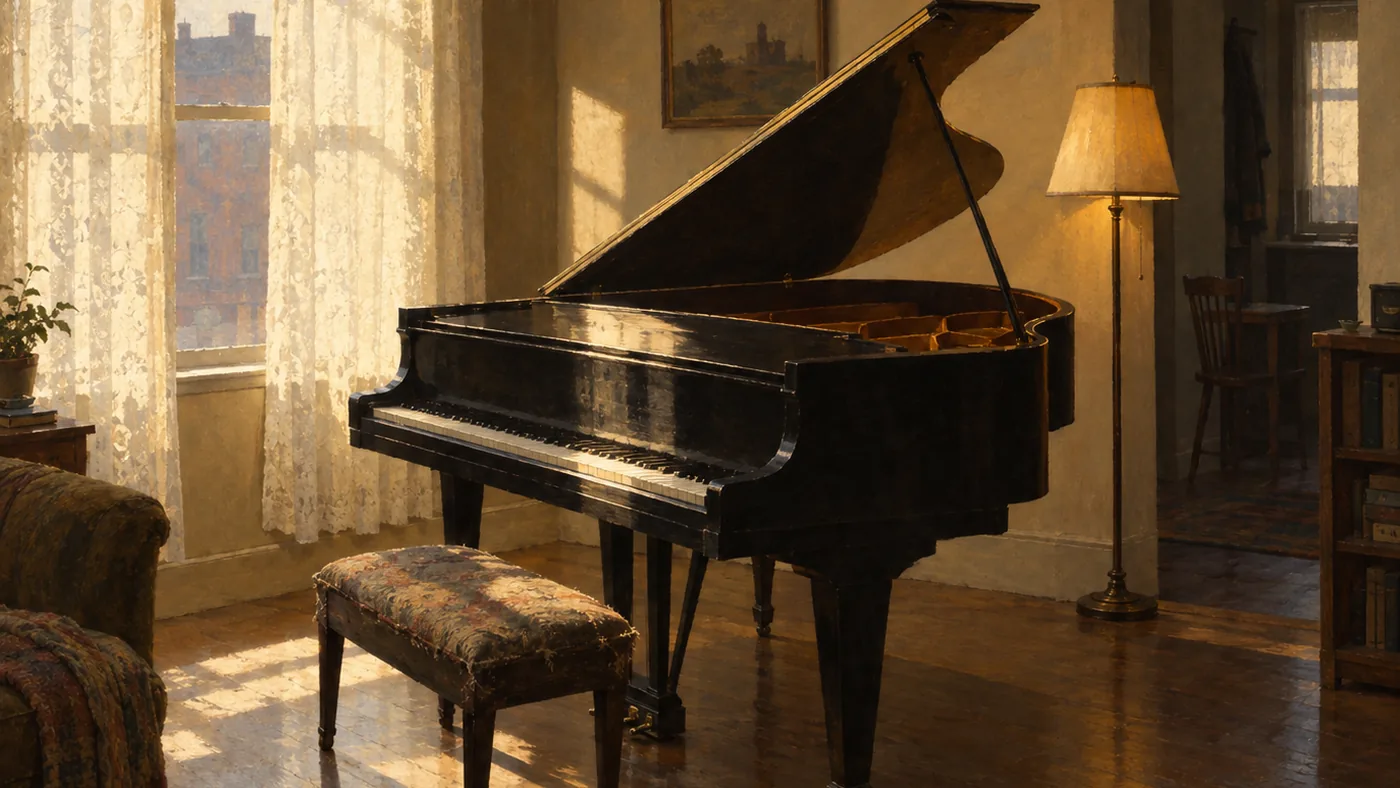
I. An Instrument in Two Genres
The introduction to Mulhern’s collected volume issues a direct critical challenge that, to date, no essay in this series has taken up on its own terms: “Read ’Piano’ beside ’Assumptions’ and you will find the same instrument, the same violence done to it, refracted through two different grammars.”1 This essay accepts that invitation as its whole method. Rather than surveying thematic overlap between Mulhern’s poetry and fiction in general — the task “Mapped in Water and Bone” and “Crossings at Twenty Poems” have already performed for the poetry collection as a whole — this essay stages a single, sustained comparison: one recurring object, a Steinway piano, doing structurally opposite work in a poem and a short story, in order to ask what verse can do with an image that prose cannot, and vice versa.
II. The Steinway Destroyed: “Piano”
In the poem “Piano,” a father takes an axe to the family’s Steinway on “that gray day,” while the speaker — his son — watches from a position of pure witness: “On that gray day, you chopped the Steinway piano with an ax. / Surrounded by yellow and red leaves on the hard earth, / you raised your arm to smash it all apart.”2 The poem’s central interpretive work happens in its second stanza, where the speaker supplies the psychological key to an act that would otherwise read as simple rage: “You were a man raised to think / crying was weak. Strength and power should define you. / Men like you couldn’t voice their secrets or despair.”2 The destruction of the piano is thus explicitly named as displaced grief — a man incapable of crying performing an equivalent act of violence against an object instead, “exorcising its shiny veneer”2 in language that treats the demolition as something closer to ritual than tantrum. The poem’s final stanza makes the displacement explicit by attaching the piano’s destruction to a second loss, the mother’s departure: “I thought of my mother, the day she moved out, / how you changed the locks and emptied every closet, / destroying each vestige of your shared lives.”2 The poem closes on an image that converts the piano’s physical wreckage back into emotional evidence: “glistening strings on the soundboard of a broken soul”2 — a simile so direct it functions almost as a caption, telling the reader exactly how to read the preceding stanzas’ careful, technical vocabulary of “dovetail joints” and “padded hammers.” Verse, here, is doing what verse often does best: compressing a father’s entire emotional architecture into a handful of couplets built around a single controlling image, trusting a closing simile to carry interpretive weight that prose would need paragraphs to earn.
III. The Steinway Played: “Assumptions”
“Assumptions” places a Steinway in an almost opposite emotional register: not smashed but sung to, not evidence of a man’s inability to grieve but the instrument through which a grieving woman, Peggy Fleming, briefly recovers her dignity. “In the knotty pine basement of Peggy’s home was a beautiful Steinway piano,” the narrator recalls, describing a childhood memory of Peg, drunk, singing unaccompanied beside it: “With one thin arm braced against the polished black surface of the Steinway, she sang with no accompaniment, and even now, years later, I hear the swelling sadness in her voice.”3 Where the poem’s piano is destroyed in a single violent action compressed into a few lines, the story’s piano survives across paragraphs of accumulated, patient detail — the narrator supplies Peg’s full biography, her dead husband Jim, her ruined voice “ravaged” by “smoking, drinking, and heartache”3 — because prose, unlike the poem’s compressed lyric mode, has the room to let grief unfold discursively, digressively, the way an adult narrator actually remembers a childhood scene: through story, anecdote, and the slow accumulation of context rather than through a single governing image. The story’s Steinway does not need to be destroyed to carry the weight of loss; its mere survival, “polished” and intact while its player disintegrates around it, is sufficient, because prose can let an object simply persist in the background of a longer, more populated scene, while a poem, working in far less space, generally cannot afford an object that does not do something.
IV. What Each Genre Withholds
The comparison sharpens once the two treatments are read against what each genre chooses not to say. The poem never names the father’s specific grief beyond the departure of a wife; it withholds narrative context almost entirely, relying on the reader to infer an entire failed marriage from “the day she moved out” and “emptied every closet.”2 This withholding is characteristic of the lyric mode generally, but it is also a specific choice available to verse that prose in Mulhern’s hands rarely takes: the poem can end on “a broken soul” without explaining what broke it, because the compression itself communicates that some things cannot or will not be explained. “Assumptions,” by contrast, withholds almost nothing about Peg’s biography — her marriage, her husband’s death in a car accident, her alcoholism, her diabetes — but withholds interpretation of the piano scene itself. The narrator does not tell the reader what to feel about the Steinway’s survival the way the poem’s closing simile instructs its reader; he simply reports that he still hears “the swelling sadness in her voice” and moves on to the next anecdote. Prose here trades the poem’s interpretive compression for something closer to accumulation without commentary — a different but equally deliberate form of authorial restraint.
V. Two Instruments, One Attention
Read together, “Piano” and the Steinway scene in “Assumptions” demonstrate that Mulhern’s stated conviction — that he experiences “fiction and poetry” not “as separate disciplines so much as separate registers of the same attention”1 — is not merely a claim about shared imagery but a claim about complementary technique. The same instrument, treated as an emotional register rather than a mere prop, allows the poem to do what poetry does best: compress a father’s entire unspoken interior life into a single afternoon and a single image, closing on a simile that does the work of pages of exposition. It allows the story to do what prose does best: let an object persist quietly across a fuller, more populated, more digressive scene, its survival meaningful precisely because nothing dramatic needs to happen to it. Neither treatment could substitute for the other without losing something essential — the poem could not sustain “Assumptions”’s biographical accumulation without becoming a different, longer poem; the story could not achieve the poem’s single-image compression without abandoning the discursive, anecdotal voice that is “Assumptions”’s whole method. The Steinway, broken in one register and merely played in the other, is Mulhern’s clearest demonstration that a recurring image is not evidence of a writer repeating himself across forms, but evidence of a writer testing what each form can do with the same piece of the past.
— Silver Current Press
Notes
Works Quoted
Related essays on this site: Mapped in Water and Bone and Crossings at Twenty Poems read the poetry collection on its own terms.
Every passage quoted here has been checked verbatim against its published source. Where the connection is inference rather than direct quotation, that is said plainly rather than implied.