An Essay · On Genetic Criticism
Revision as Theology
Recurrence, Redrafting, and the Genetic Evidence Inside Mulhern’s Collected Text.
Listen while you read
J. S. Bach, The Art of Fugue, Contrapunctus inversus 12. Kimiko Ishizaka, piano. Public-domain recording, Internet Archive.
I. A Note on Method
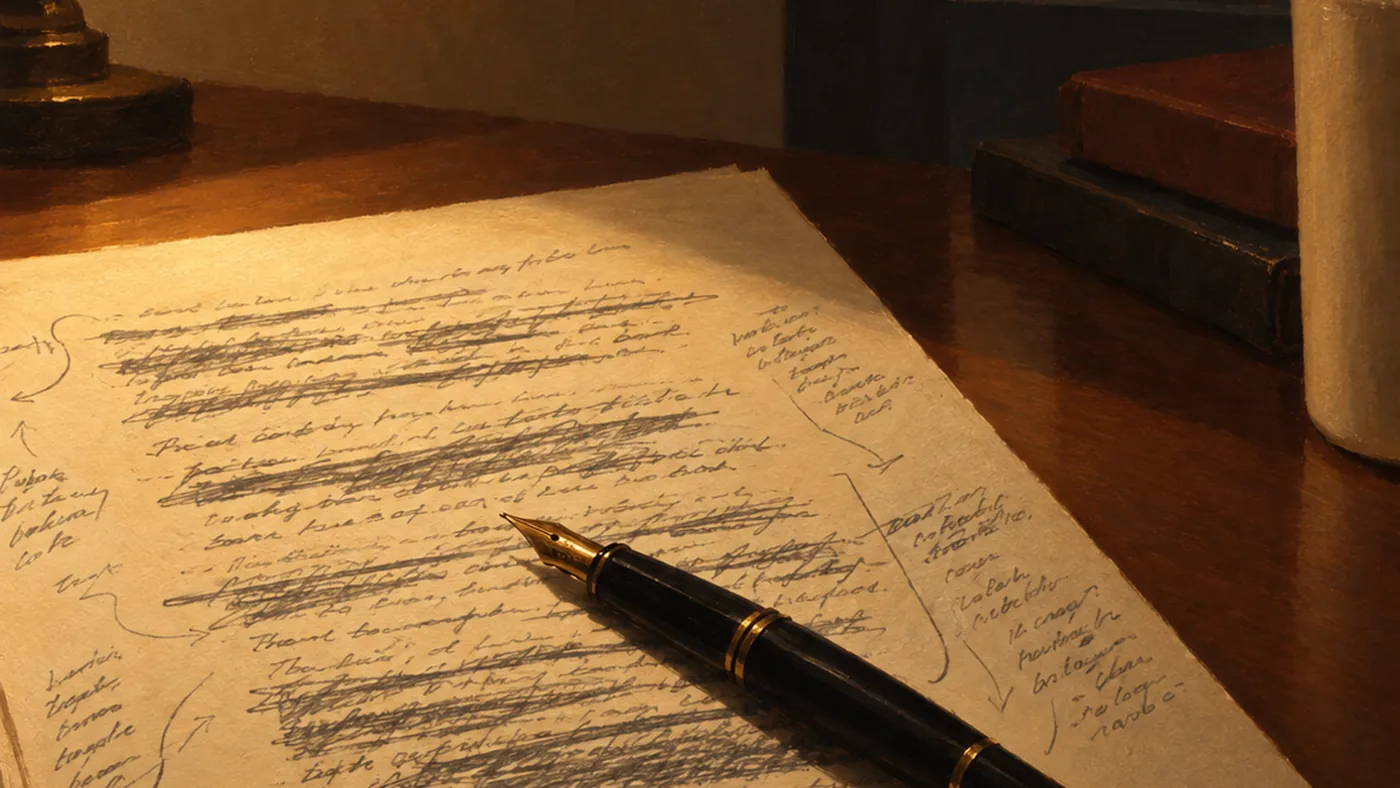
Genetic criticism classically works from an archive: successive drafts, marginal deletions, a writer’s crossed-out and reinstated lines, held up against the published text to reconstruct the labor of composition. No such archive of dated drafts survives, or has been made available, for the stories examined here. The published corpus does, however, allow a reader to observe the same scene, the same images, and in places the same sentences at more than one point — once as a poem, once as embedded short fiction, and, within the fiction itself, twice within the same collection in near-identical prose. This essay treats that internal recurrence as one possible, if unconventional, form of genetic evidence. Where classical genetic criticism reads a manuscript’s revisions to infer the author’s evolving intention, this essay considers Mulhern’s practice of redrafting a single memory-scene across multiple finished, public forms — verse, then story, then story again — as evidence of a compositional habit in which returning to and rewriting one’s own material may be a form of devotional repetition rather than simply correction, in keeping with the theology of recurrence his essays and interviews describe.
II. The Same Bath, Twice: “Scrape the Rocks” and “A Bath”
Mulhern’s poem “Scrape the Rocks” and his short story “A Bath” both stage a nearly identical domestic scene: a grandmother being helped into a bathtub by her daughter, while a grandchild waits nearby, and a framed photograph on the wall triggers a memory of Ireland — specifically, a girl wading toward a boulder at Clew Bay to gather “sea lettuce” for food. In the poem, the moment is compressed into a few couplets:
You were pushing dark water aside
to reach a boulder in the crashing foam…
“I was gathering food. Sea lettuce, we called it.
We’d scrape the rocks and then make stew…
‘Twas all the food we had and needed,
but it was good, and we were happy.”1
The scene ends with the grandson relegated outside the bathroom door: “As she eased you into the warm water, / I listened through the door.”1
The short story “A Bath” relocates a similar photograph, Clew Bay identification, and listening-through-the-door structure into an entirely different narrative frame — a different grandson (Billy, not Jimmy), a different immediate occasion (concealing a boyfriend’s violence rather than a hidden donut), and a different emotional register (crisis and confession rather than tender routine). The image cluster is closely related: “Just outside Peg’s door, my grandmother stopped us…” becomes, in the later story, “‘That was Clew Bay in County Mayo. The photograph, I mean.’ I listened through the door. There was no conversation. I heard splashing and my grandmother’s sighs as my mother rubbed her back.”2 The story also retains the poem’s gesture of the listener imagining, rather than witnessing, the bathing scene’s real content — “I suppose they were preoccupied by memory. I imagined my grandmother was thinking about an ocean three thousand miles away.”2
What is significant here is not merely thematic recurrence (grandmothers, bathing, Ireland, listening at doors are documented elsewhere as recurring motifs across the corpus) but structural redrafting: an entire scene — its blocking, its central prop (a photograph), its emotional mechanism (a memory unlocked by physical care) — has been composed once in verse and recomposed in prose, with the surrounding plot and stakes rebuilt around it each time. This is revision in the genetic sense, except that instead of discarding the earlier version, Mulhern has published both, allowing the reader to witness the redrafting directly rather than inferring it from a private manuscript trail.
III. The Jetty Passage: Self-Quotation Within a Single Collection
Another case of internal genetic evidence occurs within Mulhern’s assembled Collected Stories and Poems (forthcoming), where a single paragraph — describing a walk to a fishing jetty, the discovery of “a lonely starfish, a shiny stone, or a clam with a secreted pearl,” the startling of a mourning dove, and the simile “the waves glimmered like sparks from an unquenchable fire” — appears twice, nearly word for word, at two separate points in the collection, embedded in two tellings of a similar beach outing (Agnella, Mrs. Muldoon, and the narrator at the shore for the Feast of the Assumption).3 The first instance reads: “I got up and walked towards the end of the beach, where it was less crowded, near a fishing jetty and several clumps of boulders. I explored the spaces in between the rocks, looking for a lonely starfish, a shiny stone, or a clam with a secreted pearl, and unearthed small crabs in the sand. At one point, I startled a mourning dove that sped from its cleft into the bright sky… The waves glimmered like sparks from an unquenchable fire.”3 The second, appearing later in the same manuscript in a parallel retelling, is a close paraphrase with only minor lexical substitution: “I explored the spaces in between the boulders, looking for a lonely starfish, a shiny stone, or a clam with a secreted pearl. I unearthed small crabs that scampered across the sand… The waves glimmered like sparks from an unquenchable fire.”3
The phrase “sparks from an unquenchable fire” is worth pausing on, because it also supplies the title of the first essay in Mulhern’s critical series, “Unquenchable Fire.” The duplication may be an editorial oversight in assembling a career-spanning collection, but it may also show an image — starfish, jetty, dove, unquenchable fire — that Mulhern returns to and reuses when the narrative revisits a related emotional coordinate: a beach ritual involving an aging, vulnerable woman and a witnessing child. The sentence functions less like local color than like a recurring formula: a pre-composed unit brought back when the scene-type recurs, akin to a remembered liturgical response.
IV. Redrafting as Devotional Practice
The theological register is relevant to this reading. Mulhern’s stated poetics — expressed in the essay “A Working Philosophy” and the “Credo” — describes his compositional method in terms of “recurrence” and “the ordinary as sanctuary,” language that regards repetition as a possible spiritual discipline rather than simply a limitation to be edited away. The evidence assembled here suggests this may be more than a thematic claim: it may also describe an aspect of how the work was assembled. A liturgical calendar returns, on the same feast day, to the same readings, allowing repetition under changed circumstance to produce new meaning. The Feast of the Assumption itself — the occasion of both the jetty passage and its parallel — offers this kind of repeating structure: a fixed date revisited each year. Mulhern’s reuse of the jetty and bathing scenes in more than one finished, published context can be read as drawing on a similar logic of return. The “unquenchable fire” is not merely an image used about Peggy Fleming’s assumption into glory; the sentence containing it returns in a second telling.
V. Implications for Reading the Corpus
This has a practical consequence for how the collected fiction might be read. Passages that might otherwise be flagged by an editor as redundant — the near-verbatim jetty paragraph, the migrated Clew Bay photograph — can also be read as possible through-composition, suggesting that the collection may be more connected than an anthology of discrete, once-drafted pieces. Genetic criticism ordinarily asks what a writer removed on the way to a final text. This corpus invites another question: what does a writer choose to keep drafting, in public, more than once? One answer is that revision, for Mulhern, may be a form of return related to the “habit of return” described in other essays — composition that permits the same thing to be said again.
— Silver Current Press
Notes
- 1. James Mulhern, “Scrape the Rocks,” in The Collected Stories and Poems of James Mulhern (Silver Current Press, forthcoming). ↩
- 2. James Mulhern, “A Bath,” in The Collected Stories and Poems of James Mulhern (Silver Current Press, forthcoming). ↩
- 3. “Myra Bocca” and related Molly Bonamici material, in The Collected Stories and Poems of James Mulhern (Silver Current Press, forthcoming). ↩
Works Quoted
Quotations are drawn from “Scrape the Rocks” and “A Bath,” and from the “Myra Bocca” and related Molly Bonamici material, all collected in The Collected Stories and Poems of James Mulhern (Silver Current Press, forthcoming).
Related essays on this site: Unquenchable Fire reads the same jetty imagery as a study in recurring light; The Habit of Return treats recurrence across the fiction and poetry as a compositional system; and The Confessor Archetype and the Ethics of Listening examines “A Bath” as a confessional scene in its own right.
Every passage quoted here has been checked verbatim against its published source. Where the connection is inference rather than direct quotation, that is said plainly rather than implied.