An Essay · On Institutional Critique
Subverting the Syndicate
The domestication of crime and the displacement of institutional authority in Mulhern’s urban realism — how a failed state and a hollow church leave Mr. Scarfone’s syndicate as the only reliable guarantor of safety.
Listen while you read
J. S. Bach, Goldberg Variations, Variatio 22. Kimiko Ishizaka, piano. Public-domain recording, Internet Archive.
I. The Institutional Vacuum and State Indifference
Before a reader can accept sanctuary offered by an illicit entity, the legitimate structures of a story’s world must first demonstrate their failure. Molly Bonamici, the title character of Mulhern’s novel and the narrator of its originating novella A Prayer for Home, moves from a sixteen-year-old witness to domestic violence in 1980s Italian-American Boston through adulthood as a high school English teacher — a trajectory the novel narrates throughout in the same flat, deadpan register a storefront faith healer diagnoses, early on, as supernatural: Molly, she declares, is an “Angel of Death.”1 Formal protective structures are conspicuously beside the point in this world; the novel’s clinical detachment toward violence and death is itself evidence that no institution has ever intervened effectively enough to disrupt it.
The education system — the very apparatus meant for civic instruction and social mobility — fares little better once Molly becomes a teacher herself. Her adult teaching chapters function as a diptych on teaching as vocation and as trap, in which the institution demands a performance of conformity while remaining largely detached from the lived trauma of its constituents.
This institutional thinness is mirrored, and amplified, by the failure of folk Catholicism and storefront spiritualism in A Prayer for Home. There, the teenage Molly watches her grandmother, Agnella, deliberately deceive the storefront psychic Lady Jane, fabricating a leukemia diagnosis simply to jump a healing line — exposing the local economy of grace as a transactional, fraudulent landscape.1 The institutional church offers no better remedy for the family’s widowed, alcoholic neighbor, Mrs. Muldoon: rather than pastoral comfort, her search for the “Blessed Mother’s cure” on a public beach — itself a comic, embodied rehearsal of the Marian Assumption — is followed not by any divine or institutional intervention but by a deliberate overdose, timed to her wedding anniversary.1 Neither the church nor the state registers her death until after the fact.
II. Mr. Scarfone and the Displacement of Official Channels
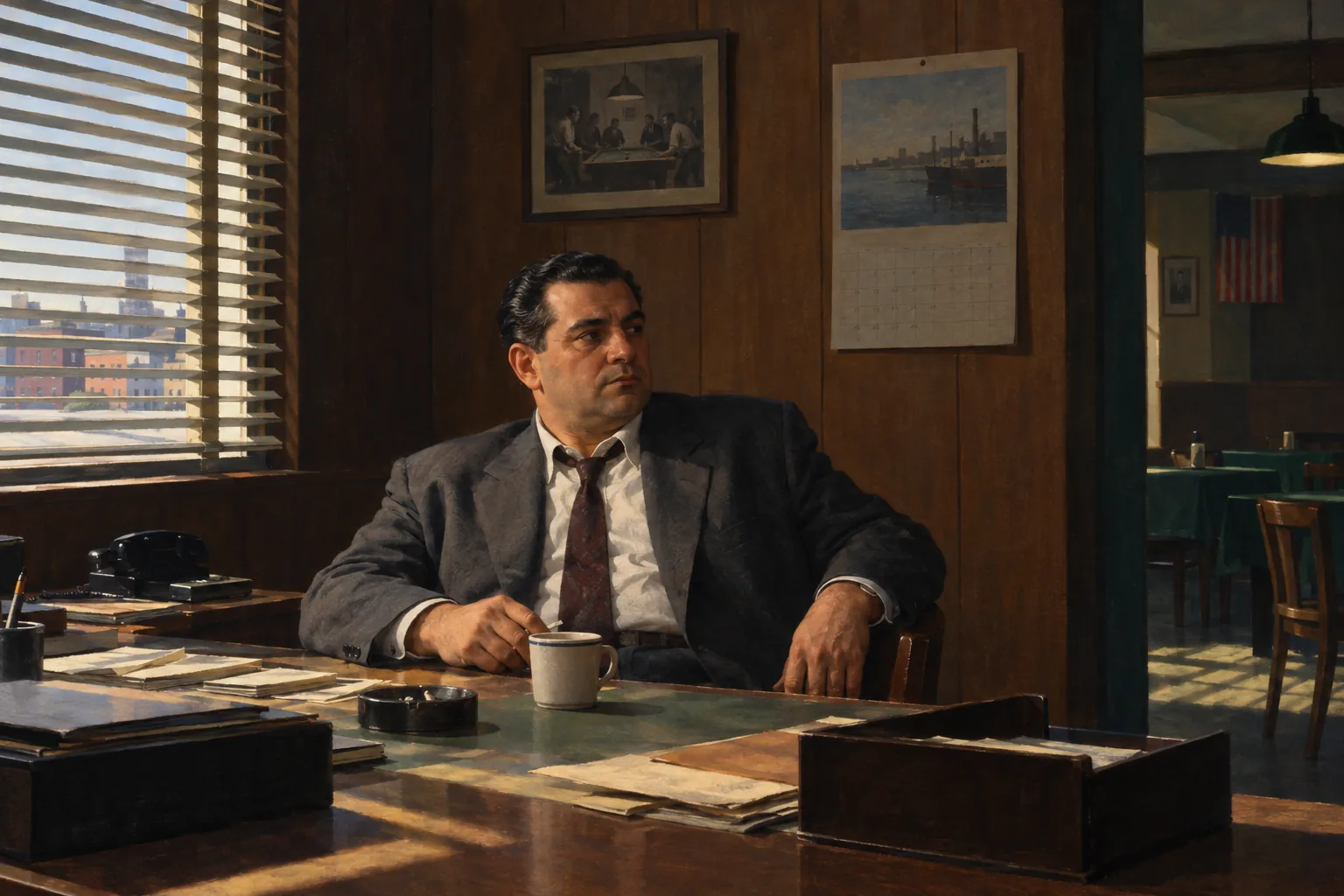
It is within this vacuum of institutional care that Mr. Scarfone, Agnella’s companion and, by her own bawdy account, her lover, comes to occupy the functional space of a protector.2 In traditional American realism and crime fiction, the mobster represents the ultimate disruption of domestic tranquility — an agent of extortion, terror, and moral decay. Scarfone is introduced into the story cycle stripped of those genre trappings almost entirely: he appears at a family graduation party as a familiar, faintly comic presence, and Agnella’s own commentary on him folds him into the household’s daily rhythm rather than treating him as an outside threat.2
The clearest evidence that Scarfone has displaced, rather than merely supplemented, official authority arrives in a single anxious aside: Agnella notes with relief that “it’s a good thing Mr. Scarfone knows the chief of police” and can supply an excuse for Molly’s behavior.2 The line does the essay’s central work in miniature: it treats a personal connection to organized crime and a personal connection to law enforcement as functionally interchangeable resources, both mobilized the same way, through favor rather than through any formal process. Scarfone is valuable not because he operates outside the law but because he has purchased, through whatever means, informal access to the people who administer it. The family does not need the police to be honest; it needs Scarfone to know someone who is willing to look the other way, and that arrangement is treated in the text with the same casual practicality as any other household resource.
III. Ethical Dissonance and Chosen Kinship
The co-optation of organized crime creates a profound ethical dissonance that the novels leave deliberately unresolved. The reader is asked to hold a troubling calculus: when the state is indifferent and the church is hollow, an illegal syndicate becomes the only functional guarantor of safety.
This reliance on illicit networks connects to Mulhern’s broader, and more explicitly developed, interest in chosen family — the idea, worked out elsewhere in his corpus, that non-biological kinship can perform every function of blood family, including its cruelties.3 If the blood family is a site of inherited trauma and the state is a vacuum, characters must construct alternative alliances. Mr. Scarfone is a manifestation of that search: a chosen protector, an artificial patriarch selected because his rules — however violent or illicit — are legible, proximate, and fiercely loyal.
The narrative tone reflects this survival strategy through a flat, deadpan register and a strategy of displaced affect that recurs across Mulhern’s fiction.4 When Molly is diagnosed by a faith healer as an “Angel of Death,” her clinical detachment is not a sign of sociopathy but a psychological defense forged through surviving immense loss. In a world where several people close to a protagonist can die within a single year, the neat moral categories of legal versus illegal, saint versus sinner, break down. The flat register lets the narrative present Agnella’s casual reliance on Scarfone’s underworld connections with the same emotional weight as a domestic chore or a classroom lecture.
IV. Conclusion: The Realism of Survival
Mulhern’s subversion of the criminal genre functions as a form of radical realism. By stripping the syndicate of Hollywood sensationalism and embedding it in the mundane, shabby textures of working-class Boston, the novels expose the limitations of modern institutional authority. When the sacraments fail to heal and the laws fail to protect, the characters find their grace where they can — even if it arrives as a quiet understanding with a neighbor who happens to have the chief of police’s ear. The domestication of crime in this corpus is a striking critique of the social contract: when a society leaves its margins underserved, the margin invents its own shortcuts to the very authority that failed to show up.
— Silver Current Press
Notes
- 1. On the “Angel of Death” diagnosis, the Lady Jane storefront-psychic scene, and Mrs. Muldoon’s beach search for the “Blessed Mother’s cure,” see A Prayer for Home: A Comprehensive Study. ↩
- 2. On Mr. Scarfone’s domestication within the family’s social world, including the “chief of police” aside, see A Prayer for Home: A Comprehensive Study and, for a related but distinct treatment of the character, The Comic Underworld. ↩
- 3. See Queer Kinship and Chosen Family for a fuller discussion of non-biological belonging across Mulhern’s settings. ↩
- 4. On the flat, deadpan register as a formal strategy for processing loss, see Molly Bonamici: A Comprehensive Study. ↩
Works Discussed
Molly Bonamici (2016) and its companion novella A Prayer for Home (2016), both James Mulhern.
Related essays on this site: Molly Bonamici: A Comprehensive Study traces the novel’s debt to Daniel Defoe’s Moll Flanders; A Prayer for Home: A Comprehensive Study examines the Lady Jane Angel of Death scene in full; The Comic Underworld reads Mr. Scarfone’s comic characterization in “Mia Bambina” through the lens of genre expectation rather than institutional failure; and The Sacred in the Shabby situates this institutional critique within Mulhern’s broader method of finding the sacred in ordinary, unglamorous places.
All Essays Molly Bonamici: A Comprehensive Study → A Prayer for Home: A Comprehensive Study
Every passage quoted here has been checked verbatim against its published source. Where the connection is inference rather than direct quotation, that is said plainly rather than implied.