An Essay · On Narrative Voice
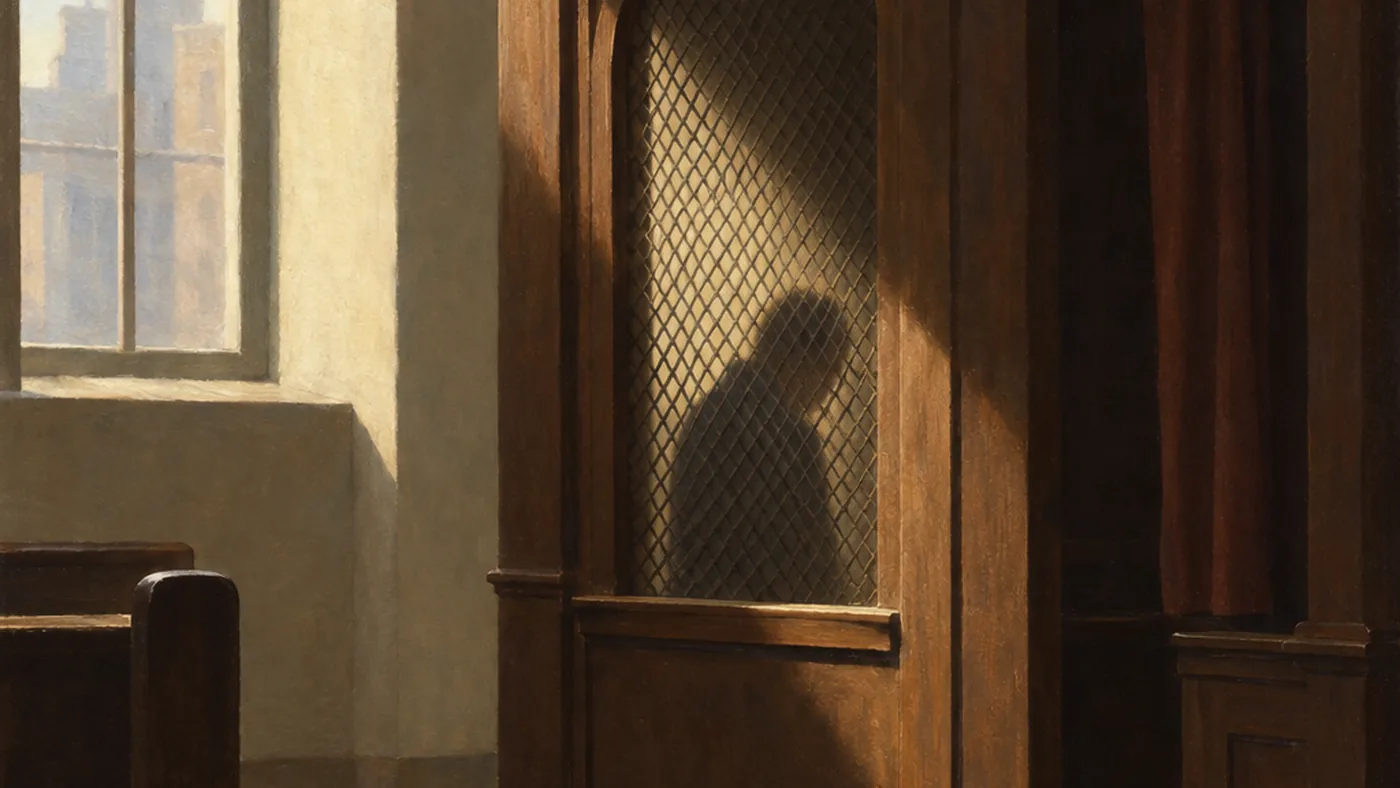
The Unreliable Confession
First-person justification in “Peppermint Candy” and “Mia Bambina” — the plain, procedural diction of the reasonable criminal narrator, after Nabokov and Highsmith.
Listen while you read
J. S. Bach, The Art of Fugue, Contrapunctus 2. Kimiko Ishizaka, piano. Public-domain recording, Internet Archive.
I. The Reasonable Criminal Narrator
Vladimir Nabokov’s Lolita offers a well-known instance of a narrative problem: a first-person narrator, Humbert Humbert, whose ornate, seductive, allusive English prose becomes a moral obstacle for the reader, who may be charmed by the sentence even as she recoils from what it describes.1 Patricia Highsmith’s Tom Ripley, introduced in The Talented Mr. Ripley, approaches a related problem from a different stylistic direction: plain, practical, almost affectless prose that narrates murder with an even tone, as Ripley might describe packing a suitcase.2 Together, Nabokov and Highsmith offer two approaches to the criminal narrator whose voice does not supply the moral alarm a reader might expect.
James Mulhern’s “Peppermint Candy” and “Mia Bambina” use plain, procedural, unornamented diction for confessions their narrators do not treat as remarkable. The stories substitute professional or clinical vocabulary for moral vocabulary when violence is confessed, so that a sentence describing a poisoning can resemble one describing a lesson plan or form.
II. “Peppermint Candy”: Confession in the Language of a Safety Data Sheet
Mr. Darnell’s confession in “Peppermint Candy” is delivered in the register of product information. Having decided to poison a student’s candy, he does not narrate deliberation, guilt, or hesitation; he narrates procedure: “I took the Visine out of my drawer. I found the paper listing the poisonous effects from tetrahydrozoline, the active ingredient in the eye drops. If swallowed: difficulty breathing, nausea, vomiting, and coma, among other effects.”3 The sentence resembles a safety data sheet because it draws on that kind of language. Mulhern has Darnell narrate his criminal method using a bureaucratic register also used for incident reports and I.E.P. reviews. The confession that follows maintains the register: “I thought of the care I had taken to lightly rub Visine onto the candy before rewrapping it. Then I searched through the trash barrel for Helen’s wrapper. I placed it in the zipper pocket of my satchel with the printout about the drug.”3
A notable feature of the passage is the absence of verbs of feeling. Darnell does not report satisfaction, anxiety, or triumph; he reports actions in sequence — took, found, thought, searched, placed — in the syntax of a procedural checklist. The story’s final line extends the pattern: “I retrieved the peppermints from my desk drawer and placed them in my satchel. I would share them again another day.”3 “I would share them again” is grammatically a statement of simple future intention, much like one used to describe returning library books; the horror depends on the context the reader supplies, since the narration does not name it. In this respect, the story draws on the broader tradition of withholding moral vocabulary and leaving the reader to provide it.
III. “Mia Bambina”: The Sociopath Who Names Herself
“Mia Bambina” performs a variation on the same technique with one crucial difference: where Darnell never uses the word that would indict him, Molly Bonamici names her own condition outright, and the naming becomes, paradoxically, part of the same procedural flattening. Having engineered a roommate’s death by lacing cookies with cocaine, obtained from a family associate, to trigger a genetic heart condition she has learned of in confidence, Molly narrates the method with the same checklist precision as Darnell: “I knew Ashley loved sweets during her workouts, and I had placed the cookies on top of my dresser, the direction she faced while doing her ‘fitness dancing.’ I also knew that whenever she paused or was interrupted, she ate a cookie.”4 The reasoning is presented as competent tactical planning, indistinguishable in its syntax from a coach describing an opponent’s habits.
Molly’s explicit self-diagnosis differs from the more oblique approach often associated with Nabokov and Highsmith: “One of the perks of being a sociopath is that you learn how to quickly gather necessary information by manipulating people, using their weaknesses to your advantage… Ironically, Ashley and I had something in common—a genetic inheritance. I guess you could say we both had heart conditions. Of course, mine was more useful. Sociopathy wouldn’t kill me.”4 The passage supplies moral vocabulary but converts it into a wry piece of self-description — “a perk” — rather than a confession requiring justification. Molly has already used the word a reader may have been considering, which can make the sentence register as confidence rather than confession.
The story’s final movement continues the procedural register with grim comedy: Molly’s grandmother Agnella, asked to add the lethal dose to the cookie batch, agrees in the same domestic register she would use for a recipe request — “Sure mia bambina. What’s one more ingredient? Not a problem” — and Molly plans to “call to thank her, and remark on the effective wording in her note,” reframing murder as a collaborative project between grandmother and granddaughter.4 The story’s closing sentence, reporting that “the chocolate chip cookies were a perfect hit,” uses a pun on baking success and a lethal strike, with a deadpan flatness that may recall Highsmith’s handling of Ripley.4
IV. Two Confessions, One Rhetorical Machine
Placed beside each other, Darnell and Molly show variations within a related technique. Darnell withholds the word for his own condition, leaving the reader to supply it; Molly supplies the word herself and may thereby defuse some of its power to indict her, converting confession into something like a professional credential. Both narrators treat the reader as an audience whose moral reaction is not their concern, while the prose remains clear and sequential regardless of what it describes. These stories locate their confessions in a public-school classroom and a Boston University dormitory, settings of ordinary American adolescent and professional life rather than Humbert’s motels or Ripley’s European high society. The comparison suggests that an unreliable confession can be staged through a desk drawer, a mixing bowl, and a narrator who describes both without raising her own voice.
— Silver Current Press
Notes
- 1. Vladimir Nabokov, Lolita (Olympia Press, 1955). ↩
- 2. Patricia Highsmith, The Talented Mr. Ripley (Coward-McCann, 1955). ↩
- 3. James Mulhern, “Peppermint Candy,” in The Collected Stories and Poems of James Mulhern (Silver Current Press, forthcoming). ↩
- 4. James Mulhern, “Mia Bambina,” in The Collected Stories and Poems of James Mulhern (Silver Current Press, forthcoming). ↩
Works Quoted
Quotations are drawn from “Peppermint Candy” and “Mia Bambina,” both collected in The Collected Stories and Poems of James Mulhern (Silver Current Press, forthcoming); from Vladimir Nabokov’s Lolita (Olympia Press, 1955); and from Patricia Highsmith’s The Talented Mr. Ripley (Coward-McCann, 1955).
Related essays on this site: Teaching as Vocation and Trap reads “Peppermint Candy” from the angle of professional burnout; and Unreliable Child Narrators and the Limits of Innocence studies Molly Bonamici’s narration in an earlier register.
All Essays Teaching as Vocation and Trap Unreliable Child Narrators
Every passage quoted here has been checked verbatim against its published source. Where the connection is inference rather than direct quotation, that is said plainly rather than implied.