An Essay · On Fictional Geography
Class, Ethnicity, and the Boston Triple-Decker
A social realist reading of the Irish-Catholic and Italian-American neighborhoods — Jamaica Plain, Braintree, Revere — that make up James Mulhern’s coherent fictional map.
Listen while you read
J. S. Bach, The Well-Tempered Clavier, Book I: Prelude No. 16 in G minor, BWV 861. Kimiko Ishizaka, piano. Public-domain recording, Internet Archive.
I. A Map Built From Kitchens
Regional fiction often develops a sense of place, whether or not an actual map is printed. Faulkner’s Yoknapatawpha County, worked and reworked across more than a dozen novels, is a prominent American example: a single invented Mississippi county with recurring families, feuds, and geography whose layout scholars have assembled from internal textual evidence.1 Alice McDermott likewise returns to Irish-Catholic parishes of Brooklyn and Long Island in novels like Charming Billy and Someone, revisiting wakes, church basements, and three-family houses.2 Read across the short stories and Give Them Unquiet Dreams, James Mulhern’s work also returns to a Greater Boston of Jamaica Plain, Braintree, Revere, and the Jamaicaway, populated by Irish-Catholic and Italian-American families and by the recurring form of the three-decker, or triple-decker.
Mulhern’s own editors gesture toward this geography without fully mapping it, describing his fiction’s enduring subject as “the streets and kitchens of Irish and Italian Boston” and noting that his Boston functions as “McDermott’s Brooklyn’s cousin: a city of women running households on will and grievance and enormous, unspoken tenderness.”3 This essay follows that observation by tracing the neighborhoods named across the fiction and considering how their differences — Jamaica Plain’s Irish-Catholic parish culture, Braintree’s lower-middle-class remove from the city, Revere’s Italian immigrant enclave — contribute to the social setting. The triple-decker, in particular, can make intimacy and surveillance plausible pressures in the plots.
II. Jamaica Plain: The Irish-Catholic Enclave and Its Casualties
Peggy Fleming, the ruined, alcoholic center of “Assumptions,” is explicitly rooted in a single Boston neighborhood: she “grew up in Jamaica Plain, an Irish catholic enclave in Boston,” arriving in America in the nineteen-thirties on the sponsorship of her cousin Mary O’Malley, who had herself “preceded her from County Mayo fifteen years earlier.”4 The neighborhood is textured with the specific institutions of first-generation Irish-Catholic life — the “socials, weekly gatherings in the basement of Saint Thomas More Church,” the cousin’s husband loading mail at South Station, the cousin herself “cleaning the houses of the ‘filthy rich on the hill’ — Mission Hill she meant.”4 This is not decorative period detail; it is a precise class map in miniature, placing Peggy’s cousin’s family as domestic labor for the same hill their own parish overlooks, and placing Peggy herself, later, as the family’s trusted nanny — a woman who occupies every rung of unpaid and underpaid female labor available to an Irish immigrant of her generation before her decline into alcoholism and poverty completes the neighborhood’s tragic arc for her.
The novella “A Prayer for Home,” set amid the same Boston and Philadelphia interiors, and “A Bath” both return to the Jamaicaway, the “curvy four-lane parkway” that borders Jamaica Pond — the same pond where, the narrator’s mother recalls, “a mother and daughter drowned” before swimming was forbidden in the nineteen-seventies.5 The detail shows one way the fiction uses Boston geography: an ordinary, verifiable piece of city history (the pond, the ban) can become an ominous frame for the domestic violence the scene is about to reveal, as Billy notices his mother’s bruises change color “like the trees along the water” while they drive past the site of an old drowning on the way to confess a new injury.5 Jamaica Plain and its pond recur as a site of loss connected with water, echoing water imagery elsewhere in the poetry.
III. Braintree: Aspiration, Distance, and the Blessed Mother
Where Jamaica Plain is the enclave a family cannot fully leave, Braintree functions in Mulhern’s geography as the destination of a first, modest upward remove — the grandmother in the essay-memoir “Altogether Beautiful” material lives “on Kendall Road in Braintree, Massachusetts,” her devotion to the Blessed Mother made physical through “statuettes and pictures throughout her home,” and her daily geography extended outward toward “Paragon Amusement Park across from the beach” and a nearby square where Peggy Fleming, in her decline, is found “wandering the streets… bruised and beaten-looking.”6 Braintree is close enough to the old parish network that Peggy remains a next-door presence in the family’s life, but far enough from Jamaica Plain proper that the move itself registers, however faintly, as a class achievement — a family that has left the enclave without fully leaving the people who never could.
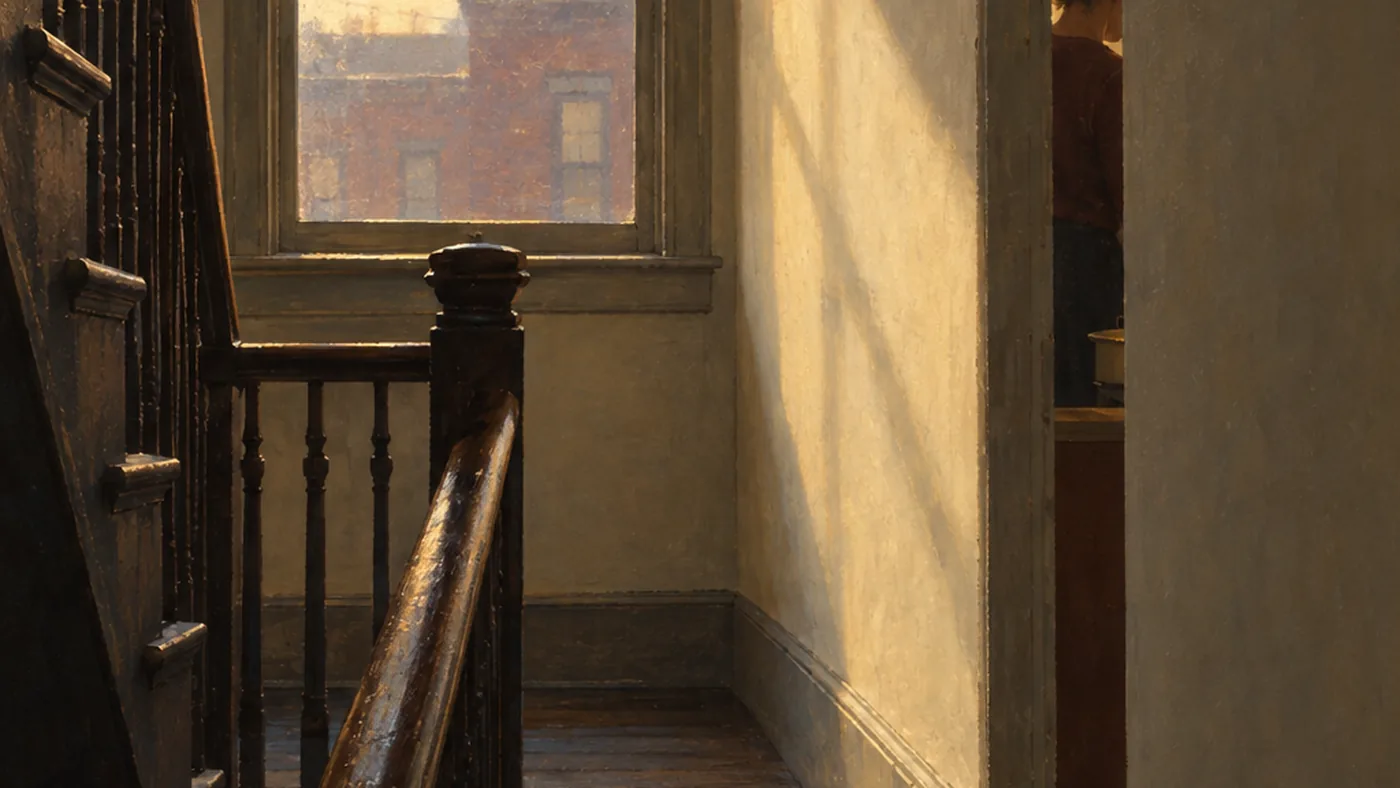
“A Bath” supplies the geography’s clearest architectural fact: Nana “lived on the second floor of a three-decker,” her building’s stairwell smelling of the Chinese food cooked by the family on the first floor, its walls thin enough that Billy can hear, through Nana’s bathroom door, “splashing and… sighs” but “no conversation” as his mother bathes his grandmother.5 The three-decker’s stacked intimacy — families audible to each other through floor and wall, doors that “never” lock because, as Nana explains with characteristic bluntness, “that way people could get in if they smelled her dead body” — is the essay’s central architectural claim: this housing form does not merely contain Mulhern’s plots, it generates them.5 A confession extracted in a bathtub behind a door that does not fully mute sound is a confession that has already, structurally, been half-overheard by the building itself.
IV. Revere: The Italian-American Enclave and Its Export
Molly Bonamici’s Italian-American geography runs through Revere, the dense immigrant enclave “about five miles to the north” of Boston that she names, with visible neighborhood pride, when a Boston University roommate asks about the Mafia: “I am from a very Italian neighborhood… One of my Nonna’s friends, Mr. Scarfone, has ties to the Mafia. He’s involved in small-time things like gambling, money laundering, and drugs.”7 The exchange is instructive precisely because of its comic surface: Molly is performing Revere for an outsider, converting the neighborhood’s reputation into a kind of social currency at the exact moment her roommate reveals her own geographic and class naivety, mistaking the African nations Mali and Guinea for cities and assuming Molly’s dorm-room crucifix collection means something it does not.7
Revere’s Mr. Scarfone reappears later in the same story cycle at a considerably darker register, when Molly, having narrated her own sociopathy in procedural, confessional prose, notes that “obtaining cocaine from Mr. Scarfone, the mobster friend of my grandmother’s, was easy” — the neighborhood’s low-level criminal infrastructure, introduced as comic local color for a roommate’s benefit, converts without any narrative flag into the actual supply chain for a murder.7 This is the geography essay’s point in miniature: Mulhern’s neighborhoods are never simply backdrop or dialect color. Jamaica Plain generates the specific, class-inflected grief that ruins Peggy Fleming; Braintree generates the aspirational distance from which that ruin is watched with pity but not full intervention; Revere generates both the ethnic pride Molly performs for outsiders and the practical means of the crime she goes on to commit. Each neighborhood is load-bearing.
V. A Coherent Geography, Read as One
Faulkner’s Yoknapatawpha invites readers to track the Compsons, Sartorises, and Snopeses across books, watching an invented county accrue weight through repetition. McDermott’s Irish Catholic Long Island similarly returns to wakes and three-family houses. Mulhern’s Greater Boston, distributed across stories not necessarily first published as a single mapped world, can be read with similar attention to recurring places: Jamaica Plain’s parish culture, Braintree’s modest remove and Marian piety, Revere’s Italian-American sociability and low-level criminal economy, and the Jamaicaway. The three-decker’s stacked, overheard intimacy offers one context for the family secrets these stories explore. Reading these settings together can reveal how place contributes to the plots’ social and psychological pressures.
— Silver Current Press
Notes
- 1. On Yoknapatawpha County as a mapped fictional geography, see William Faulkner’s own hand-drawn map, first published as an endpaper to Absalom, Absalom! (Random House, 1936). ↩
- 2. Alice McDermott, Charming Billy (Farrar, Straus and Giroux, 1998) and Someone (Farrar, Straus and Giroux, 2013). ↩
- 3. Introduction, The Collected Stories and Poems of James Mulhern (Silver Current Press, forthcoming). ↩
- 4. James Mulhern, “Assumptions,” in Assumptions and Other Stories / The Collected Stories and Poems of James Mulhern (Silver Current Press, forthcoming). ↩
- 5. James Mulhern, “A Bath,” in The Collected Stories and Poems of James Mulhern (Silver Current Press, forthcoming). ↩
- 6. James Mulhern, on the Feast of the Assumption memoir material collected in The Collected Stories and Poems of James Mulhern (Silver Current Press, forthcoming). ↩
- 7. James Mulhern, “Mia Bambina,” in The Collected Stories and Poems of James Mulhern (Silver Current Press, forthcoming). ↩
Works Quoted
Quotations are drawn from “Assumptions,” “A Bath,” and “Mia Bambina,” all collected in The Collected Stories and Poems of James Mulhern (Silver Current Press, forthcoming); from William Faulkner’s Yoknapatawpha map, first published in Absalom, Absalom! (Random House, 1936); and from Alice McDermott’s Charming Billy (Farrar, Straus and Giroux, 1998).
Related essays on this site: The Quiet Cartographer of Irish-American Memory considers the corpus’s geography at the level of theme; The Confessor Archetype and the Ethics of Listening reads “A Bath” for its confessional structure; and Domestic Violence and Silence gives the same story a fuller treatment.
All Essays Domestic Violence and Silence → The Quiet Cartographer
Every passage quoted here has been checked verbatim against its published source. Where the connection is inference rather than direct quotation, that is said plainly rather than implied.