An Essay · On a Single Story
Domestic Violence and Silence
Reading “A Bath” against the family elegy tradition of Alice Munro and Andre Dubus — how restraint becomes a story’s central formal argument.
Listen while you read
J. S. Bach, The Well-Tempered Clavier, Book I: Fugue No. 14 in F-sharp minor, BWV 859. Kimiko Ishizaka, piano. Public-domain recording, Internet Archive.
I. The Family Elegy of Withheld Information
A specific strain of American and Canadian short fiction has made an art of what a family declines to say about violence in its own history. Alice Munro’s stories return again and again to women who absorb, manage, and eventually half-reveal violence that the surrounding community, and often the story’s own narration, treats as unremarkable domestic weather — the past tense in Munro is rarely a simple record of what happened, but a record of what a family has agreed, without ever convening to agree it, to characterize a certain way.1 Andre Dubus, writing from inside a Catholic, working-class New England milieu that overlaps substantially with Mulhern’s own, built a comparable body of work around bodies that suffer and the euphemisms families construct to metabolize that suffering into daily life, most famously in the story collection Adultery & Other Choices and in the novella Voices from the Moon.2 Both writers share a formal conviction: that the sentence which does not say the true thing directly is not a failure of the story’s nerve but the story’s actual subject.
James Mulhern’s “A Bath” can be read alongside this tradition, with attention to euphemism, deferral, and partial disclosure. The story is compact — a single car ride and a single kitchen scene — and its dramatic movement follows the slow, incomplete correction of a lie. This essay reads that correction sentence by sentence, considering how the story’s restraint (the unnamed abusive man, the euphemized “fall,” the bathroom door that mutes confession into ambient sound) depicts a family processing violence not through a single cathartic confession, but through a rationed, multi-generational economy of partial truth.
II. The Euphemism as Load-Bearing Wall
“A Bath” opens mid-euphemism, with the reader given no orientation before the lie is already in motion: Billy’s mother Grace has bruises that “seemed to grow” as she talks, and when her son asks if it hurts, she deflects into a different register of harm entirely — “Not any longer… Don’t worry, Billy. Your mother’s a survivor.”3 The euphemism proper arrives once mother and son reach Nana’s building: “I said I fell off a stepladder when I was hanging a curtain. I told her you were helping me. Promise me you’ll stick to the story.”3 What makes this moment characteristic of the Munro-Dubus tradition rather than simple plot mechanics is that the euphemism recruits a third party’s complicity before it is even tested: Billy is asked to co-author the lie before the reader has any confirmation of what it is covering for, which means the reader experiences the story’s central deception exactly as Nana will — as something already rehearsed and reinforced before it reaches her.
Mulhern is precise about the euphemism’s architecture: it is not a lie about whether an injury occurred (the bruises are visible and undenied) but a lie about causation and agency, redirecting a man’s violence into an accident with no human author. Nana’s first response to seeing her daughter’s face already senses the wall’s load-bearing function without yet naming what it holds up: “It needs to breathe, Grace. Wash your face straightaway,” a command to remove concealment (makeup) that will, a few pages later, become a command to remove concealment of an entirely different order.3 The story’s restraint is visible in how long it allows the euphemism to survive even after Nana has begun actively suspecting it: “This is the second fall you’ve had in three months. I don’t understand it, Gracie,” a line that registers disbelief without yet demanding correction.3
III. Disclosure by Precedent, Not by Confrontation
The scene’s mechanism of disclosure is worth isolating, because it differs from the confrontation model a reader might expect from a story about hidden domestic violence. The lie is not broken by direct accusation but by Nana volunteering her own history first, in response to her daughter’s question rather than the reverse: “Did he ever hit you?” Grace asks her mother, apparently apropos of an offhand comment about her own dead husband’s temper, and Nana answers, after some evasion, “A few times. When he was drunk. Men were different back then.”3 The scene shares with Munro and Dubus an interest in disclosure that emerges indirectly: the older generation’s confession is not offered as sympathy for the daughter’s situation, because at the moment it is offered, Nana does not yet know there is a situation to sympathize with. She is instead simply answering a question, and it is Grace’s response to the answer — “Not so different” — that finally brings the euphemism into the open.3
Once Grace confirms that a man named O’Toole “smacked me twice. Said I was a bitch,” the disclosure that follows is strikingly unceremonious — no extended confrontation, no demand for further detail, simply Nana’s immediate absorption of the fact into practical comfort: “You’re not that horrible word, Gracie. You’re opinionated and strong… Forget about that bastard O’Toole. I didn’t like him.”3 The story’s restraint here is a deliberate refusal of catharsis-as-spectacle: there is no scene of weeping recognition, no extended reckoning with what it means that violence has recurred across generations of the same family. Nana metabolizes the disclosure in roughly the same number of sentences she used to metabolize the earlier lie about the stepladder, which is itself the story’s argument — that in this family, receiving news of violence and receiving news of a cover story for violence are handled by the same emotional apparatus, because both have, tragically, become routine.
IV. The Bathroom Door as Formal Limit
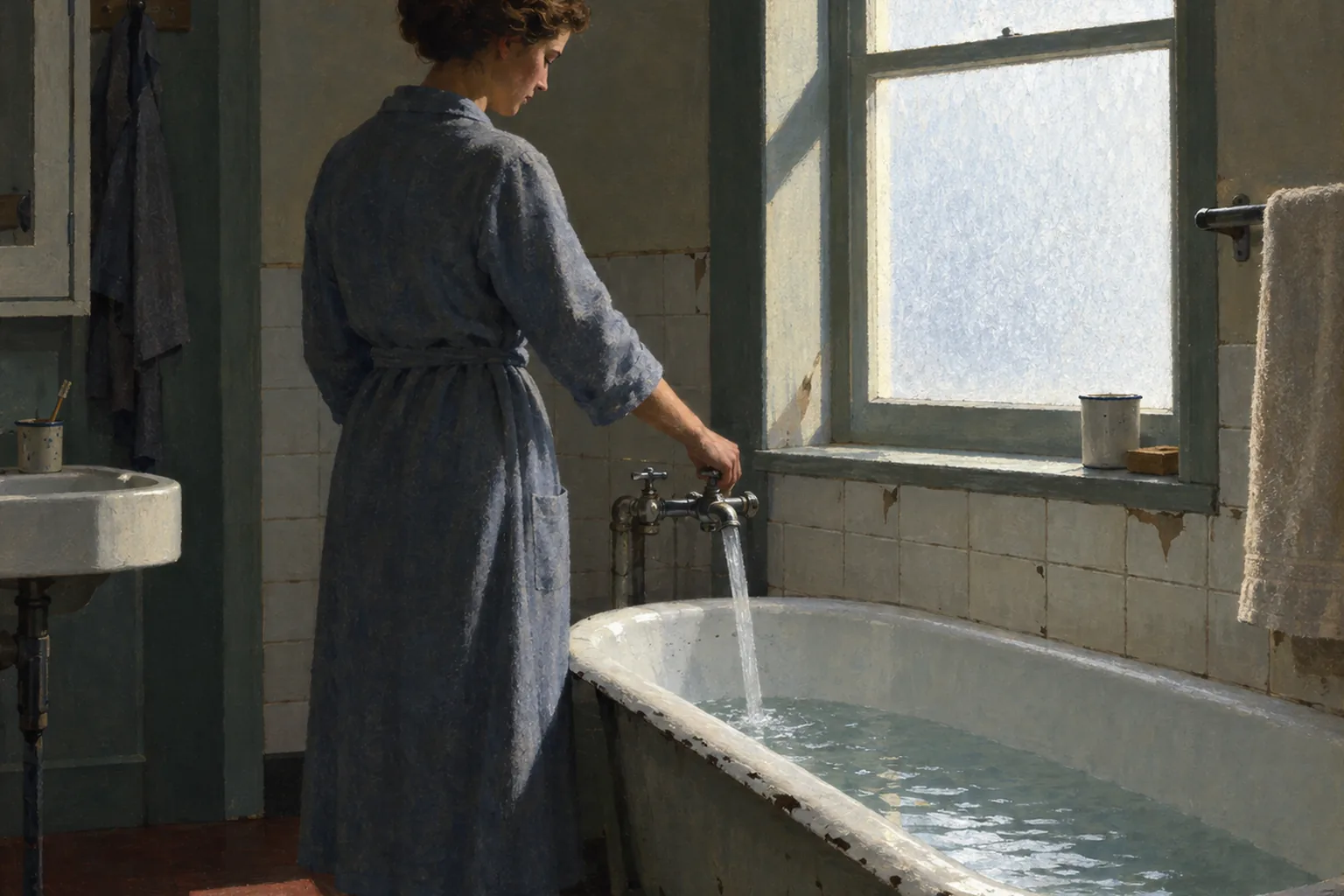
The story’s closing movement enacts its restraint architecturally. Once Grace helps Nana into the bath — the act of physical care that gives the story its title and that occasions, throughout, the intimate proximity the confessions require — Billy is placed outside a closed door and the narration follows him there: “I listened through the door. There was no conversation. I heard splashing and my grandmother’s sighs as my mother rubbed her back. I suppose they were preoccupied by memory.”3 This is Mulhern’s most explicit formal statement of the essay’s thesis: the story could have followed the women into the bathroom and staged whatever further reckoning occurs there, but instead withdraws its own narrative access at precisely the moment the reader might expect maximum disclosure, leaving Billy, and the reader with him, to infer meaning from “splashing” and “sighs” rather than dialogue.
The final sentence — “For a few moments, the three of us had all we ever needed”3 — depends on much that the story has withheld along the way. Munro’s and Dubus’s fiction can also end with a small, provisional stability that does not resolve the violence it follows but exists alongside it. The man who hit Grace remains unnamed and unpunished within the story’s frame; O’Toole is dismissed with a single epithet and never appears; Billy’s own biological father, the subject of the car-ride conversation that opens the story, remains a set of secondhand physical details (“a gentle voice and light blue eyes”) rather than a person.3 Instead of resolution, the story offers presence: three generations of women, one recovering from violence, one who has weathered it decades earlier, and one child absorbing both without full understanding, sharing a small apartment for the length of a bath. The refusal to name, confront, or resolve may suggest that in this family, silence and care are intertwined.
— Silver Current Press
Notes
- 1. See generally Alice Munro’s story collections, including Runaway (McClelland & Stewart, 2004) and The Progress of Love (McClelland & Stewart, 1986), for the withheld-family-history technique this essay describes. ↩
- 2. Andre Dubus, Adultery & Other Choices (David R. Godine, 1977) and Voices from the Moon (David R. Godine, 1984). ↩
- 3. James Mulhern, “A Bath,” in The Collected Stories and Poems of James Mulhern (Silver Current Press, forthcoming). ↩
Works Quoted
Quotations are drawn from “A Bath,” collected in The Collected Stories and Poems of James Mulhern (Silver Current Press, forthcoming); from Alice Munro’s Runaway (McClelland & Stewart, 2004); and from Andre Dubus’s Voices from the Moon (David R. Godine, 1984).
Related essays on this site: The Confessor Archetype and the Ethics of Listening reads the same story’s confessional structure; Class, Ethnicity, and the Boston Triple-Decker examines its housing setting; and The Habit of Return traces the story back to its origin in a Mulhern poem.
All Essays The Confessor Archetype Class, Ethnicity, and the Triple-Decker
Every passage quoted here has been checked verbatim against its published source. Where the connection is inference rather than direct quotation, that is said plainly rather than implied.