A full critical reading of the published collection — its architecture, its recurring image systems, its formal command, and what it achieves.
A Note for Readers, Before You Begin
This essay moves through poems from an earlier, expanded manuscript of Crossings. The published book — Crossings: Selected Poems (Silver Current Press, August 2026) — is a tighter, twenty-poem selection. It opens with “A Prayer” and closes with “Leaves,” not with “Copacetic” and “Moving Forward” as the discussion below might suggest; both appear in the book, but not first and last. Four poems treated here as among the collection’s strongest or weakest work — “Longing,” “The Guard,” “To Be,” “Simply Silly” — are not in the published edition. The rest of the essay’s references — “Water,” “Copacetic,” “Dark City,” “The Crosswalk,” “Carol” — are. I chose the smaller sequence because it read as the more cohesive book. The remaining poems live in full on the Complete Collection page, and some are bound for a forthcoming, enlarged, illustrated edition of Crossings (date to be determined), where I mean to give myself more room.
I offer that multiplicity of versions not as inconsistency but as faith. A poem revised is a small resurrection — the same material returning transfigured, never finished because it is still becoming. Emerson said as much in “Circles”: people wish to be settled, and only so far as they remain unsettled is there any hope for them. Hope, I’ve come to believe, needs that unsettledness the way a life needs breath.
This is close to why I teach. A student arrives unsettled, too — not yet the person they will become. Helping one discover the genius already there feels less like instruction than grace passing through me. It is, simply, a blessing. Shirley Chisholm called service the rent we pay for the privilege of living on this earth. Part of that rent, I think, is homage — to the thinkers and the kindness that shaped us, Emerson among mine. Elsewhere on this site, that homage takes literal shape: an image of literature as “the ladder hanging close to the side of the schooner” borrows its ladder directly from Adrienne Rich’s “Diving into the Wreck.” Paying such debts openly is not separate from the writing life. It is close to the point of it, and it remains my quest.
♫Listen while you read▶
J. S. Bach, The Art of Fugue, Contrapunctus 8. Kimiko Ishizaka, piano. Public-domain recording, Internet Archive.
Scope of This Assessment
What follows is offered in two movements. The first is analysis: a descriptive account of how Crossings is built — its sequence, its governing images, its habits of syntax and line. The second is evaluation: a judgment of how well the collection accomplishes what it sets out to do and where its strongest work lies. The two are kept separate on purpose. Analysis that slides into praise stops being useful, and evaluation that skips analysis is only opinion wearing a robe.
The collection under discussion is Crossings: Selected Poems — twenty poems, with dedication, acknowledgments, and introduction, published by Silver Current Press in August 2026; see the Crossings overview for the complete text. Quotations here follow the published text. Where this assessment differs from the collection’s own critical apparatus — The Poetics of Crossings, which reads the book’s figures and forms at length — the difference is one of purpose: that study asks how the poems work; this one also asks how well.
Part One
Analysis
I. The Architecture of the Sequence
The title is doing structural work, not decorative work. A crossing is a threshold event — a passage from one state to another — and the collection is arranged as a series of them: from childhood to knowledge, from health to illness, from presence to absence, from darkness toward light. The book opens in a domestic interior with “Copacetic,” a poem whose central gesture is a refusal (“I’m not hungry.” He pushed it away), and closes, before the epilogue, with “Moving Forward,” whose central gesture is an offering: “I place my arm under hers. / She stands, / kisses my forehead.” That is the arc of the book in miniature — from the plate pushed away to the hand extended.
Between those poles the sequence moves less by narrative than by pressure. Poems of family illness and decline (“Water,” “Last Supper,” “Fragility,” “The Teapot”) are set against poems of institutional life and vocation (“Longing,” “Session’s End,” “The Guard”), and against a small number of poems whose register is deliberately lighter (“Simply Silly,” “Carol”). The lighter poems are not filler; they function as pressure valves, and their placement is one of the more sophisticated things about the manuscript. A collection this concerned with grief needs air, and the sequencing supplies it at roughly the intervals a reader can bear.
The one structural risk is that the book’s emotional center of gravity sits in its middle third, where the illness poems cluster most densely. A reader arriving at “Water” has already absorbed a good deal; the poem is strong enough to survive the position, but the surrounding poems bear more weight than they otherwise would.
II. The Recurring Vocabulary
Four image systems govern the collection: hands, water, thresholds (doors, crosswalks, stairs), and light against darkness. They recur so consistently that recurrence has to be treated as method rather than habit — and the poet has been explicit that it is method. The repetitions are purposeful: the same truths set down again in new hands, new voices, new incarnations. What looks like repetition is recurrence, and recurrence is the argument.
The hands are the collection’s most reliable instrument. They appear as evidence (“Your hands on my shoulders. / One moment, framed.” in “The Crosswalk”), as failed reach (“He bends, / cupping his hands / toward the lake below, / reaching for water / that will not rise” in “Water”), and finally as tenderness offered directly (“I place my arm under hers” in “Moving Forward”). Because the poet declines to gloss them, the hands accumulate meaning by position rather than by statement — the reader learns what a cupped hand signifies in this book the way one learns a word from repeated context.
Water carries the heavier freight. In “Water” it is the thing the old man cannot reach; the poem’s catalog of a weathered body — “weathered face, / capillaries like tributaries / on dry land” — converts a body into a drought map, so that the closing phrase, “reaching for water / that will not rise,” lands as both literal thirst and something considerably larger. The figure is doing double service, and it does not announce the second service. That restraint is the collection’s signature.
Light and darkness are the riskiest of the four, because the pairing is worn nearly smooth by use. The collection earns it in one place decisively — the closing line of “Dark City,” “I see you move from darkness into light” — where the phrase survives because the poem has spent its length refusing consolation, so the turn arrives as report rather than reassurance. Elsewhere the pairing is the collection’s most predictable move.
III. The Discipline of Restraint
The collection’s most consistent technical virtue is its refusal to explain. Its characteristic sentence is short, declarative, and slightly under-informed — it tells the reader what happened and stops before telling the reader what it meant. “Copacetic” is the clearest instance: a father’s four-word evasion, a four-word narrative clause, and no commentary. The poem trusts a reader to supply the grief.
This is harder than it looks, and it is where the manuscript most clearly separates itself from competent work. The temptation in poems of family illness is to secure the feeling with a closing statement; the poems here mostly decline. “Longing” is the exception worth noting because it declines in the opposite direction — the poem states its condition outright (“Mostly, I feel empty and small— / a space between words or a tiny font”) and then rescues the statement with a figure precise enough to justify it: “The colon at the end of an unfinished thought.” A grammatical mark standing in for a life’s incompletion is exactly the kind of image this poet finds when he is working at full strength.
Where restraint slips, it slips into a final line that interprets the poem it concludes. There are perhaps three or four such endings in the manuscript. They are not failures of feeling; they are failures of trust.
IV. Formal Command
The poems are free verse with an audible substrate of accentual-syllabic expectation, which the collection exploits locally rather than sustaining as pattern. Three devices recur with real control.
Syntactic suspension. “Water” moves through a sequence of descriptive fragments — face, capillaries, belly, ankles, skin — before the single verb of action arrives in its final movement: “He bends, / cupping his hands.” The poem holds the reader in description until the gesture finally comes, and the gesture fails.
Caesura as refusal. The collection favors two kinds of break — the line-ending dash that removes connective syntax (“The old man on the dock—”), and the hard stop after reported speech that declines elaboration. Both are deployed at moments of withheld tenderness, and the consistency suggests the device is tied to a recurring dramatic situation: the adult who will not explain.
Catalog and litany. “To Be” abandons connective syntax altogether for an asyndetic list — “the Wife of Bath’s scarlet stockings / poor Yorick’s skull / Dickinson’s sherry in the glass” — which levels literary monument and roadside debris (“a flattened sneaker on some road”) into identical syntactic weight. “Moving Forward,” at the other end, borrows the cadence of litany without adopting its apparatus. The two poems mark the collection’s formal outer limits: leveling on one side, blessing on the other.
Lineation is the element most uneven across the manuscript. The strongest poems break where breaking creates meaning; a handful break where the sentence happened to run out of room.
V. A Note on a Possible Illustrated Edition
The published edition of Crossings: Selected Poems is text-only. A separately planned illustrated edition, should it go forward, raises a genuine question of proportion rather than a question of taste. This is a collection whose method is withholding — it works by declining to interpret its own images. The danger is not illustration itself but illustration that insists: a picture that fixes a single meaning where the poem has deliberately left the meaning open. Set carelessly, a picture of a cupped hand on the page facing “Water” would perform exactly the gloss the poem spent nine lines refusing to perform.
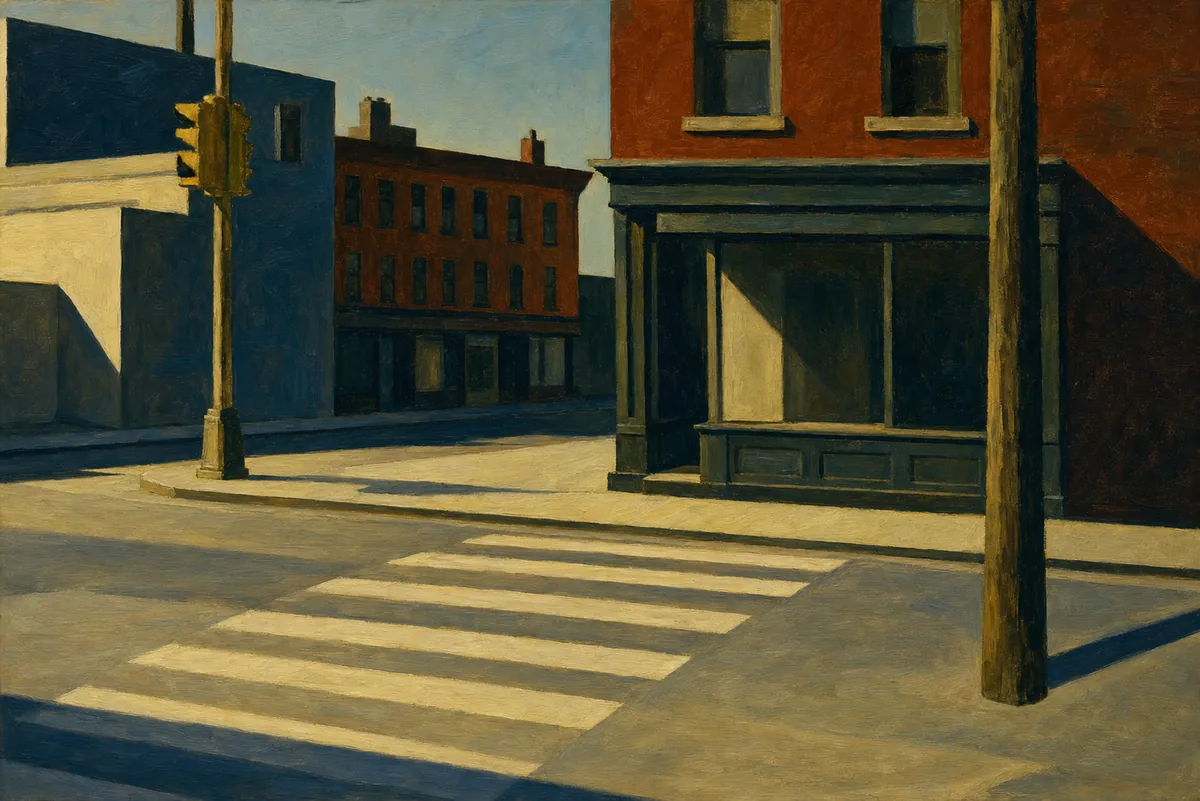
The productive path is the one the poems themselves take: suggestion over statement. Illustration that stays tonal — light, surface, weather, the grain of an interior — will extend the book’s atmosphere without closing its images. What the poems ask of a picture is not a verdict but a threshold — an image offered as an invitation rather than a conclusion. The safest structural solution is to illustrate the thresholds rather than the figures: doorways, crosswalks, stairwells, the surface of water, the room after someone has left it. Those images are the collection’s architecture, and they can be drawn without being explained.
Four poems discussed elsewhere in this essay — “Longing,” “The Guard,” “To Be,” and “Simply Silly” — belong to the fuller manuscript rather than the published Selected Poems. Mulhern reserved them, along with the rest of the expanded sequence, for this future illustrated edition, where a larger page count and visual apparatus give him more room than the tighter, cohesion-driven published selection allowed. Readers curious about them can find the full text of every poem discussed in this essay on the Complete Collection page.
Those images are now being made. The illustrator, Mr. Cennamo, has begun rendering the collection’s thresholds in a painterly register — a crosswalk, a stairwell, a lighthouse. For each poem, he has set down the essence as he perceived it, not to fix its meaning but to offer a threshold. His image is not the poem’s last word but an invitation: one way of seeing, held open so the reader may cross into a meaning of their own.
The Crosswalk · after Edward Hopper
Part Two
Evaluation
VI. What the Collection Achieves
Three achievements are worth naming precisely, because they are the grounds of the assessment that follows.
It sustains a unified vision across twenty poems without becoming monotonous. This is rarer than it sounds. Most first collections are anthologies of their author’s best individual poems; this one reads as a book, with a governing vocabulary and a discernible arc. The recurrence of hands, water, and thresholds is what makes the unity possible, and the variation in register is what keeps it from flattening.
It finds the sacred in domestic material without reaching for the sacred vocabulary. A kitchen table, a teapot, a pair of shoes, a hospital dock. The collection’s spiritual claims — and it makes them — are carried almost entirely by ordinary objects handled with attention. The poems are closer to Transcendentalist habits of seeing than to devotional verse: the current running through things is felt rather than named, and never asks the reader to assent to a doctrine.
It maintains emotional control over material that invites sentimentality. Poems about a father’s decline and a family’s inheritance are the most sentimentality-prone subjects in the language. The collection’s prevailing understatement is a deliberate ethical position as much as a technical one — it extends mercy to its subjects rather than judgment, and it declines to extract feeling from them for effect.
VII. The Strongest Work
Four poems would carry the collection in any submission or contest context.
“Water” is the best poem in the book and one that would stand in any journal — its suspended syntax, its drought-map figure, and its closing four words operate as a single unified device. “Copacetic” achieves more with less than anything else here; it is the collection’s clearest demonstration that restraint is a technique and not an absence. “Longing” earns its direct statement of emptiness through the precision of the grammatical figure that follows it, and it is the poem most likely to be quoted. “The Guard” is the most formally accomplished of the institutional poems.
“Dark City,” “The Crosswalk,” and “To Be” form a strong second rank. “To Be” is the most technically ambitious poem in the manuscript and the most likely to divide readers.
VIII. Placement and Readership
The collection sits in a recognizable and currently well-attended tradition: the elegiac domestic lyric of Irish-American Catholic inheritance, working in plain diction and short free-verse lines. Its nearest kin are the poems of family and parish that treat the working-class interior as a serious moral setting. What distinguishes this manuscript within that company is the consistency of its image system — many collections in this mode are looser, assembled around subject rather than around a governing vocabulary.
Its readership is correspondingly broad for contemporary poetry. The poems are accessible on first reading without being thin on the second, which makes the collection unusually well suited to reading groups, secondary and undergraduate classrooms, and general readers who do not ordinarily buy poetry. A future illustrated edition, should one follow, would widen that reach further, provided the illustration follows the restraint the poems model.
IX. Editorial Assessment
The summary judgment below reflects the collection as set for publication, assessed against professionally published contemporary poetry rather than against unpublished work.
Thematic Cohesion
Exceptional — a genuine book rather than a gathering of poems
Image Precision
Exceptional — concrete, unhurried, and rarely decorative
Emotional Control
Strong to exceptional — restraint held against sentimental material
Formal Command
Strong — assured in syntax and caesura
Sequencing
Strong — effective pressure and release; middle third densely weighted
Accessibility
Exceptional — open on first reading, durable on the second
Overall
Professional-grade and publication-ready — assessed at 9/10 for the collection as a whole, with the individual poems’ craft at the upper end of that range
A final observation, offered as description rather than praise. The collection’s governing conviction is that nothing is finally lost — that what is laid down is taken up, that the same griefs and joys return in other hands, and that attention paid to a teapot or a cupped palm is a way of keeping what would otherwise go. That conviction is never argued in these poems, which is precisely why it persuades. It is carried instead by the recurrence itself: the same images arriving again in new incarnations, each time slightly altered, none of them spent.
Editorial assessment prepared for Silver Current Press.
About the Author
James Mulhern has been published over 300 times in literary magazines, journals, and anthologies in the United States and around the world. His work has been recognized with numerous awards. In 2015, he was granted a fully paid writing fellowship to Oxford University. That same year, a story was longlisted for the Fish Short Story Prize. In 2017, he was nominated for a Pushcart Prize. His novel, Give Them Unquiet Dreams, is a Kirkus Reviews Best Book of 2019 and a Readers’ Favorite Book Award winner. He was shortlisted for the Aesthetica Creative Writing Award 2021 for his poetry. Two of his novels were Finalists for the United Kingdom’s Wishing Shelf Book Awards. He is a professor and writer living in Philadelphia, Pennsylvania, where he teaches The Art of Telling.
Get The Quiet Craft: A Working Writer's Notebook — an expanded collection of working notes on fiction, poetry, and memoir craft — free, plus occasional word of new essays, poems, and guides. No spam, unsubscribe anytime.