A Critical Study · Recurrence and Resurrection
“What Is Laid Down Is Taken Up”
Recurrence, mercy, and artistic resurrection in the work of James Mulhern—a study of the governing method across the fiction, poetry, and creative nonfiction.

Listen while you read
J. S. Bach, The Art of Fugue, Fuga a 3 soggetti. Kimiko Ishizaka, piano. Public-domain recording, Internet Archive.
Contents
I. The Method Named
Mulhern has named his method twice. His “Credo,” published on his author site, is both a craft statement and a spiritual testament. It moves from the ordinary as sanctuary and mercy as method to the discipline of attention, the classroom, and writing as communion, and it rests on two central ideas, repeated incarnation and resurrection. Repeated incarnations, it says, means “not that the same thing happens twice, but that what is laid down is taken up, in another room, by another hand,” and of the dead, “I believe the dead are changed rather than simply absent, and I believe it the way one believes in a light one cannot quite see—in hope rather than certainty.” The presiding term is Emerson’s Oversoul rather than God. A companion “Note from the Author” compresses the idea into a single sentence: “In art, as in faith, what is laid down is taken up—and it becomes life eternal.”1
The second naming comes in the front matter of Crossings, whose introduction opens with a proposition about memory and then states the book’s organizing principle:
Memory is an act of attention. We choose what to preserve, which words to carry forward, which silences to honor. In this collection of poetry, I return to thresholds—doorways where my father asked, “Everything copacetic?” Near a fire under a bridge, when my brother hugged my shoulder, in a hallway where my grandfather touched my head, by the hospital bed where a face I knew would soon be gone.2

Three claims are packed into the passage. Memory is selective and therefore moral: to remember is to choose, and choosing is an act for which one is answerable. The units chosen are not scenes but positions: doorway, bridge, hallway, bedside. The verb is return, not remember. Remembering would make the poems retrospective. Returning makes them present and repeatable. The threshold is not where something once happened. It is where the poet goes. The introduction closes with a chiasmus that is a statement of purpose rather than a flourish: “My family members are my prayers. / My poems are my prayers. / My family members are my poems.”2 A prayer is not a description of an absent person. It is an address to one. The poems are therefore not elegies in the ordinary sense, reports of loss, but attempts to keep an address open.
“Incarnation” is a more exact word than “motif” for what follows. A motif merely returns. An incarnation returns in a new body, circumstance, or form. A motif that returns without gaining anything is repetition, and it is a fault. A motif that returns altered, in a new position, carrying what it acquired the last time, is recurrence, and it is a structure. The density of that structure has been measured. A concordance of religious and literary allusion across the collected work, The Religious Architecture of James Mulhern’s Work, catalogues 2,030 passages matched to sources in scripture, liturgy, hagiography, iconography, and a literary line running from Yeats and Joyce through Dante to Flannery O’Connor.3 The figure does not mean that every entry carries equal weight. It shows a small set of images, gestures, and echoes coming back across genres and decades, often enough to count as a system. Mulhern has described how such a system arrives:
I do not think the religious architecture in a story like “Assumptions” arrived because I sat down and planned a Marian allegory. I think it arrived because I kept returning to the same image—a woman anointed with oil on a beach, a housedress, a sea catching fire in the late light—until I could hear what the words had been saying all along.4
Revision, on this account, is less correction than listening: “I believe a sentence should be revised until it knows more than its author knew when he began it.”1 The rest of this study follows the returns, from the smallest unit to the largest.

II. The Threshold
The threshold is the governing motif of the poems, and it is unusually literal. Mulhern rarely reaches for the abstract liminal. He reaches for the parts of a house: doorways, hallways, crosswalks, windows, the edges of rooms. The emotional event almost always happens at the edge of a room, seldom inside it, and the same threshold does a different job each time it appears.
Consider the doorway. In “Copacetic” a living man occupies it: “My father stands in the doorway. / ‘Everything copacetic?’ he says.”5 In the dedication to the same volume it has become the place where he is remembered standing: “Dad—You stood in doorways asking / if everything was copacetic.”6 By the end of “Copacetic” the threshold has migrated into euphemism, as the dying man “wants to leave—/ something about a trip.”5 In the dedication it has become a cosmology: the family consists of “those who remain / and those who have passed / into the other room.”6 Four appearances; four different jobs. The doorway is a feature of a house, a habit of character, a euphemism for dying, and a picture of the world. Nothing is restated. Each instance depends on the reader having met the image before, and each adds a meaning the last could not carry. Because of that dependency, the collection reads as a book.
“Dark City” builds a whole poem on one spatial contrast:
My only memory of you—in the dark hallway of your Boston home,just off the sunny kitchen.I was two, you were sixty.Tall and thin, wispy silver hair,blue eyes lit by a slant of kitchen sun.7
The grandfather stands in the dark hallway, and the light reaches him from the kitchen behind only as a slant. The poem does not say that he stands between life and death, or that memory is partial. It puts him in a corridor between a lit room and an unlit one and lets the house say the rest. When he leaves, he leaves along the corridor, “then walked down the shellacked hallway,” and the next line is his death. The hallway does the work that a paraphrase would ruin. The poem’s second half crosses an ocean. The grown speaker stands at the empty homestead in Ireland, imagines the twenty-one-year-old leaving through its door, and closes on a physical rhyme rather than a statement: “I press my palm against the homestead wall, / as you touched my head so many years ago. / I see you move from darkness into light.”7 The touched head has become the touching hand. The threshold, finally, is a crossing, the passage that gives the collection its title.
“The Crosswalk” moves the same structure outdoors. The speaker is stopped at a threshold he is not crossing, watching a father and son cross it: “Today, I saw a father and son / step onto the crosswalk. / I braked and watched them pass—.”8 He is stationary and enclosed. They are in motion, in the open, “the boy on his father’s shoulders.” The poem’s subject, a son’s unmet wish to have been carried, is stated by the geometry before it is stated in words. The window does quieter work in “Shoes.” After the speaker’s grandmother explains her crooked toes, the poem gives her a window rather than a reflection: “She looked out the window and sighed.”9 The speaker then imagines what she may be seeing, her own mother “hugging a bag of discarded shoes” down a windy street. The window is the hinge between two generations. It is also, characteristically, a way of not asking her.
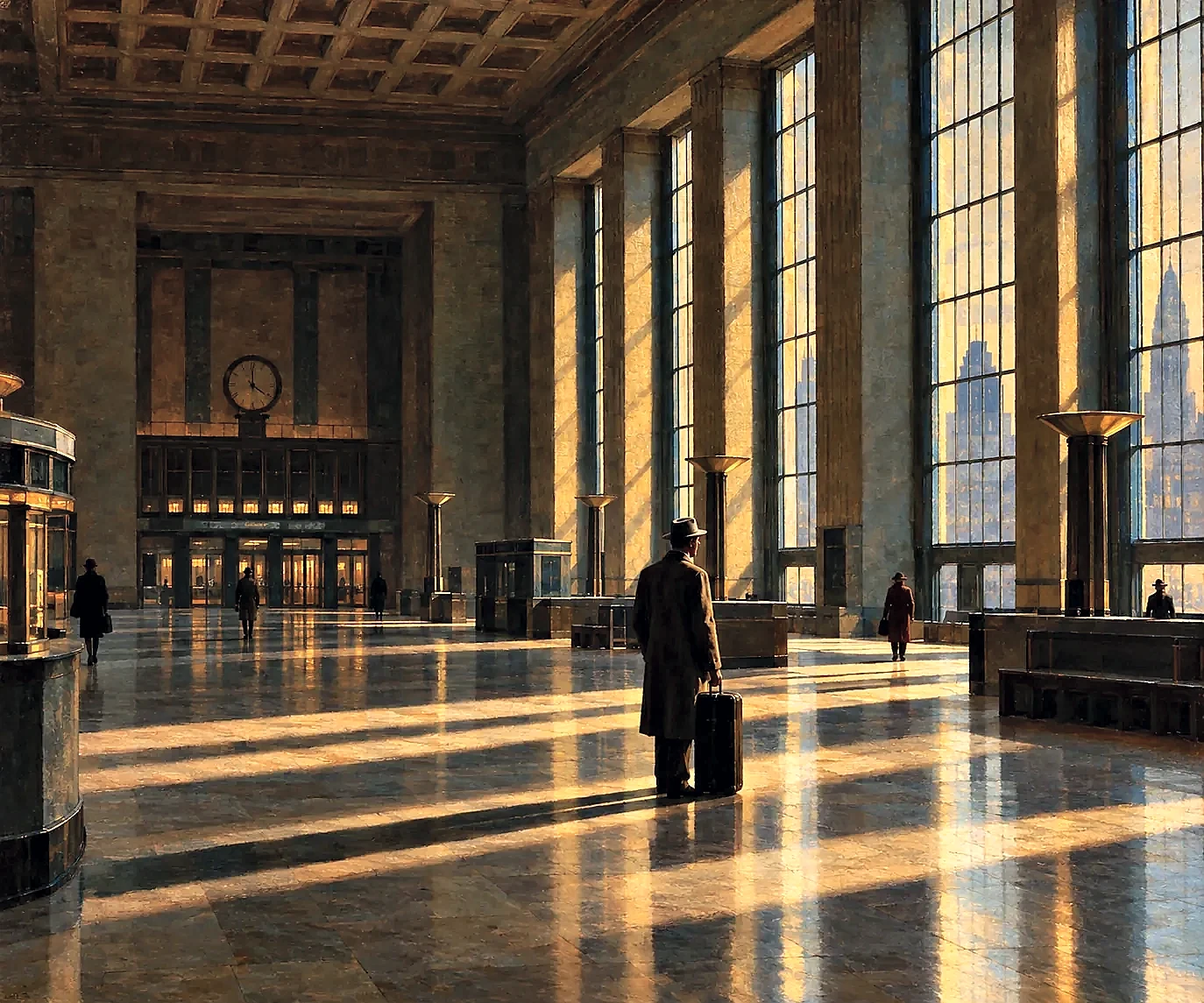
The threshold can also be crossed in time. In “Brother Mark” two young men build a fire on the tracks beneath a bridge on the way to a dance, “Your arm on my shoulder, / your face orange from flames.” Then the tense shifts:
Sometimes in the blackness of my room,a fire blazes.I see our faces.Hear our voices.10
The past scene does more than recollect itself. It becomes present. The fire does not repeat. It returns in a new place, the dark bedroom of the grown man. “Leaves” makes the same move with a phrase. The speaker and the “you” of the poem rake leaves behind the shed until dark, and only when the flashlight shows “not a speck of leaf” does the elder say, “We’re done.” Years later the speaker kneels at the grave, clearing wet leaves: “Again, I smell the earth, / feel the biting cold.” The phrase returns in a new mouth and a new tense, “‘We’re done,’ you whisper in my ear,” and the satisfaction of finished work has become the finality of death.11 The poem ends plainly: “You’re no longer here. / I stand and leave.” But the voice has just been heard. This is where “artistic resurrection” can be defined with some precision. It is not a literal return from death. It is the persistence of a relation through formal re-encounter. The dead are not restored. They are made present again by the form of the poem.

III. The Hand and the Tended Body
If the threshold is the governing motif, the hand is the most reliable instrument, and Mulhern’s second principle explains why. “To summon a character into fuller being is an act of mercy rather than of judgment,” he writes.1 Mercy here is a way of making as well as a way of judging. It decides what is looked at, for how long, and what is withheld. It also refuses the most common evasion in writing about the old and the sick: “I believe a body in decline—diabetic, gouty, bald, unsteady on its feet—is not a subject the serious writer looks past on the way to something more dignified. It is where dignity actually resides, if it resides anywhere at all.”1 Compassion, so understood, asks the writer to keep looking. Sentimentality begins when the writer looks away.
The hand carries that mercy through the collection in three offices, and their order amounts to an argument. In “The Crosswalk,” the speaker has been listing his father’s failures of affection: the swings that never happened, the shared memory of building a shed credited to another son. Against them he sets one image, “I had other memories—/ your help knotting my tie,” and at the poem’s end a photograph on the table by the casket: “Your hands on my shoulders. / One moment, framed.”8 Here the hand is evidence, offered in a case the son is arguing with himself. In “Water” it is a failed reach. After a catalogue of a ruined body, the old man
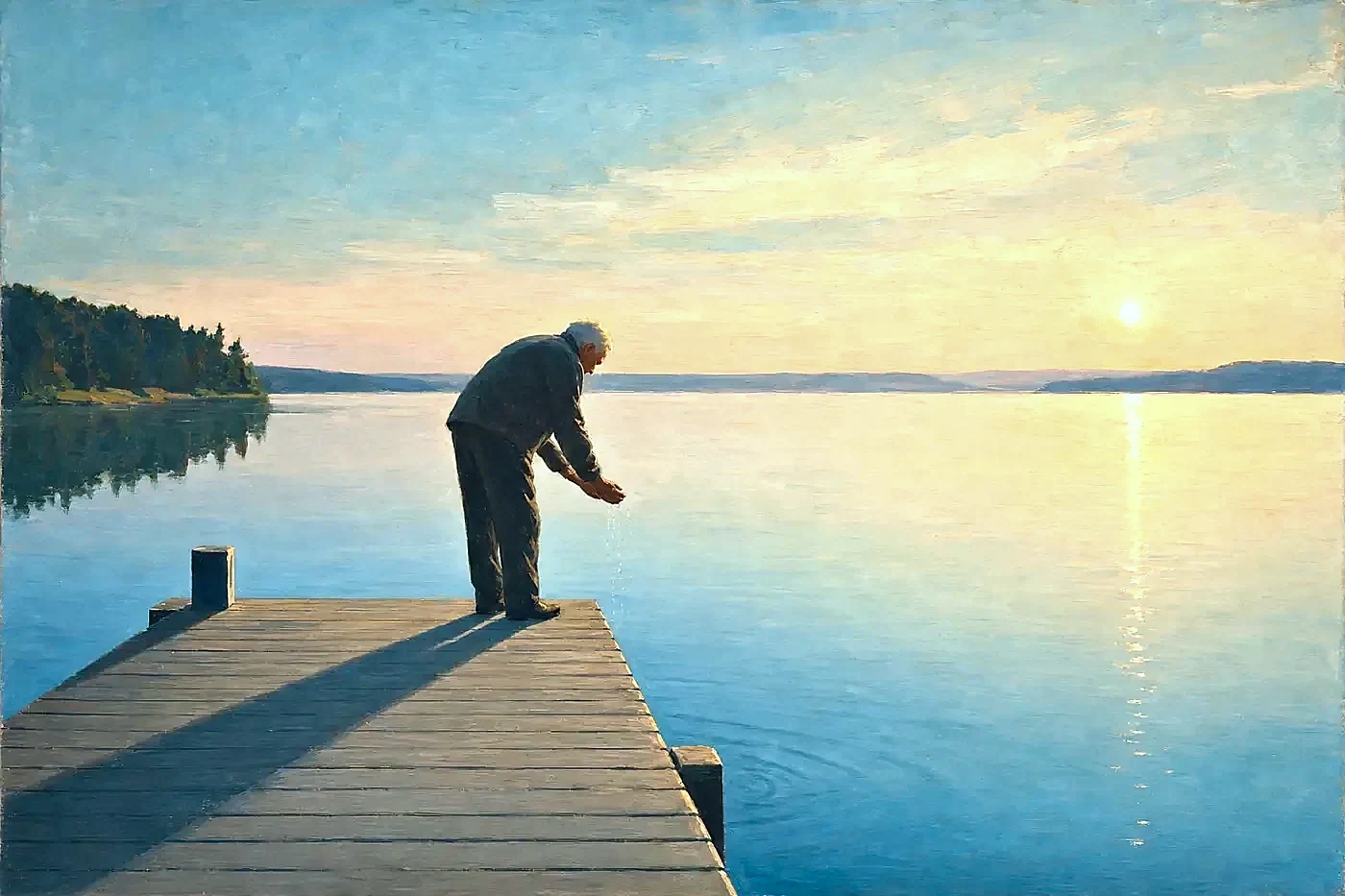
bends,cupping his handstoward the lake below,reaching for waterthat will not rise.12
The cupped hand is the oldest vessel there is, and here an empty one. In “Moving Forward” it becomes presence. The speaker’s mother, losing her sight, says “Move your chair close,” and “Her fingers trace the shape of my face.”13 The hand that was evidence in one poem and futility in another becomes the only instrument the living still have: touch as recognition, a blind mother mapping her son’s face because she can no longer see it. The motif moves from evidence through loss to presence without a line of commentary to mark the transit.

The hand also makes the sign of the cross. In “Brother Mike” the speaker, home from the airport and worried about a sick friend, waits for his reticent brother’s advice, “but you simply looked at me / and crossed yourself / in the dashboard light.” The poem names what passed between them in one word: “Communion—/ the road we share.”14 Ritual survives as a language of care, even where belief is uncertain. The same tenderness extends to the feet. In “Honeymoon” the speaker rubs ointment into his mother’s cracked heel and kneels beside her chair: “I think of how far these feet have walked, / the tenderness at the bottom of her sole. / Kneeling, I’m thankful to ease one hurt.”15 The kneeling posture reverses the usual order of care, the grown child serving the parent in an attitude of humble attention. The dedication gathers the same vocabulary into a family portrait. Helen has “crooked toes from shoes / passed house to house,” and a mother’s “fingers touch the contours of my face.”6 Across the collection the hand is trusted in a way that statement is not.

IV. Water
Water in Mulhern’s work is almost never grand. It does not part, flood, or drown anyone in a single dramatic stroke. Because it is the most conventional of his motifs, it is the one most at risk of being over-read, and what distinguishes his handling of it is that he almost never lets it be symbolic on its own terms. It describes first. Any larger meaning comes later, on its own. “Water” opens with a body rendered as terrain:
The old man on the dock—weathered face,capillaries like tributarieson dry land.His belly smooth as stone,ankles swollen purple,skin rippled like water.12
The governing conceit is drought. The capillaries are tributaries on dry land, the belly is stone, and the skin is “rippled like water,” a surface still remembering a tide that has gone out. Only after this is established does the poem reach the cupped hands and the lake that will not rise. The ending’s charge is produced entirely by the accuracy of what precedes it. Nothing has to be asserted.
Elsewhere water is inherited along with hardship. In “Catherine” the grandmother keeps an old photograph of herself as a girl in a bathing suit “like a dress,” swimming toward “a boulder / battered by foam.” Asked whether the waves frightened her, she laughs: “I was gathering food—sea lettuce, we called it. / We’d scrape the rocks / and make stew.”16 Then the poem lowers her present body into a warm bath, while the boy listens from the other side of the door: “That was Clew Bay in County Mayo,” she calls out. The girl who swam for food and the old woman bathed by her daughter are the same body, decades apart, held in the same element. Water in these poems is rarely simply given, and the collection never lets the reader forget what it cost to fetch.
Just as often water is domestic and unremarked. In the same poem the mother “put dishes in the sink and ran water.” A man caring for a dying dog “made sure she had water.”13 These are not symbols but chores, and their plainness is the point: in this body of work the sacramental and the menial use the same tap. In “Honeymoon” the rain does no plot work at all. “The room darkens. Rain taps a pane.”15 It keeps time while care is paid out in small installments. In “Moving Forward” water appears at its least dignified, in the diapers that “sagged and slipped off” a failing dog, and the poem lets that humiliating material stand beside the speaker’s tenderness to his mother without ranking them.13 In “Carol” water is finally a current. Carol once pictured herself as an apostrophe “lost in a crowd” of painted waves, and the speaker’s last word to her is a correction:
you were not lost.Just part of a currentcarrying yousafely home.17
The fiction asks water to do theological work only once, and then withholds the miracle. In “Assumptions” two old women walk into the Atlantic at Nantasket on the feast of the Assumption, seeking a cure. “Altogether Beautiful” reads that scene in full. The story lets the reader believe, briefly, that the sea is where healing will happen, and then does not say so. Taken together, the dock, the bath, the rained-on pane, and the incontinent dog suggest one use of water across the work. It is not the medium of the miracle so much as the medium of tending, met where illness, mourning, and love cross. A tear that might be dew, a tide that might be a cure, a rain that is only rain until you notice what it falls on: unlike the fire, the water in these pages does not announce itself.
V. Light, the Unasked Question, and the Withheld Gloss
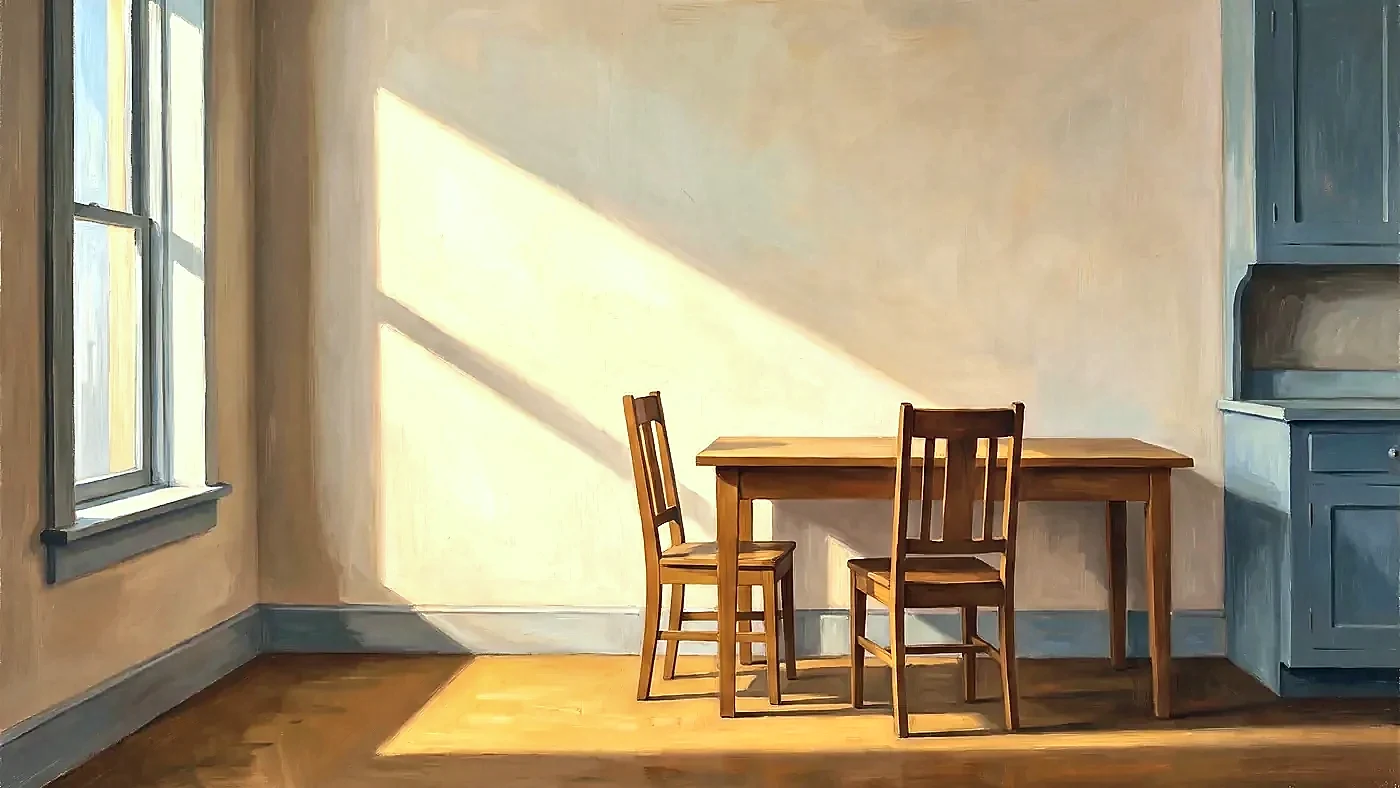
Light and darkness are the most conventional pairing in the work, and Mulhern’s handling of them is uneven. Where it succeeds, the light has a source and an angle, and no announced meaning. “A slant of kitchen sun” is the exemplary case.7 The phrase locates the light (a kitchen), gives it a geometry (a slant), and declines to interpret it. A reader who knows Dickinson may hear “There’s a certain Slant of light” behind the line, her winter-afternoon illumination that reaches without arriving and leaves only an “internal difference.” If the echo is there, it has been moved from the metaphysical to the domestic. Dickinson’s poem is about the light. Mulhern’s simply contains it, falling on a particular old man’s face at the edge of a lit room. Compare the shadow in “Copacetic”: “I sat by him until shadows / crossed his face.”5 The verb is the book’s title word, arriving as a description of late-afternoon light in a hospital room. The pun is available and unpressed. This is the collection’s usual tact. The larger meaning is put within reach and then left alone. Where the pairing is weaker, it is because light has been asked to signify without being seen, to stand for hope in general. The difference between the strong and the weak instances is consistently the presence or absence of a physical source.
A further motif is verbal: the question that stands in for one that cannot be asked. “Everything copacetic?” is the book’s recurring formula, and the introduction names the people it was spoken among: “men who couldn’t cry, women who worked until their feet hurt, / children who waited for words that never came.”2 The dedication turns the father’s formula: “It wasn’t always, but your asking / made it so.”6 The inadequate question is not excused. It is reclassified. The asking, not the answer, was the love. That reading of insufficient speech as sufficient feeling keeps the family poems from becoming grievances.
The formal corollary is the withheld gloss, and “Copacetic” is the pattern case:
“Don’t want it.”“You’ve got to eat, Dad.”“I’m not hungry.” He pushed it away.5
Three lines of speech, one clause of action, no interpretation. The refusal of food by a dying man is among the most heavily freighted moments available to a writer, and the poem spends four words on it. What follows is equally spare: “Mostly, he slept. / Sometimes he asked the time. / I left at nine.” The flat report of the hour is the poem’s most affecting line because it declines to be affecting. The household object works the same way. A yellow teapot searched for in every cabinet and found years later in an upstairs room, a pair of Dr. Scholl’s eased onto crooked toes, a robe “folded, / on the table by the door”: each is a reliquary in the strict sense, an ordinary container whose value is entirely a function of what it has been near. “The Unspoken Elegy” reads these objects at full length.
Four habits of the sentence make the withholding visible. The first is syntactic suspension. “Water” withholds a finite verb through its whole opening, a noun and a series of appositives with nothing to predicate them, so that the reader is held in grammatical incompletion as the man is held in a suspended life. The second is the dash as a removed connective. “My only memory of you—”; “The old man on the dock—”; “I braked and watched them pass—”; “I had other memories—.” In each case the dash stands where an explanatory clause would go. Here the poems are closer to Dickinson’s practice than to Whitman’s; for Dickinson the dash is the visible trace of everything a poem declines to state. The third is understatement as measurement. Learning that his father has credited their shared work to another son, the speaker of “The Crosswalk” reports: “I was bothered just a bit.”8 The phrase is not modest but calibrated, and the gap between the wound and the words is where the feeling is kept. The fourth is the levelled catalogue. “To Be” sets “the Wife of Bath’s scarlet stockings,” “poor Yorick’s skull,” and “Dickinson’s sherry in the glass” in the same grammatical rank as “a flattened sneaker on some highway” and “a lost sock under a sagging couch.”18 Monument and litter receive identical weight. A reader may find the device faintly Whitmanic, but the scale is the difference between the two poets’ worlds. Whitman’s list contains a continent, and Mulhern’s a household. Where Whitman expands to include everything, Mulhern contracts to keep what would otherwise be thrown away. The comparison’s chief use is to show the poems’ own household scale.
VI. One Book
The poems’ system does not stop at the edge of the poems. “Arise and Go Now,” an Aiden Glencar story, opens by placing its narrator at a door and moving him at once through a house toward light: “I arrived at Rita’s house about noon. Her blue eyes widened when she opened the door. . . . We walked through the hallway and kitchen to a brick patio covered by a pergola. . . . Sunlight glimmered through the red cedar lattice above us, dappling her face.”19 Door, hallway, kitchen, light on a face: it is the sequence of “Dark City” in prose, at a different tempo and in reverse, leading outward into sun rather than inward into a dark corridor. The author’s own note on his prose names the habit that surrounds it, “a willingness to slow down” and “a habit of placing the ordinary and the unspeakable in the same paragraph.”20
A reader who meets the writer through a single book may treat recurrence as a limit. The same family keeps reappearing, water keeps rising in the same places, grief keeps arriving in the same Boston triple-decker, and one concludes that the writer has not moved on. The opposite case deserves to be made. Read across the published work (the novels Molly Bonamici and Give Them Unquiet Dreams, the novella A Prayer for Home, the story collections, the linked Aiden Glencar stories of The Weight of Small Mercies, and the poems of Crossings), what looks like repetition turns out to be design. Mulhern is not writing separate books that happen to share furniture. He is writing one continuous book, assembled over two decades, in which characters, symbols, and settings return less like reused props than like doctrine.
When a setting comes back, it comes back exactly. West Roxbury, the Irish Catholic parishes of Boston, the Italian-American blocks that produce Molly Bonamici, and the Philadelphia interiors of the later stories are not interchangeable backdrops for “working-class Northeastern Catholic life.” They are named and mapped with the granularity of a gazetteer the writer intends to use again, and each book adds a layer of soil to ground already broken. Characters are related across books as well as within them. Family shapes rhyme: the spiritually porous child, the matriarch who is both source of harm and source of grace, and the absent or damaging father whose absence is itself a structuring presence. Molly’s Italian-American speech and Aiden’s Irish Catholic speech sound like two branches of one family. What the whole catalog suggests is distinctive is the crossing of that Irish Catholic mystic realism with an American transcendentalist undercurrent, an Emersonian Oversoul relocated to a West Roxbury three-decker. Second sight, in Mulhern’s hands, is folk mysticism joined to the premise that all consciousness takes part in one larger, permeable mind.

None of this is fully visible from any single book. It becomes visible only at the scale of the whole, where the returning streets, the rhyming families, and the water that rises and recedes stop looking like a writer revisiting old material and begin to look like a single current under every title. The emblem under which the books are published supplies the name: a silver current, carrying the dead toward the living and the past into the present tense. And at that scale a further kind of recurrence comes into view. The fiction returns to more than images. It returns to whole scenes, and sometimes to its own sentences.

VII. Revision in Public

Genetic criticism classically works from an archive of dated drafts, marginal deletions, and reinstated lines, held against the published text to reconstruct the labor of composition. No such archive has been made available for this work. The published corpus does something stranger. It lets a reader watch the same scene, the same images, and sometimes the same sentences at more than one point: once as a poem, once as a story, and in places twice within the same collection. That internal recurrence can serve as an unconventional form of genetic evidence. It suggests a habit in which returning to one’s own material is a kind of devotion as well as a kind of correction.
The bath in “Catherine” is the clearest case. The poem’s blocking (a grandmother helped toward a bath by her daughter, a grandchild sent out of the room, a photograph that unlocks a memory of Clew Bay and sea lettuce) is recomposed in the short story “A Bath” inside an entirely different plot. There is a different grandson, a different occasion (concealing a boyfriend’s violence rather than a hidden donut), and a different mood: crisis in place of tender routine. The mechanism survives intact. “‘That was Clew Bay in County Mayo. The photograph, I mean.’ I listened through the door. There was no conversation. I heard splashing and my grandmother’s sighs as my mother rubbed her back.” So does the listener’s habit of imagining what he cannot witness: “I imagined my grandmother was thinking about an ocean three thousand miles away.” This is more than thematic recurrence. A whole scene, with its blocking, its central prop, and its emotional mechanism of memory unlocked by physical care, has been composed once in verse and recomposed in prose, with new stakes built around it. Instead of discarding the earlier version, the writer has published both, and the reader can watch the redrafting directly.
Within the fiction a single sentence-cluster recurs the same way. The beach outing on the feast of the Assumption, when Agnella and Mrs. Muldoon take the young narrator to the shore, is told twice in the collected material. Both tellings carry the same walk to a fishing jetty, the same search for “a lonely starfish, a shiny stone, or a clam with a secreted pearl,” the same startled mourning dove, and the same simile: the waves “glimmered like sparks from an unquenchable fire.” The image is also the one “Assumptions” gives the sea as Peggy and Helen walk into it. The duplication may be an editorial accident in assembling a career-spanning collection. It may also show a unit of language brought back whenever the scene-type recurs, a beach ritual with an aging woman and a witnessing child, much as a liturgical response returns on its feast.

The poems show the opposite motion, revision by subtraction, and it confirms the same disposition. Across the magazine texts and the collected Crossings, “Brother Mike” loses its abstract theological nouns. The later text deletes “what we call the sacred,” “the words of your prayer,” and “the creed in your gesture,” and keeps only the sign itself, the brother who “crossed yourself / in the dashboard light.”21 The revision polishes the ritual and cuts the sermon. Read together, the two motions describe one method. The writer keeps redrafting, in public, the scenes and images that will not leave him, and he trims from them whatever explains them. What a writer removes on the way to a final text is the usual question of genetic criticism. This corpus asks another: what does a writer choose to keep drafting, in the open, more than once?
VIII. The Chalice Told Twice
The Weight of Small Mercies announces this principle before its first story begins. Its introduction says the stories “have been revised, restored, and gathered here because they belong together. They speak to one another across the years. A chalice reappears. A grandmother reappears, and dies, and speaks again in a memory the boy did not know he was keeping.”22 That is an unusually direct instruction to the reader: read these as tellings of the same material, and expect the repetition.
The collection then tells the same story twice. In “Blindfolded,” Aiden’s grandmother steals a chalice from Mission Church, believing it can cure his institutionalized mother: “I need to get that chalice, Aiden. The Boston Globe article said some people think it has curing powers . . . If I have your mother drink from it, maybe she’ll get better and come home to us. Won’t that be nice?” The theft is a small comic set piece. Aiden fakes a fall to distract a priest while his grandmother “crossed herself, hurried across the altar, swiping the gold chalice and putting it in her handbag,” and when the chalice comes back the priest proclaims, “It’s a miracle,” “holding the chalice above his head.” “Keep Calm and Carry On” retells the episode in nearly identical language, with the same newspaper article, the same staged fall, and the same theology of borrowing rather than stealing: “I’m going to return it, sweetheart. We’re just borrowing the chalice to help your mother. God will understand.” Two unreconciled drafts would be a fault. Here the doubling is the collection performing its own argument. A reader who meets the chalice a second time meets it as recognition, exactly the experience the introduction promised.
The book’s closing “Credo and Philosophy” states outright what the fiction enacts:
I believe that memory is not a container but a river. What returns to us returns changed, and the writer’s task is to be faithful not to what happened but to what will not leave. The chalice comes back. The grandmother comes back. The mother’s voice comes back, from the other side of a door that has been closed for many years.
Its final section, “The Resurrection, Rewritten,” goes further: “it seems to me, having lived a while and buried a number of people I loved, that the resurrection is not a doctrine but a fact of ordinary experience. . . . What returns is not the person entire; what returns is enough.”22 Read against that passage, the chalice’s second telling is a small demonstration of the book’s largest claim. Repetition, at the right emotional pitch, becomes almost indistinguishable from resurrection. The returning object does not claim to be the original event unchanged. It comes back enough to alter the story that follows. The same logic governs the narrator. “The boy in these stories is not me, and he is not not me,” the introduction says. “He believes that a grandmother, dying, is only crossing to the next room.” Aiden is himself a return of the author, altered in the returning. The title completes the thought. If mercy exists only in small, repeatable acts, then a mercy that could not recur would not be a small mercy at all.
A liturgical calendar works this way. On the same feast it returns to the same readings, and repetition under changed circumstance produces new meaning. The Feast of the Assumption, the occasion of both beach tellings, is such a fixed date, revisited each year. The jetty sentence and the Clew Bay bath return the way the propers of August 15 return, and the “unquenchable fire” is used for more than one woman’s assumption into glory. It is a sentence that comes back.
IX. One Instrument, Two Grammars

Recurrence across genres poses a final question: what can each form do with the same piece of the past? The introduction to Mulhern’s collected volume sets the test itself: “Read ’Piano’ beside ’Assumptions’ and you will find the same instrument, the same violence done to it, refracted through two different grammars.”23 One object, a Steinway, does opposite work in a poem and a story.
In “Piano” a father destroys the family instrument while his son watches:
That gray day, you took an axe to the Steinway.Yellow and red leaves scattered as you raised your arm,smashed the instrument apart on the hard earth.You shattered the shiny veneer—wooden ribs, dovetail joints,padded hammers, strings.24
The poem gives no account of the man’s psychology. It moves straight from the wreckage to a second loss:
I thought of my mother,the day she moved out,how you changed the locks,emptied closets,erased every vestige of your shared life—
Then it closes on an image that turns the physical ruin back into emotional evidence: “glistening strings / on the soundboard / of a broken heart.”24 The technical vocabulary of dovetail joints and padded hammers is the vocabulary of something carefully made. The closing image tells the reader what was being taken apart. A whole failed marriage is inferred from a changed lock and an emptied closet. The poem can end on “a broken heart” without explaining what broke it, because the compression itself says that some things will not be explained.

“Assumptions” puts a Steinway to almost the opposite use. It is not smashed but sung beside, and it is not evidence of a man’s inability to grieve but the instrument by which a grieving woman briefly recovers her dignity. “In the knotty pine basement of Peggy’s home was a beautiful Steinway piano,” the narrator recalls. After a few highballs, Peg sings for the boy: “With one thin arm braced against the polished black surface of the Steinway, she sang with no accompaniment, and even now, years later, I hear the swelling sadness in her voice.”25 Where the poem compresses destruction into a few lines, the story lets the instrument survive across paragraphs of patient detail. The narrator supplies Peg’s biography: her dead husband, her alcoholism, a voice “ravaged” by “smoking, drinking, and heartache.” Prose has room to let grief unfold the way an adult actually remembers a childhood scene, through anecdote and accumulated context. It can let an object simply persist in the background. A poem, working in far less space, usually cannot afford an object that does nothing.
Each genre withholds something different. The poem withholds narrative almost entirely and interprets its image in one closing phrase. The story withholds almost nothing about Peg’s life but declines to interpret the piano. The narrator does not say what the Steinway’s survival means. He reports that he still hears the sadness in her voice and moves on. Mulhern has said that he experiences fiction and poetry not “as separate disciplines so much as separate registers of the same attention.”23 The Steinway shows that he means technique as well as shared imagery. The poem could not hold the story’s biography without becoming a different poem, and the story could not reach the poem’s single-image compression without abandoning its anecdotal voice. Broken in the poem and played in the story, the instrument is the clearest evidence that a recurring image can do new work each time. It is a writer testing what each form can do with the same piece of the past.
X. What Is Laid Down Is Taken Up
Why return at all? The introduction to Crossings has already given one answer: the poems are prayers, and a prayer is spoken to someone. The shape of the work gives a second. Almost none of the poems resolve. “Copacetic” ends with a robe folded on a table by the door. “The Crosswalk” neither forgives the father nor indicts him. “Moving Forward” moves from a dog’s death to the clerk’s “Sorry for your loss” and a man leaning on a steering wheel. The refusal of closure is consistent enough to be structural. If a poem concluded, the image inside it would be used up and the address would close. By leaving the poems open and letting their images travel, the writer keeps the material in circulation. The doorway is available to the next poem because no poem has finished with it. What looks like a habit of return is, functionally, a refusal to let anything be over.
The ethical name for that refusal is mercy. The father who could only ask “Everything copacetic?” is not corrected but re-read. The grandmother’s crooked toes are not turned into an indictment of the houses her mother cleaned. The dog is not spared the diapers or the needle, and the mother who suggests putting her down is answered but not condemned. Judgment would require conclusions, and conclusions are what these poems decline to reach. Taken together, the motifs make a claim no single poem states. The threshold says that the important moments happen at edges. The hand says that what passes between people passes through touch. Water says that the body is a landscape and that landscapes dry. The household object says that value is conferred by nearness to love. The unasked question says that insufficient words may still carry sufficient feeling. The scenes told twice say that what will not leave a writer deserves to be written again.

The work’s wider literary inheritance extends the same ethic beyond autobiography. Scripture, Transcendentalist thought, Irish literary tradition, and the canon work as shared memory, languages in which experience can be understood. Literature, as “Teaching at Fifty-Six” suggests, is not a place to stand above life and interpret it from safety. It is meant to bring the reader into contact with life, to “get wet.” Mulhern’s corpus thus enacts a non-dogmatic theory of artistic resurrection. It does not try to defeat death, erase grief, or compel belief. Its claim is that whatever has been carefully attended to, remembered, witnessed, and put back into words, can be present again. No person, grief, gesture, object, or moment is finally negligible. What is laid down may be taken up again: not unchanged, not restored to a former life, but made newly available through the attention of art.
Notes
- 1. James Mulhern, “Credo,” authorjamesmulhern.com; quotations from the author’s working philosophy are drawn from this statement. The sentence “In art, as in faith, what is laid down is taken up—and it becomes life eternal” is from his “Note from the Author,” in The Collected Stories and Poems of James Mulhern (Silver Current Press, forthcoming). ↩ ↩ ↩ ↩
- 2. James Mulhern, “Introduction,” Crossings (Philadelphia: Silver Current Press). Read the complete reading text. ↩ ↩ ↩
- 3. The Religious Architecture of James Mulhern’s Work, authorjamesmulhern.com (2,030 catalogued passages). ↩
- 4. Quoted in “Altogether Beautiful”: The Religious Architecture of “Assumptions,” authorjamesmulhern.com. ↩
- 5. “Copacetic,” first published in Better Than Starbucks Poetry Magazine; collected in Crossings; quoted from the complete reading text. ↩ ↩ ↩ ↩
- 6. Mulhern, “Dedication,” Crossings. ↩ ↩ ↩ ↩
- 7. “Dark City,” first published in Academy of the Heart and Mind; collected in Crossings; quoted from the complete reading text. ↩ ↩ ↩
- 8. “The Crosswalk,” first published in Academy of the Heart and Mind; collected in Crossings; quoted from the complete reading text. ↩ ↩ ↩
- 9. “Shoes,” first published in Red Eft Review; collected in Crossings; quoted from the complete reading text. ↩
- 10. “Brother Mark,” collected in Crossings; quoted from the complete reading text. ↩
- 11. “Leaves,” collected in Crossings; quoted from the complete reading text. ↩
- 12. “Water,” first published in Impspired Magazine; collected in Crossings; quoted from the complete reading text. ↩ ↩
- 13. “Moving Forward,” first published in CC&D Magazine; collected in Crossings; quoted from the complete reading text. ↩ ↩ ↩
- 14. “Brother Mike,” collected in Crossings; quoted from the complete reading text. ↩
- 15. “Honeymoon,” collected in Crossings; quoted from the complete reading text. ↩ ↩
- 16. “Catherine,” first published in Abstract Magazine; collected in Crossings; quoted from the complete reading text. ↩
- 17. “Carol,” collected in Crossings; quoted from the complete reading text. ↩
- 18. “To Be,” first published in Tipton Poetry Journal; collected in Crossings; quoted from the complete reading text. ↩
- 19. James Mulhern, “Arise and Go Now,” an Aiden Glencar story collected in The Weight of Small Mercies. Opening pages reproduced on the Writing page. ↩
- 20. “What characterizes a Mulhern sentence,” Writing. ↩
- 21. On the revision of “Brother Mike,” see “The Religious Architecture of the Work.” ↩
- 22. James Mulhern, Introduction and “Credo and Philosophy,” in The Weight of Small Mercies: Selected Stories (Silver Current Press). ↩ ↩
- 23. James Mulhern, Introduction, in The Collected Stories and Poems of James Mulhern (Silver Current Press, forthcoming). ↩ ↩
- 24. “Piano,” collected in Crossings; quoted from the complete reading text. ↩ ↩
- 25. James Mulhern, “Assumptions,” in All We Ever Needed (Silver Current Press, 2026); the opening is reproduced on the Assumptions and Other Stories page. ↩
Works Quoted
Poems are quoted from the complete reading text of Crossings on this site, the fuller manuscript from which Crossings: Selected Poems (Silver Current Press, 2026) draws its twenty poems; some lines are revised in the printed selection. Individual poems first appeared in Better Than Starbucks Poetry Magazine, the Galway Review, Sparks of Calliope, Impspired Magazine, the Font, Fragmented Voices, Academy of the Heart and Mind, Abstract Magazine, Scars Publications, Tipton Poetry Journal, VerbalArt, Ancient Paths Journal, Red Eft Review, Frost Meadow Review, and CC&D Magazine.
Prose is quoted from James Mulhern’s “Credo” and “Teaching at Fifty-Six” (both on this site), his “Note from the Author”; from “Assumptions”; from the Introduction, “Arise and Go Now,” “Blindfolded,” “Keep Calm and Carry On,” and “Credo and Philosophy” in The Weight of Small Mercies: Selected Stories (Silver Current Press); and from “A Bath” and the Molly Bonamici beach material in The Collected Stories and Poems of James Mulhern (Silver Current Press, forthcoming). Dickinson is cited from The Poems of Emily Dickinson, ed. R. W. Franklin (Harvard University Press, 1998); Emerson from “The Over-Soul,” Essays: First Series (1841).
Related essays on this site: “The Sacred in the Shabby” reads the ordinary as sanctuary; “The Allusive Method” treats the work’s literary inheritance; “The Unspoken Elegy” reads Crossings poem by poem.