One passage from the published fiction, then a few paragraphs on how it works. The gentlest way in.
Read the seriesEssays & Critical Readings
Author’s Notes
The Credo, the essays, and critical readings of the books, kept on one page and apart from the books themselves. None of it is needed before a novel or a poem.
Where to Start
Three First Readings
Chosen to begin gently, from a two-minute reading to an afternoon’s essay. Each piece on this page is labeled by what it is and roughly how long it takes.
A teacher near the end of three decades in the classroom, writing about why he still believes his students contain multitudes.
Read the essayOne reading of the whole body of work: the motifs that return, the scenes told twice, and the case for reading the books as one story.
Read the essay
How this page is arranged
Three shelves
In the Author’s Own Words holds what James Mulhern has said for himself about writing, teaching, and belief. Critical Readings holds interpretations of the novels, stories, and poems, from short readings to full studies. Reference and Experiments holds the concordances, the gallery, and tools to browse.
The books themselves live on the Books page, with sample pages on Sample Writing and the reading path; nothing here needs to be read before them.
I · In the Author’s Own Words
What He Says for Himself
Pieces in which James Mulhern speaks for himself about writing, teaching, and belief. They are his account of what he hopes the work does, not a key to it.
His working philosophy in nine sections: the sacred in ordinary life, mercy as method, attention, the classroom, comedy and reverence, writing as communion, and a fire that returns by changing.
Read the CredoOn teaching, the Transcendentalist writers he carried into the classroom, and the sacred hidden in an ordinary school day. Notes on the allusions and a separate critical reading follow the essay for readers who want them.
Read the essayWhat a dear friend once told a curious, questioning boy, and the poets and psychologists who noticed the same thing about permeable boundaries.
Read the essayBrief entries on teaching, writing, and reading, best taken one at a time rather than straight through.
Read the musings
II · Critical Readings
Readings of the Work
Interpretations of the novels, stories, and poems, arranged by subject and labeled by length.
These are interpretations, not instructions. Each follows one image, name, or pattern and argues for what it might mean. Where an essay hears an allusion, take it as a possibility to test against the page; the stories and poems leave room for readings these essays do not make.
Short Readings
One passage from the published fiction or poetry per entry, followed by a few paragraphs on the craft at work in it.
Read the seriesWriters reviewers have compared with the poems and stories, set beside them in homage, each paired with a short passage and a brief note on what the pairing shows.
Read the notesAcross the Work
Recurrence as resurrection: repeated motifs, the scenes the fiction tells twice, one Steinway in a poem and a story, and the case for reading the catalog as one book.
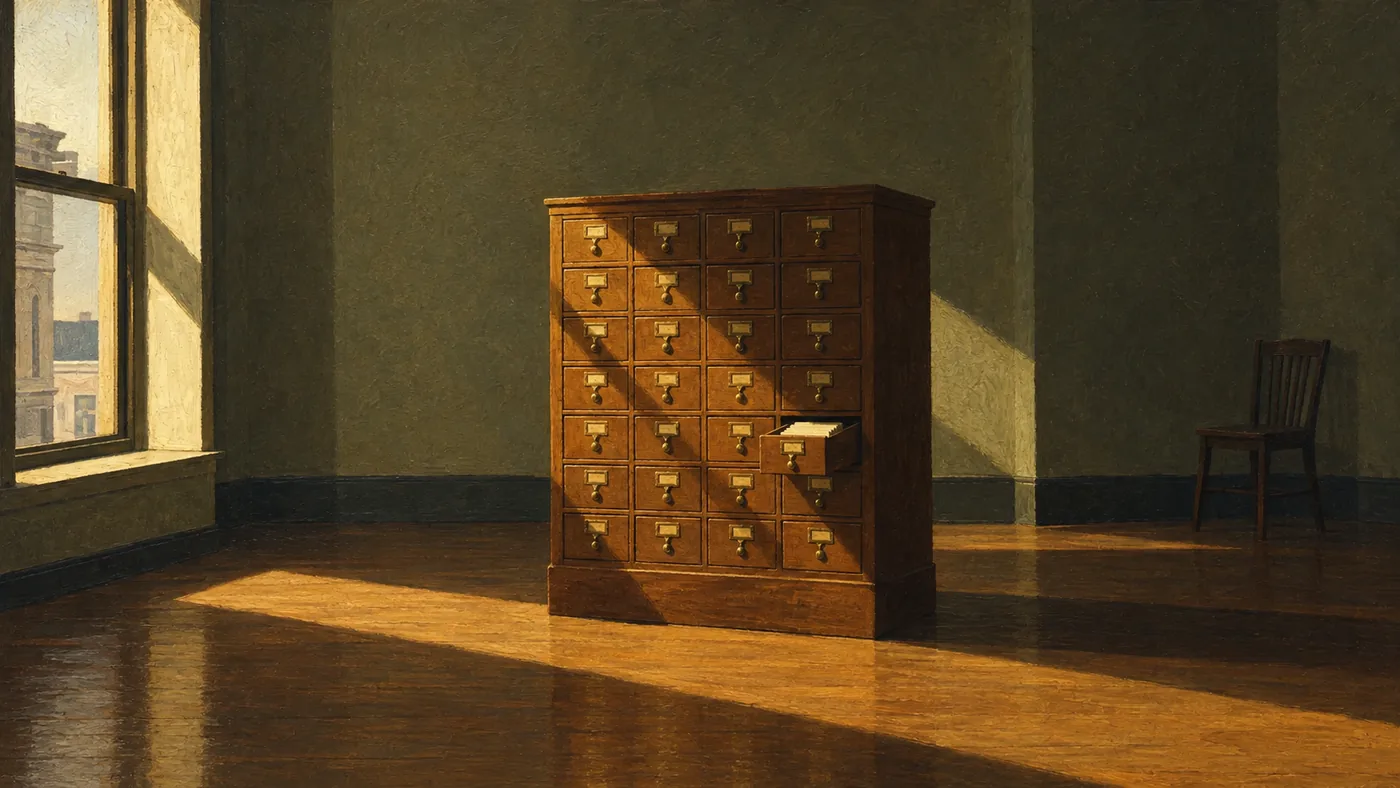
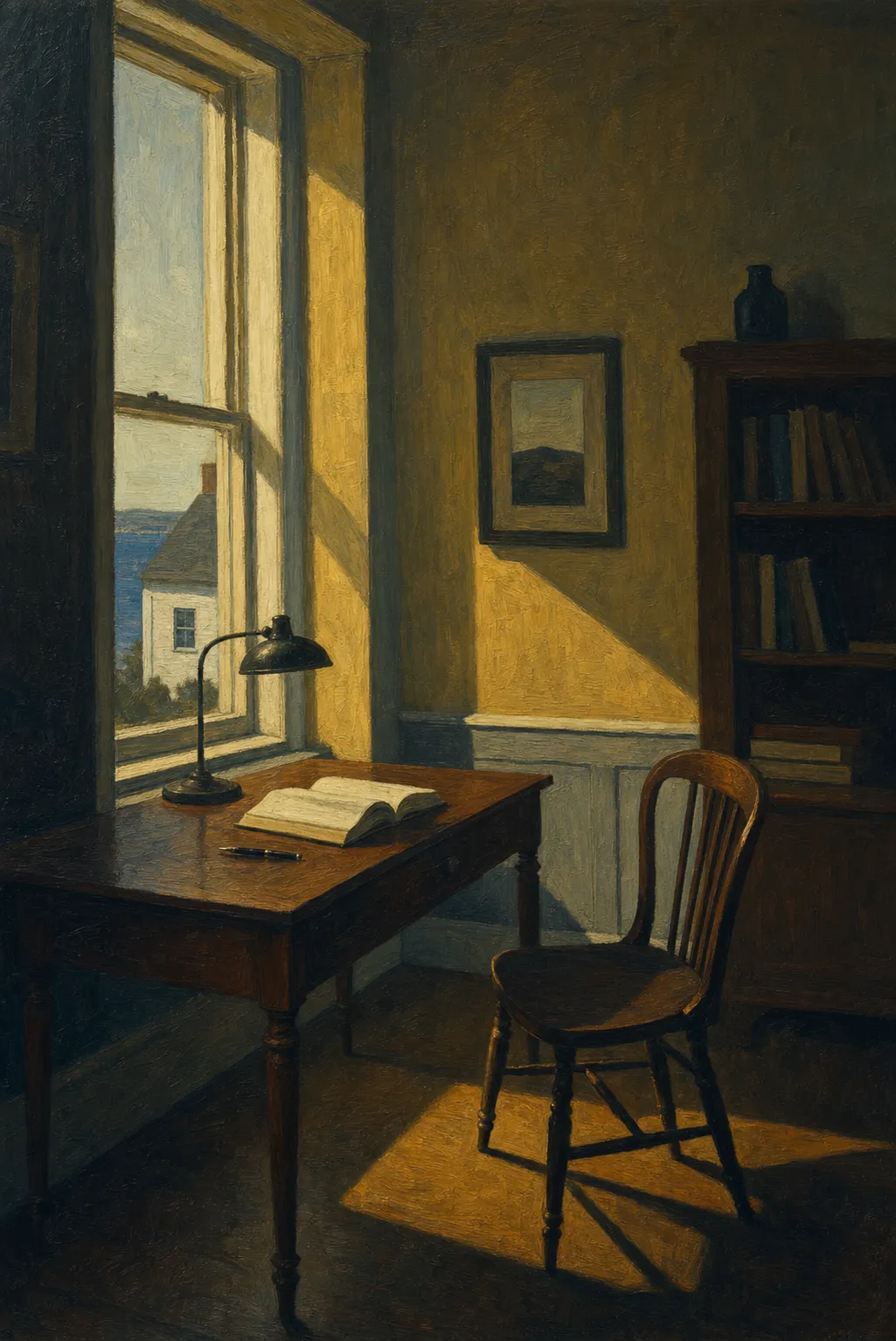
Read the essayWhy the paintings in the manner of Edward Hopper sit beside the writing: light as attention, the shabby detail held in light, and the empty chair as offered company.
Read the essayOne way of reading the holy in the work as disguised in the ordinary: communion in the classroom, the women who carry the ministry, useless objects, food as sacrament and poison, and the Transcendentalist creed beneath it.
Read the essayThe allusion that is literally true first, names as possible citations, re-addressing in “Teaching at Fifty-Six,” recurrence across the books, and democratic sources.
Read the essayThe adult cadence and the child’s uncorrected eye, sentence texture, white space, and the mechanics of dialogue in the short fiction.
Read the essayDialect, malaprop, and profanity as inherited registers of trust, set against the polished grammar of institutional authority.
Read the essayThe Novels
Second sight as narrative technology, who gets believed, the well, the pooka’s revenge and the Yeatsian frame, and Martin and the Christ pattern.
Read the studyThe Angel of Death premise, a narrator who withholds affect, the Defoe inheritance, deadpan comedy, and A Prayer for Home, the novella in which Molly first appears.
Read the studyThe Stories
“Peppermint Candy” and “Drenched to the Bone” read as a diptych about burnout in the classroom.
Read the essayThemes, motifs, character archetypes, allusions, and craft in the story collection, with close readings and direct quotation.
Read the essayUnlicensed confessors who hear what cannot otherwise be said, and the reasonable criminal narrators of “Peppermint Candy” and “Mia Bambina.”
Read the essayThe Marian antiphon of the feast, conversion without erasure, the unquenchable fire over the sea, the sacred vocabulary the story never uses, and its published texts.
Read the essayThe faith healer’s parlor, the confidence woman, the benign mafioso, the grandmothers as matriarchs of larceny, and bathos as a tragic hinge.
Read the essayThe Poems
Enjambment, metrical substitution, caesura, and stanza in the poems, with examples bridging verse and prose.
Read the studyThe collection’s architecture, its recurring image systems, and its formal choices.
Read the close readingA close reading of every poem: threshold, the objective correlative, touch, domestic objects, elegy and apostrophe, prosody, and ethical witness.
Read the studyThe collection read whole: grief carried by objects rather than named, the sequence from emigration to unresolved loss, and second-person address.
Read the essay
III · Reference & Experiments
Tools to Browse
Concordances, a gallery, and reading tools, meant to be consulted as questions arise rather than read straight through.
The threshold, the hand, water, the slant of light, the domestic object, the unasked question, and fire, each traced across the poems and stories where it appears.
Explore the motifsEvery painting on the site in the manner of Edward Hopper, each with a note on why it stands where it does.
Visit the gallery The Hopper Suite index (PDF)Allusive moments read twice, literally and allusively, across the stories, the Aiden cycle, both novels, the poems, and the essays.
Read the concordanceA catalogue of religious and literary allusion across the collected fiction—the fullest scholarly treatment on the site.
Read the studyAt the writer’s workbench: A Glossary of Literary and Writing Terms and The Shape of a Story, a word-count and beat-map tool.
Also among the notes
Indexes, print editions, and the press
Downloadable Studies offers typeset PDF editions of the longer studies, free to download. “Silver Current Press and the Independent Press Movement,” a short essay of about five minutes, places the imprint within the history of the small press.