An Essay · On the Paintings
The Room Kept Ready
Why the paintings in the manner of Edward Hopper throughout this site are not decoration but a statement of the work’s aesthetics and beliefs, and how their empty rooms, read closely, turn from loneliness to welcome.
Listen while you read
J. S. Bach, The Well-Tempered Clavier, Book I, Prelude No. 1 in C Major, BWV 846. Kimiko Ishizaka, piano. Public-domain recording, Internet Archive.
Contents
I. An Argument in Paint
The first room a visitor enters on this site is a painted one. A desk stands by a window, a chair waits beside it, and beyond the glass a city holds the last of the afternoon light. No one is there. The note that accompanies the painting in A Painter’s Pages explains the absence in a single clause: “the desk is waiting and the chair is empty, so the room belongs to whoever reads.” It is a modest sentence, easy to pass over on the way to the books. It also contains, folded small, the whole case this essay sets out to make. The paintings that hang throughout the site, one hundred and one of them in the manner of Edward Hopper, are not ornaments placed beside the work. They are one of the places where the work says what it believes.
The site makes the claim itself. “The choice of Edward Hopper is itself an argument,” the gallery begins, and it insists that the paintings “are not decoration but a visual gloss on the page each one opens.” A claim of that kind should be tested rather than admired. If the choice is an argument, what exactly does it argue, and does the argument hold?
The answer offered here is that the paintings borrow Hopper’s grammar (light laid across ordinary rooms, figures at windows, open doorways, interiors with no one in them) and set it to work for convictions the site states outright in “Credo”: that the sacred lives in ordinary things, that attention is a moral discipline, that mercy means continuing to look, and that a page is a place set for company. The most revealing thing about the borrowing, though, is where it departs from its source. Hopper is often remembered as the painter of loneliness. These paintings keep his stillness and his empty chairs, yet they teach the eye, slowly and without announcement, to see those chairs as waiting rather than abandoned. That turn is the hinge of the whole suite, and it arrives the way illumination arrives in the fiction: not as a statement but as a sudden recognition of something that had been in plain view all along.
II. Sunlight on the Side of a House
Begin with light, because Hopper did. “Maybe I am not very human,” runs a remark of his dated 1946. “What I wanted to do was to paint sunlight on the side of a house.” The line can be heard as dry self-deprecation, but it is also a statement of priorities: an ordinary surface, struck by light, is subject enough. Near the end of his life, in Sun in an Empty Room (1963), he pressed that priority almost to its limit, painting a room that contains nothing but light and the shadows it throws.
“Credo” begins in the same place, though it gives the light another name. Its first section, “The Ordinary as Sanctuary,” locates the sacred “in the unremarkable hours,” and its first concrete image is “the kitchen light at six in the morning.” Then comes a sentence that could stand beneath half the paintings on the site: “Grace is not clamorous.” The painting that opens the section, Kitchen Light, Six A.M., makes the image visible, and the gallery’s first chapter, Light, gathers nineteen paintings under a phrase that could gloss the whole suite: “The ordinary room charged with light.”
The resemblance matters less than the reason behind it. In “Credo,” light is not mood; it is the visible form of a habit of mind. “Our failure, then, is not principally a failure of faith but of attention,” the statement says, and its eighth section reduces the whole practice to a sentence and its consequence: “Attention is the whole of the discipline. The rest is mercy, which is only attention, carried toward another person, and held there a little longer.” A painting of a single lamp falling on one reader in a dim room, then, is more than atmosphere. The gallery’s note on that painting, The Single Lamp, which hangs in “The Remembering Voice,” calls it “attention as an architecture,” and the phrase is exact: the light decides what can be seen, and everything outside its circle falls away. Hopper’s sunlight falls as evenly on a filling station as on a bedroom wall. The light in these paintings looks the same and means something more. It is what close looking would look like if looking could be painted, and in this body of work close looking is the first form love takes.
III. The Shabby Detail, Held in Light
If light is the method, the things it falls on are the creed. “Credo” distills its working philosophy into one instruction: “watch the shabby detail long enough to see what else it may contain.” The paintings obey that instruction almost literally. Consider what they choose to look at: a housedress and an apron on a clothesline; bread and milk on an unpeopled table; a rosary “worn smooth at the decades” in an aged hand; a Boston triple-decker at dusk with its windows lit from within. None of these is a picturesque subject. Each belongs to the category “Credo” names when it describes the attention a sentence must pay “to something most writing would consider beneath its notice.”
Hopper painted unglamorous America too (storefronts, lunch counters, rented rooms), so the choice of painter fits. The suite, however, presses the fit toward commitments that are distinctly Mulhern’s. The gallery’s note on the clothesline calls it “the sacred disclosed in the shabby, grace hung out to dry,” and its note on the rosary says the object is made holy “not by itself but by the person on the other end of it.” Neither note turns the object into a symbol and then throws the object away. That restraint has a name elsewhere on the site. The painting for “Altogether Beautiful” shows ordinary things caught in a shaft of light, “luminous but unchanged,” and its note describes “conversion that keeps the mundane rather than retiring it to make room for the sacred.” The same conviction governs the fiction; “Credo” finds its clearest picture of it in the Transfiguration and concludes “that matter need not be thrown away in order to become radiant.” It is also, precisely, what a realist painting of a clothesline does. The housedress remains a housedress. The light simply stays on it long enough for the viewer to see what else it may contain.
There is an ethical edge to this as well. “Credo” refuses to make dignity a reward for respectability: “I do not believe dignity should be conditional on being presentable.” It defines sentimentality as what happens when a writer “flinches from the actual body in front of them,” and compassion as “what happens when the writer keeps looking.” Paintings of a worn armchair in a tenement parlor, a nearly empty bus in morning light, and a grandmother’s table with a child’s coat left on the chair are the visual equivalent of keeping looking. They neither prettify these rooms nor pity them. They light the working-class kitchen exactly as they light the chapel, and in doing so they make one of the site’s moral claims more directly than prose can, because a viewer sees the equality of the light before any argument for it has been made.
IV. Not Loneliness but Waiting
Here the argument meets its strongest objection. Hopper is the painter of isolation. His figures sit apart in diners and hotel rooms; his late empty interiors strike many viewers as desolate. Why would a body of work centered on communion, mercy, and the company of the dead take as its visual language a painter so closely bound to solitude?
The answer lies in an ambiguity Hopper left open and the site deliberately resolves. The Art Institute of Chicago describes Sun in an Empty Room as showing “a room not yet occupied or—perhaps more likely given Hopper’s advanced age—recently vacated.” An empty room can be read in two tenses: someone has gone, or someone is coming. Carter Foster, discussing the same picture for the Whitney Museum, observed that Hopper “takes everything out of the room, except for perhaps the viewer,” and added, “The viewer is implicated.” The emptiness, in other words, quietly enlists the person looking at it. Even the Art Institute, describing that most austere of Hopper’s rooms, adds: “Although it is austere, it is not bleak. It is radiant and evocative.”
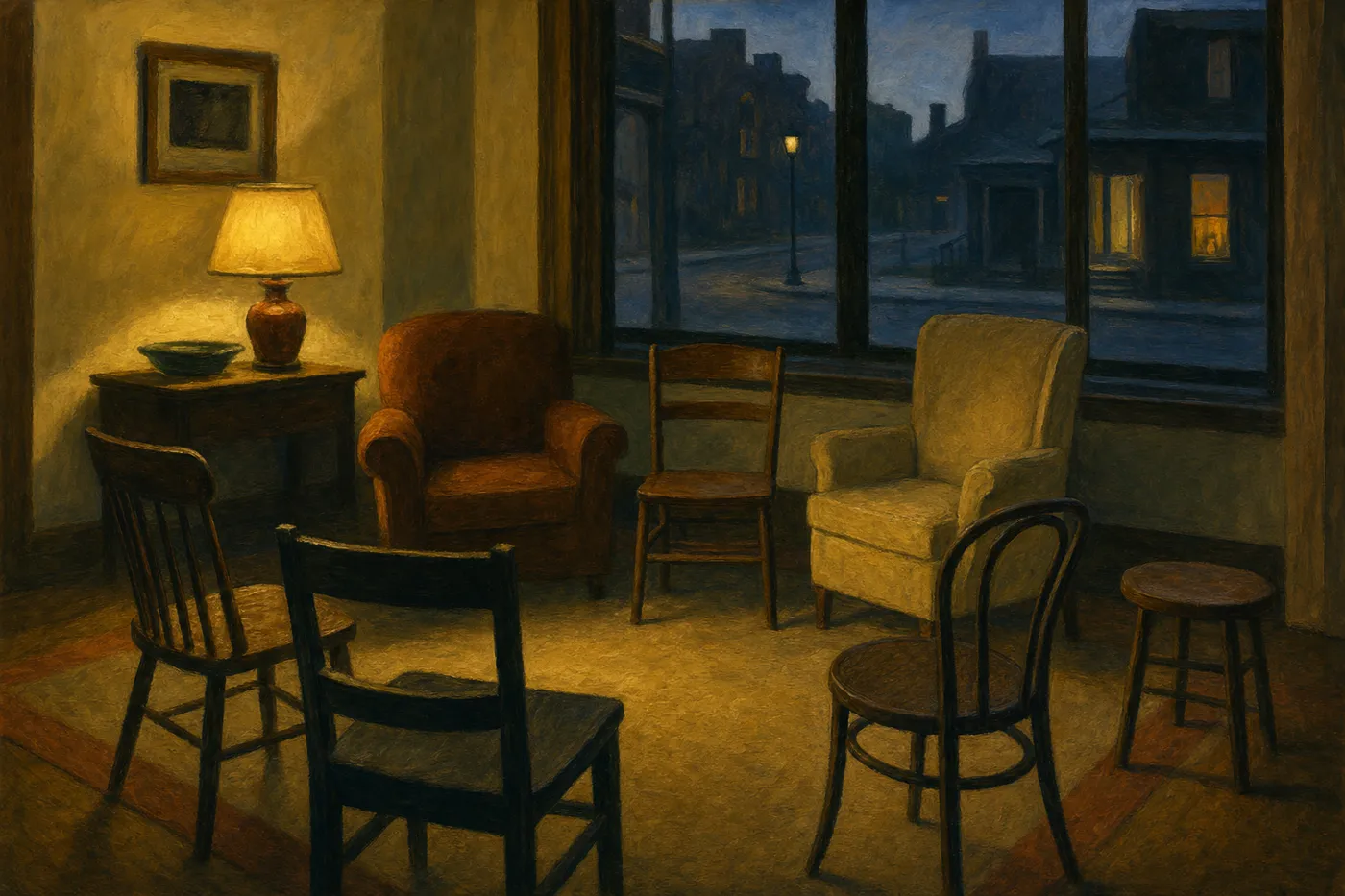
The paintings on this site lean, for the most part, toward the second tense, and the gallery’s own notes say so. The circle of chairs that opens the Book Club Companions page is “a company not yet arrived,” and “The warmth is in the waiting.” The worn armchair facing a window is “an empty chair waiting to receive the confession.” And the empty chair on the homepage exists “so the room belongs to whoever reads.” Hopper’s solitude remains visible in every one of these images. What has changed is its tense. These rooms are not after something. They are before it.
“Credo” supplies the reason. Its sixth section, “Writing as Communion,” sets aside the idea of writing as expression and describes it as hospitality: “I think of it as a place set at a table,” the passage says, set for the subject, for the reader, and for a later self who will need the sentence back. Of writing about the dead it offers a sentence that could caption the entire suite: “Writing does not preserve the dead so much as it reopens a chair for them.” That sentence holds both of Hopper’s tenses at once. The chair is empty because someone is gone; the chair is ready because the writing has set it again.
The gallery does not pretend that every guest will come. Its note on the bright café that hangs in that same section of “Credo” calls the room “communion without a congregation” and counts among those held in its light “the reader who will never arrive.” “Credo” makes the same admission about what it calls its third communion, “the one between the finished page and a reader I will likely never meet,” and still describes the page as “an offer of company, extended blind.” That is the claim in its strongest form. A room kept ready is not a promise that someone will come. It is a place set whether or not anyone does.
The same statement has a word for a single thing that carries two senses at once. It calls the habit “doubling,” and its examples come from “Assumptions”: “God-awful” as both ugly and awe-inspiring, “blinds” as both window shades and “our shared blindness.” The empty chairs of the suite are doubling carried into paint, absence and invitation held in one object. A Hopper-like room is unusually suited to that double work because its emptiness is never explained. The fiction practices the same refusal. Of the painting in which Martin lifts a fallen man in the snow while a lamppost lays the shape of a cross across the curb, the gallery note says the image works “as the novel gives the Gospel pattern and declines to name it.” The paintings decline to name as well. They leave the reader to finish the thought, which is how this work has always preferred to be read.
V. Thresholds, Water, and the Fire That Returns
The gallery’s chapter headings read almost as a summary of the work’s concerns: “Alone at the threshold of something unspoken”; “What the sea carries, and keeps”; “Matter made a vessel for grace”; “The small rite that returns.” Hopper’s doorways and windows supply the vocabulary of the first. The site’s twenty-one threshold paintings (a painted crosswalk at an empty corner, a stairwell landing, two people close together on a small stoop, a figure walking toward a single lit door) translate the organizing figure of Crossings, a collection whose introduction says, simply, “I return to thresholds.”
The other chapters show where the suite moves beyond its model, and the departures are as telling as the debts. When Hopper opened a room directly onto the sea in Rooms by the Sea (1951), his notebook called the picture “The Jumping Off Place,” and Yale’s curators read it as “more a metaphor of solitude and introspection than a depiction of the actual place.” Water on this site means something else: a holy well on a coastal bluff at a “thin place,” two women wading into a sea that heals rather than judges, and a lighthouse whose note supplies the suite’s own key to itself: “A lighthouse returns to the same station and shows the same light; so does the body of work.” The smallest chapter, Fire & Ritual, holds only three paintings, among them the fire that Mulhern and his brother Mark built under a bridge on the way to a dance. “Credo” says of that fire’s return, decades later, in a dark room: “It is not the same fire, and it is not exactly a different one.” Hopper’s world is lit by the sun. This one is lit also by a remembered fire, and the difference marks the distance between an aesthetic of observation and an aesthetic of return.
Return explains, finally, why there are so many paintings and why the same kinds of rooms appear again and again. Across one hundred and one paintings, repetition might look like a limit of range. On this site it reads as the visual form of the work’s central principle, which the essays call recurrence: the same kitchens, windows, tables, and thresholds taken up again by other hands. A visitor moving from page to page meets the morning window, the empty chair, and the slant of light across a kitchen floor until they become familiar, as a reader of the fiction comes to know a grandmother’s kitchen or a basin of water when it reappears. The suite teaches recurrence before a single essay has explained it.
VI. The Epiphany in the Empty Chair
A careful argument should mark its limits. These paintings are made in Hopper’s manner, not by him; they claim no place beside him, and on their own they prove nothing about the fiction. A gloss can misread, and a viewer who brings Hopper’s chill to these rooms will find some of it still there. The lone woman at a night window in the study of Molly Bonamici is meant to be lonely; the gallery calls her “Hopper’s lonely window as the novel’s keynote.” Nor do the paintings replace the prose they accompany. Their claim is narrower, and for that reason stronger: a visitor who has never opened one of the books can learn from the images alone what the books attend to and how they attend, slowly and to ordinary things, in a light that neither flatters nor looks away.
And yet the suite does one thing that no single essay on the site can do, and it does it in the manner of the fiction’s own moments of illumination. Discussing “Assumptions” beside Joyce’s “Araby,” “Comparative Studies” draws a distinction that turns out to describe the paintings as well: “Joyce’s epiphany arrives as self-judgment. Mulhern’s is withheld, and in its place the story offers a person.” In the introduction to Crossings, the poet locates the source of his poems in the same place: “Many of these poems were inspired by epiphanic moments in the presence of those I love.” This is epiphany of a particular kind. It is not the lone mind seeing through itself; it is a recognition that happens in company.
Hopper, asked about the subject of Sun in an Empty Room, answered, “I’m after me.” Whatever he meant by it, the remark turns the empty room inward, toward the painter. The suite turns the same room outward, and the moment it does so is the moment the whole program comes into focus. A visitor who has walked through the gallery (past the empty circle of chairs, the armchair waiting by the window, the café set for a reader who may never come) arrives back at the homepage and looks again at the desk and the chair in the late city light. On the first visit the room seemed merely empty. Now it is plain whose chair it is. It has been kept ready all along for the person looking at it.
That recognition is the epiphany the site has been preparing, and it is the same one the fiction withholds and then offers in the form of a person. In place of the revelation, a reader. In place of the lonely room, a room kept for someone. “Credo” turns its account of the narrow doorway on a sentence about direction: “We are not made whole by being helped, but by helping.” A painted room kept ready for another is that sentence given walls and a window. “Credo” also says of its own beliefs that “very little of it announces itself as faith at all. It looks, on the page, like craft.” The paintings make the same claim in another medium. They look like rooms. Stay with them long enough, as this work asks of every shabby detail, and they disclose what else they contain: a table set, a chair reopened, a company not yet arrived, and a reader invited to be the one who comes in.
Works Quoted
From this site: “Credo”; the gallery notes and chapter headings of A Painter’s Pages; the introduction to Crossings; and “Comparative Studies.” Every painting named here is indexed, with its note and the pages where it hangs, in The Hopper Suite (PDF).
On Hopper: the Art Institute of Chicago, “Late Work,” for Sun in an Empty Room and Hopper’s reply about its subject; Carter Foster’s audio commentary on Sun in an Empty Room for the Whitney Museum of American Art; the Wichita Art Museum’s page for Sunlight on Brownstones, for the 1946 remark on sunlight; and the Yale University Art Gallery’s page for Rooms by the Sea. These are a reader’s points of comparison.
Every passage quoted here has been checked verbatim against its published source. Where the connection is inference rather than direct quotation, that is said plainly rather than implied.