
The Credo in Nine Sections
I. The Ordinary as Sanctuary

I have come to believe that the sacred is not kept in some far country, or only in the ceremonies we have built to hold it. It is here, in the unremarkable hours—in the kitchen light at six in the morning, in the faces we pass and neglect to see, in the small domestic liturgies we perform without knowing that we are performing them. Grace does not make a racket. It does not announce itself, and it does not wait until we are ready. It sits in the everyday, patient, until we finally notice it.
I believe a homely woman singing badly in a cellar stands nearer the sacred than most of what has been painted on a ceiling.
Our failure, then, is not principally a failure of faith but of attention. We mistake the urgent for the important. We defer the essential to a season that never arrives. And we neglect to recognize that the love of others—the plain, unglamorous bond between one person and another—is the single greatest inheritance we are given. Whether we get along or do not get along, love remains the thread that binds us: the one sacred thing, running unbroken beneath every quarrel and every silence, and beneath even our estrangements, which it outlives.
II. Mercy as Method
I was taught early, in an Irish Catholic home, to forgive and to have empathy—not as doctrine received but as household practice, performed daily and imperfectly by people who had every reason to withhold it. Those people, flawed and devoted, became the first of my characters, and they taught me the truest lesson I know as a writer: that even those who have wounded us stand in need of comfort.
In the secluded Study Room my father designated as my own—a space I had not asked for but that, in retrospect, became my chapel—I often read and annotated the Bible. There I took to heart Philippians 2:3–4: to regard others with humility and to look beyond one’s own concerns toward the needs of others. Long before I could have expressed it, I began to feel that God’s grace and the presence of the Holy Spirit inhabited other people and the ordinary events of life; that the sacred abides in all things, both profane and hallowed.
So it is with the people I make. I will not write anyone off, on the page or in life. To summon a character into fuller being is an act of mercy rather than of judgment—a way of granting each figure its wound, its reason, its intelligible history, its chance to be understood before it is condemned. A reader always knows when a writer has secretly despised one of his creations: the prose stiffens, the character flattens into a verdict, and the fiction, however well made, starts to feel like a courtroom. Judgment is the cheapest tool a writer owns, and the first to wear out.
I believe grace does not wait upon worthy people to administer it. It travels through cruelty, exhaustion, and bad temper as readily as through kindness, and it is no less real for the unreliable hands through which it passes.
I believe a body in decline—diabetic, gouty, bald, unsteady on its feet—is not a subject the serious writer looks past on the way to something more dignified. It is where dignity actually resides, if it resides anywhere at all. I do not believe dignity should be conditional on being presentable. Sentimentality, as I understand it, is what happens when a writer flinches from the actual body in front of them. Compassion is what happens when the writer keeps looking.
III. The Discipline of Attention
The same conviction runs underneath the fiction. I do not think a sentence earns its seriousness by being about a serious subject. I think it earns seriousness by paying close, undistracted attention to something most writing would consider beneath its notice: a chipmunk crossing a patio, a scent of roses arriving mid-sentence, a bottle of suntan oil, a housedress with a pattern of tiny roses on it. My habit, which I did not choose so much as discover I already had, is to place the ordinary and the unspeakable in the same paragraph—a teacup poured, a lie confessed; a hand laid on a bald scalp, a body quietly dying under it. I trust that if I watch the ordinary detail closely enough and long enough, it will tell me what it is actually for. It is very rarely only what it appears to be.
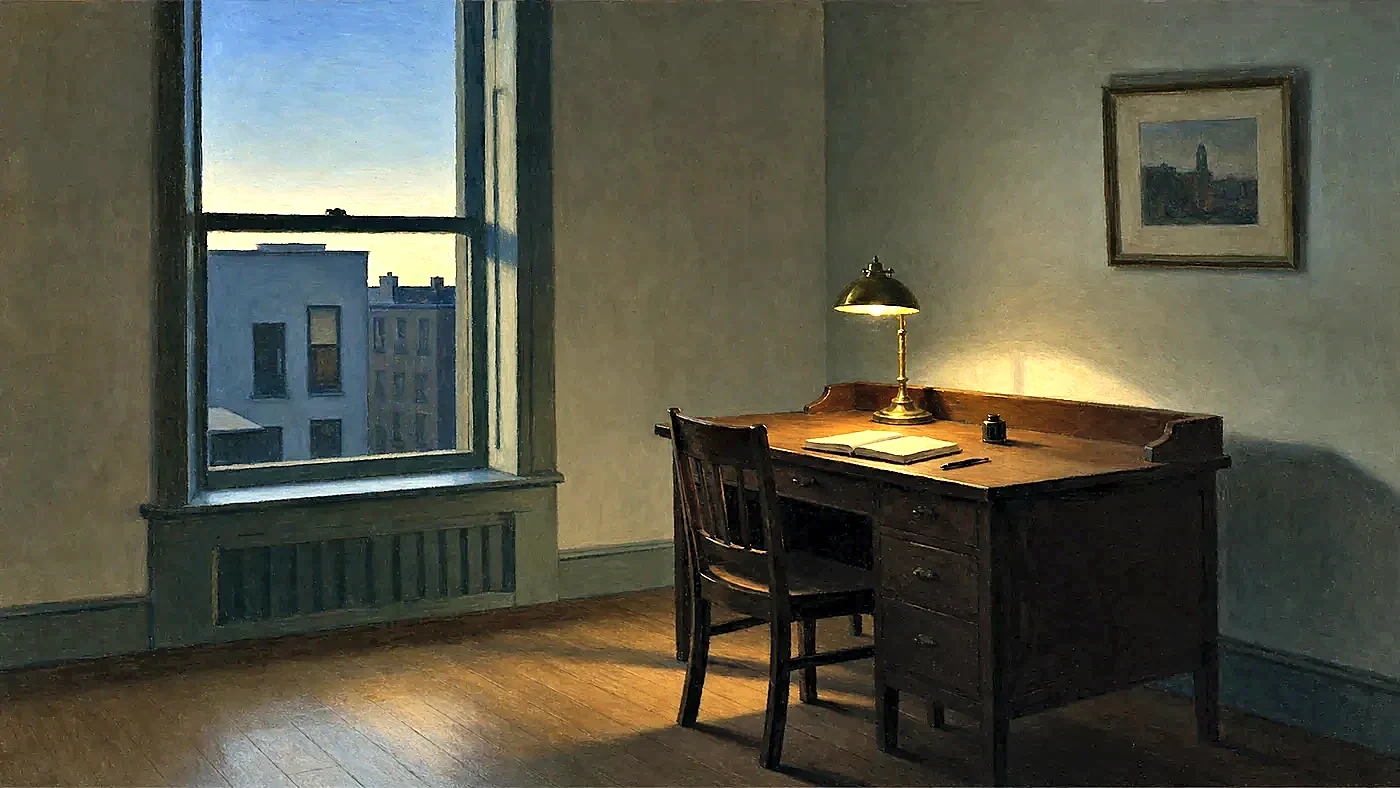
I believe a sentence should be revised until it knows more than its author knew when he began it, and that this is not a failure of planning but the only honest way a true sentence is ever made.
This is, I recognize, a philosophy built on faith in revision as much as on any single technique. I do not think the religious architecture in a story like “Assumptions” arrived because I sat down and planned a Marian allegory. I think it arrived because I kept returning to the same image—a woman anointed with oil on a beach, a housedress, a sea catching fire in the late light—until I could hear what the words had been saying all along.
I believe fire is not only punishment. In the right light, at the right hour, upon the right stretch of ordinary water, it can look like glory.
Imagination sustained me through the hard passages of my life, and I have come to regard the faculty itself as something held in trust rather than owned—a gift on loan from something larger than myself; call it the inner light, or the grace that moves through all things. To write, then, is to answer that gift with attention and with love. It is less self-expression than stewardship.
My working philosophy, distilled, is a single instruction: watch the shabby detail long enough to see what else it may contain.
IV. The Classroom
I did not arrive at a philosophy of writing by sitting down to invent one. It arrived the way most working philosophies do—backwards, out of a classroom, after years of watching what actually moved a roomful of unconvinced teenagers, and after years of noticing which of my own sentences held up under a second and third reading and which ones were only trying to impress me.
I tell my students, in whatever ways I can, that they contain multitudes, that nothing is at last sacred but the integrity of their own minds, and that the real business of life is to live in the present and find eternity in a moment. I borrow this, gladly and openly, from Whitman, Thoreau, Emerson, and Dickinson—patron saints, as I think of them, of American literature. I ask my students to explore the circumference of their own lives, to celebrate themselves, to write toward a sacred self they have not yet been given permission to notice. Most of them think I am out of my mind. A fair number of them tell me so. I have come to think the skepticism is not an obstacle to the method—it is the method working correctly. Nobody discovers they contain multitudes by being told so gently.
I believe every student who has ever informed me that a poem is stupid, that this isn’t math, or that they aren’t getting wet for nobody, already contains multitudes. Persuading them of it is the whole of the job. Thirty-five years in the classroom, and I have not once completed it in a single semester.
I believe teaching is not the transmission of information but the slow, unprovable work of convincing another person that their interior life is worth the labor of expression. Nothing in the profession is harder to measure, and I can think of nothing in it that matters more.
V. Comedy and Reverence
This is less a technique than a debt I owe my own upbringing: I do not believe moral seriousness and comedy are opposites, or that reverence and mockery cannot occupy the same sentence. My characters are cruel and devoted in the same breath because the people I grew up among were cruel and devoted in the same breath, and I have never trusted fiction that resolves that contradiction too neatly.
I have a name for the habit that lets a single word hold both at once: doubling. When the grandmother in “Assumptions” calls Peggy’s boots “God-awful,” she means ugly—but the word carries its older sense too, of inspiring awe, and the story wants both, because Peggy is both, and so is every one of us. The blinds pulled down in that dark kitchen are the window-blinds and our shared blindness in the same word. Even the title does it: an assumption is a thing taken up, and a thing taken for granted. And when the grandmother urges Peggy into the water with “For Christ’s sake, Peg! The point is to get wet,” the exasperation is at the same instant a literal invocation—the cure is sought for Christ’s sake in both senses.
VI. Writing as Communion

I have said before that teaching can feel like communion—that a roomful of unconvinced teenagers and one exhausted teacher, meeting honestly for fifty minutes, can take on something close to the seriousness of a sacrament. I have come to believe something similar may be true of writing itself, and I discovered it sentence by sentence, the way a person discovers most things they already half-believed.
A sentence, when it is working, is not a message sent from a writer who already knows something to a reader who does not. It is closer to a shared table. I sit down not entirely certain what I mean, and the sentence, if I am patient enough with it, tells me—the way a good conversation tells both people something neither of them arrived already knowing. That is the first communion: between the writer and the page, two parties neither of whom fully controls what gets said.
The second is between the writer and the subject—and here I mean subject in the oldest sense, the person or memory or ordinary object being written about. I cannot write about a grandmother anointing a bald scalp with tanning oil, or a mother’s calloused heel, or a housedress with roses on it, without in some sense sitting with that person again, at that table, in that weather. Writing does not preserve the dead so much as it reopens a chair for them. Every essay, every poem about a person now gone is, whether I announce it or not, an act of company kept past the point company should be possible.
My family members are my prayers. I wrote that once and meant it more literally than the sentence lets on. To write about a person with enough attention to get their gestures right—the exact word they used, the exact slant of light in the kitchen when they said it—is to hold them in mind the way a prayer holds its subject in mind: not to fix them, not to improve them, only to keep them present a little longer than memory alone would manage.
The third communion is the one I have the least control over and perhaps trust most: the one between the finished page and a reader I will likely never meet. A poem written out of one family’s grief may become, on a stranger’s late-night reading, a poem about their own. I do not think this is a failure of the poem’s specificity. It is one reason to write something down rather than simply feel it privately—an offer of company, extended blind, across however many years and rooms the page happens to travel through. A writer who finishes a book alone at a desk at midnight can only hope that a reader may later find something of use in it.
None of this requires the reader to share my faith, and very little of it announces itself as faith at all. It looks, on the page, like craft: revision, patience, the refusal to look away from an ordinary detail until it begins to disclose more of itself. Craft, practiced with patience, need not be separate from communion. It can be one way of approaching it. The sacred, if it appears at all, may emerge through attention to the shabby, the overlooked, and the nearly forgotten rather than through declaration alone.
This is why I no longer think of writing as expression, a word that suggests something already complete inside the writer, waiting only to be let out. I think of it as a place set at a table—for the subject, for the reader, for whichever version of myself will need this sentence back someday and will not remember writing it. Teaching was the pond I said I bathed in each morning. Writing may be the same current, though I seldom see who else is in the water with me.
VII. The Fire Under the Bridge

When I try to say what I believe about permanence, I do not begin with philosophy. I begin with a fire my brother Mark and I built under a bridge by the train tracks, on our way to a dance, while the snow came down outside. We had beer in gloved hands and a song we kept singing over again. Years later I put that night into a poem, and the line I trust most in it is the plainest one: your face orange from flames. That is what the fire did. It lit my brother’s face for a while, and then we stepped out into the snow, and it went out behind us.
The fire did not last. That is the first fact, and I do not want to hurry past it. The twigs we burned are nowhere now. The night is nowhere. The two young men at that fire are nowhere either, not as they were. Whatever I believe has to start by admitting that much, or it is not belief but a way of looking away.
And yet the poem has a second movement, and it is truer to my life than the first: Sometimes in the blackness of my room, / a fire blazes. I did not decide that it would. It comes back on its own, decades later, in a dark room the first fire never saw. It is not the same fire, and it is not exactly a different one. Heraclitus, who said that no one steps twice into the same river, also called the world an ever-living fire, kindling in measures and going out in measures. I do not read him as a scientist. I read him as a man who had sat a long time in front of a flame and noticed that it is not a thing that lasts but a change that keeps happening, and that going out is part of how it burns. I have found versions of the thought in other traditions, too, and I am glad of the company. I do not need them all to be saying the same thing.

That is as far as I can see by the light of one fire, and it is farther than I expected. What returns does not return unchanged. The fire in my bedroom is warmer than the one under the bridge, because I know now what I did not know then: that the night would end, and that I would want it back. Memory does not preserve the past. It takes the past up again and makes something new of it. This is what I mean, in the fiction, by repeated incarnations—not that the same thing happens twice, but that what is laid down is taken up, in another room, by another hand.
My own tradition has a story for this, and I have never been able to set it down. On a mountain, a teacher’s face shone like the sun and his ordinary clothes turned white, and he did not stop being a body. The Church calls it the Transfiguration. I do not offer it as proof of anything. I offer it as the clearest picture I know of what I hope is true: that matter need not be thrown away in order to become radiant, and that resurrection, if it comes, may be less a reversal of nature than nature at last showing what it was all along. I was raised in an Irish Catholic house where the dead were spoken of at the table as though they had only stepped into the next room. I have kept that habit. I have not been able to keep it without grief, and I no longer think I should.
VIII. The Spark
And so I return, as I always do, to the ordinary, which is where all of it lives.
I would like to say that nothing loved is ever lost. I cannot say it honestly. Things are lost: voices, kitchens, the exact weight of a hand on a shoulder. What I can say is smaller, and I find I believe it more. Loss is not the only thing that happens to what we love. Some of it is carried forward. Some of it comes back in another form, at another hour, the way that fire comes back in a dark room. I believe the dead are changed rather than simply absent, and I believe it the way one believes in a light one cannot quite see—in hope rather than certainty, and without asking anyone to believe it with me.
The name I have chosen for whatever carries it forward is one my first and best teachers would recognize: the Oversoul—that common heart of which all sincere conversation is the worship, and to which all right action is submission. It does not ask to be believed in the abstract. It asks only that we notice it, here, in the kitchen light at six in the morning, in the faces we pass and fail to see, in the small domestic liturgies we perform without knowing we are performing them. Attention is the whole of the discipline. The rest is mercy, which is only attention, carried toward another person, and held there a little longer.
I write, finally, to practice that attention—to watch a small thing until it discloses what it is actually for, and to leave no one written off. The mercy I manage to show a flawed character I made up is the mercy I have been trying, all my life, to learn how to show the living, the dead, and myself. I have not learned it yet. The trying is the work.
IX. The Narrow Doorway
I believe in the narrow doorway—that no one passes through it alone, that we are each helped along by another’s arm, and that this is not a lesser part of the journey but the point of it.
For we are all broken. Not one of us escapes the fracture; and any account of a human life that pretends otherwise has flattered us at the cost of telling us the truth. And yet the consolation is stranger and better than we expect. We are not made whole by being helped, but by helping. When we bend toward someone else’s brokenness, our own begins to mend; the healing goes out from us and comes back changed.
This is what I believe, and what I try to write toward: that love is the thread binding life to imagination, truth to searching, and each of us, in the end, to one another.
I believe a book, a poem, or a classroom is a place where a person may be told, perhaps for the first time, what the lover in the Song of Solomon tells the beloved, in the line that stands at the head of “Assumptions”: you are altogether beautiful, and there is no flaw in you. I know it is not literally true. It is not literally true of anyone; I have just said that we are all broken. The lover does not say it because he failed to see the flaws. He says it because he kept looking until he could see past them, which is the only kind of looking I have ever trusted. The sentence cannot be said cheaply. I believe it is worth an entire working life spent earning the right to say it, and I have not finished earning it.
What principles guide your own work?
Last revised October 2026.