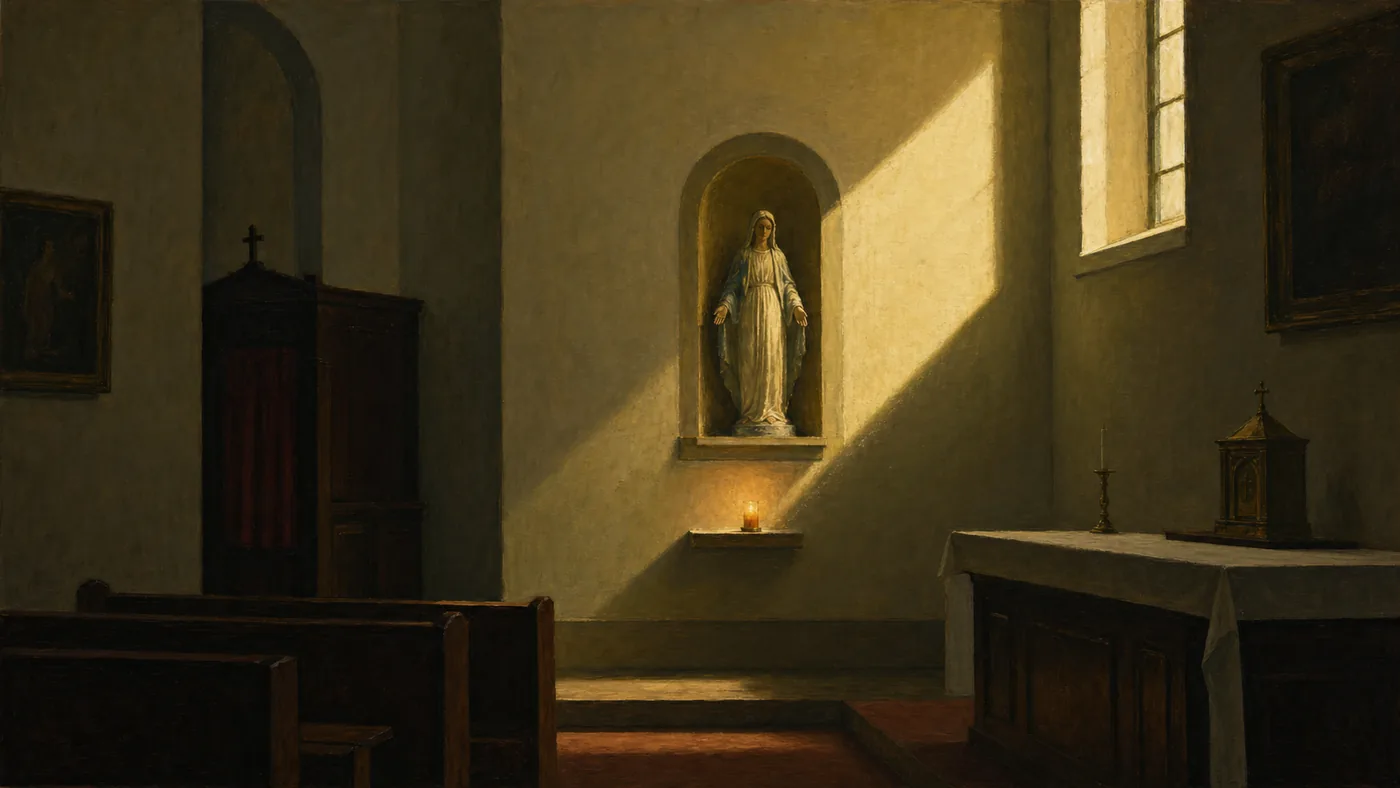
The title carries two meanings at once. “Assumptions” names the small cruelties of a family that has already decided, before the beach trip even starts, what Peg is worth — “the homeliest damn woman” in the family, good for a joke, not much else. But capitalized, in Catholic usage, an Assumption is a specific doctrine: the teaching, defined by Pope Pius XII in the 1950 apostolic constitution Munificentissimus Deus, that the Virgin Mary was taken up body and soul into heavenly glory at the close of her earthly life, spared the ordinary corruption of the grave. The story explores the tension between these senses of its title, asking whether the second sense — a body received into glory rather than left to decay — can be imagined in relation to a body that has already failed every test implied by the first.
The epigraph is the antiphon of the feast
The verse that opens the story is not chosen for its sweetness. In the Vulgate, Song of Solomon 4:7 reads Tota pulchra es, amica mea, et macula non est in te. From the fourth century onward that verse, with Mary’s name substituted for the beloved’s, has been sung as Tota pulchra es, Maria — one of the oldest Marian prayers in the Latin Church. In the older chant books it is assigned to two feasts. One of them is August 15: the Feast of the Assumption, which is the day on which the story takes place.
So the epigraph is not a poetic flourish laid over a summer outing. It is the proper chant of the liturgical day the plot occupies. And it supplies the story’s single most important word. Macula means stain. Immaculate means unstained.
Now read the first close description of Peggy’s body on the morning of that feast:
“Her housedress, which had a pattern of tiny roses, shrouded a pair of small black boots; there were red stains at the end of her sleeves from where she had spilled some juice.” — “Assumptions”
The epigraph promises a body without stain. The body arrives marked — in red, at the ends of the sleeves, which is to say at the wrists, which is where the nails go. The dress that carries the stains is patterned with roses, the flower of the Litany of Loreto and of the Passion. And the dress does not cover the boots; it shrouds them, three pages before the woman wearing it will need a shroud.
None of this is announced. The narrator supplies an innocuous explanation in the same clause — spilled juice — and moves on. One possible reading is that the story places sacred associations in the language of the shabby without having a character point them out.
The sacramental sequence disguised as a day at the beach
Once the pattern is visible, the Nantasket excursion reads as a sequence of sacraments performed by people who would be astonished to hear them called that. Tanning oil is rubbed into a bald scalp, forehead, and neck — and oil poured on the head is what makes a king, a priest, an anointed one; it is also what the woman with the alabaster jar did at Bethany, of which Christ said she had done it beforehand for his burial. Peggy dies within days. And the word the story chooses for her afterward — she “shone like a miniature sun” — is itself a pun: sun is also son. The woman anointed with oil is an anointed one, Christos, and the noun that names her shining quietly names her as the Son.
A gust lifts her wig; a child catches it and holds it up “like the head of John the Baptist”; the narrator smooths it and buries it in a paper bag with a stone he has found near the water. A head, a shroud, and a stone: an entombment, performed as play, on the morning of the feast. What is buried is the false hair. What comes out of the sea an hour later is the true head, anointed and shining. And the gesture is the title in miniature. The sentence is literally an assumption — “a gust had lifted Peg’s wig into the air” — part of her carried up into the sky on the morning of the feast, while the thing carried up is a comic prop to be chased and buried in a paper bag. Taken up and taken for granted in one motion: the story enacts both senses of its title before either is spoken.
A mourning dove starts from a cleft in the rocks, rises, and then descends over the water at the exact spot where two women are wading in. That is the Baptism of the Jordan, and the cleft in the rock is Song of Songs 2:14. A wave nobody asked for knocks both women flat and leaves them kneeling in the surf, laughing until they cry — a total immersion administered by force, arriving at the posture of prayer by accident. And when a boy reaches down and she takes his hand, the sentence reads: she rose from the sea.
Judgment’s imagery, reissued to mercy
One striking element of the story is not simply its use of religious imagery but its altered emphasis. Nothing abject is removed; the shabbiness stays, and the sacred language is laid over it rather than in place of it.
The reissue is visible in the very first picture the story gives of Peg, which is not a portrait but a child’s drawing: “Spindly, awkward limbs stuck out of a round body, like you might see in a kindergartner’s rendering of a person.” The figure is crude on purpose — a round torso with stick limbs, seen the way a boy sees — and the last paragraph repaints that same round, awkward body without correcting a line of its anatomy. The unskilled rendering is the true icon. Glory arrives without improving the drawing.
Even the grandmother’s smallest complaint is doubled. Knocked flat by the wave, she says her “permanent is all ruined” while she fusses with her hair — a hairdo, and also the word for the everlasting things this feast day is about. Peggy, bald beneath the wig, answers, “At least I don’t have to worry about that,” and they laugh harder. The woman with nothing perishable left to protect is the one free to receive the permanence the word half-names, and the story leaves the joke standing as a joke.
Two darker images run the other way, and the ending needs them to. Peg’s delirium tremens produces a counterfeit summons — she is “telling crazy stories about monkeys calling her up on the phone” — and in medieval iconography the monkey is the simia Dei, the ape of God, sender of false visions; in a story about being called home, this is the one phantom call. And the single explicit passage through cloud belongs not to an assumption but to a drowning. Remembering the schoolgirl who mocked her, pushed off a cliff by the wee people, Peg murmurs: “What must she have thought as she fell through that cloudy air?” The medium that bears Mary up in Titian — “a cradle of thunderhead gray” — carries a child down here, into Achill Sound. Neither image is cancelled. The rising at the end is an answer to them.
The word she uses about herself
The clearest evidence that the story knows exactly what it is doing sits in Peg’s own mouth, hours before the beach. Asked to hurry, she answers: “It will only take me a moment to get ready. I have to use the little girls room and put on my fancy wig and makeup so I can look divine for my Jim over there.”
Divine, in that sentence, is pure kitchen-table idiom — the word a woman uses about a wig and a lipstick. It carries no theology whatever. Now set it beside the story’s final sentence about the same woman: “Completely awake—laughing, altogether beautiful, and divine—she rises once again to sing her favorite song.” The last word the story grants her is the word she used about her own makeup. Nothing has been imported from outside; the vocabulary of glorification was already in her, used comically, and the ending simply declines to keep treating it as a joke. And the word is earned by sound before it is earned by sense: its long i is threaded through the paragraph in advance — “eyes,” then “divine,” then “shines,” then “child’s” — so that by the time “divine” arrives it is already the paragraph’s vowel, already heard, and the story’s single word beyond the epigraph’s “altogether beautiful” lands at the peak of the rising beat. The name does the same work. “My Jim over there” fuses the living boy with the dead husband who shares his name — “over there” is the other side — and the wave that “razed” the two women on the sand is the same word the Assumption uses for being raised up, so the knock-down and the lift-up are one motion.
The same holds for the doctrine. Peg is not a passive object of the story’s theology — she states its premise herself: “I believe miracles sometimes do happen, Helen.” And it is the grandmother, not the narrator, who supplies the liturgical calendar, “all the while explaining the importance of August 15th to Beth and me.” The framework never arrives as authorial commentary from above. It is what these women say in kitchens.
And the song she is given to sing is a bridal song. In the cellar, before the beach, Peg sings “When Your Old Wedding Ring Was New,” a Jimmy Roselli ballad in which an old couple looks back at the day they were married — the ring that is old now and was new then. It is a bridal song in the secular register, which is exactly the point: the epigraph of the story is the Bible’s bridal song, the Song of Solomon, and Peg is its Bride — she speaks the Bride’s idiom (“my love”), she wanders the night streets after her Beloved and is beaten by the watch. So when the story needs a song for her, it hands her the Canticle doubled by a ballad, the sacred and the shabby as the same song in two keys. She sings it “dreaming—longing for her husband Jim,” which is the Bride of the Canticle exactly: “I sought him whom my soul loveth.” And the final sentence returns her to it — “she rises once again to sing her favorite song” — so that the ballad she sang badly in a cellar becomes, in glory, the wedding song of the Apocalypse. The story also catalogues a second song it never lets her sing — “You Stepped Out of a Dream” — whose title is the plot in six words: the beloved who steps out of a dream into waking is exactly what the ending does to Peg, “dreaming—longing for her husband Jim” all story, then “Completely awake” at the close.
The evidence, and its limits
Four things hold this reading together, and it is worth being exact about how far each goes.
The doctrine is quoted rather than gestured at: the language of the 1950 constitution surfaces inside a short story, alongside Mark 15:33–34 and Song of Solomon 4:7. The images recur across three decades of work — the Feast of the Assumption, a seawater cure, a wet silvery scalp, a crown. And revision runs toward the sacred rather than away from it: a poem was changed from “At dawn, he was gone” to “When I wake, I find that he has gone,” a small alteration trading a flat report for the cadence of the empty tomb.
The pattern can also be absent, which is what makes it a finding rather than a lens. One story in The Weight of Small Mercies lacks the apparatus entirely — no ghost, no rite, no transfiguring image — and it is the bleakest thing in the corpus. The machinery is not applied everywhere; where it is withdrawn, the difference shows. It is also narrower than it can look. The story’s Marian repertoire is fixed — Assumption, Annunciation, Nativity, and an inverted Pietà — and it stages no Station, no Deposition, no Last Supper. Nor does every noun carry a second life: in the same two sentences that load the starfish and the stone, the “dark clumps of seaweed” and the “small crabs in the sand” are simply beach, and mean nothing at all. The doubling is a habit of this writing, not a law of it.
It is worth resisting the tidier version of the claim, too. There is no functioning priest in these books who does what a priest is for; the sacramental work is done by grandmothers, aunts, neighbours, and children. Characters who deny God outright still grieve in Catholic language. What the stories suggest is not a devotional program but people for whom Catholicism has become the available grammar for loss — used fluently, and often without belief.
Not catharsis. Conversion.
Catharsis purges; this work converts. The stain stays and becomes a wound. The drunkenness stays and becomes Pentecost. Even the visual grammar refuses the sentimental option: describing a painting of the Assumption, the narrator notes that “the cloud, which you’d expect to be a soft fleecy white, is a cradle of thunderhead gray.” That is the method in one clause — the expected softness named, then denied, and the glory delivered in a darker colour than the reader was promised. But the two words also do quieter work. Fleecy is the Lamb — the Agnus Dei, the sacrificial Lamb of God — so the cloud that bears Mary up is described as the Lamb that was slain. And cradle names the manger: the cloud that carries the Virgin is the cradle that held the infant Jesus. The two words together identify Peg with Christ at both ends of the Incarnation, the Child in the cradle and the Lamb on the Cross — and cradle returns in the last sentence, in the Father’s hands, where the dead woman is cradled as a child.
And the state the story grants her at the end is named with the same economy. To be “Completely awake” is not only to have risen from the dead; it is to be filled with the Spirit. At Pentecost the apostles were mistaken for drunkards — “these men are full of new wine” — which is the very accusation the story’s world levels at Peg. To be awake, in “Assumptions,” is to be awake to the realm of the divine: the boy who spots “flying Mary’s everywhere” is awake; the neighbours who shut their doors are asleep; the pagan god Lugh “tried to wake us all up” and failed, because the sleep he could not break is spiritual, not bodily. Peggy dies “in her sleep” — the Dormition — and wakes “Completely awake,” which is Easter and Pentecost at once: the sleep of death and the sleep of unbelief are the same sleep, and the last paragraph breaks both. And the wakefulness is a literary answer as well as a theological one. Joyce, the acknowledged master, ends “The Dead” with Gabriel’s soul swooning into the snow that falls “upon all the living and the dead”; “Assumptions” reverses that descent into a rise, its narrator pairing “the pang of grief” with “a sweet happiness” and leaving Peggy “Completely awake” — the anti-swoon, consciousness that stays awake through death rather than dissolving into it.
The grief works the same way. When the news of Peggy’s death arrives, the narrator reports: “I felt the pang of grief, but a sweet happiness, too.” Not consolation instead of grief, and not grief cancelling the sweetness — both held inside one sentence, which is the nearest thing to a thesis the story offers.
In 1950 a pope closed a document with the words we pronounce, declare, and define. The story closes: “Completely awake—laughing, altogether beautiful, and divine—she rises once again to sing her favorite song.” That formulation is spoken by a boy about a woman his family has treated unkindly all day. Tota pulchra es, said of the homeliest damn woman in the family.
That closing line is not a flourish left in a single draft. It appears word for word identical in every printing this story has had — the 2015 magazine publication, a 2020 reprint five years later, and the version collected in the book. Across three separate venues and five years, an author revising his own sentences elsewhere left this one exactly as written. The line the whole story is built to earn is the one line nobody, including its own author across three publications, has touched.
What makes that ending land is partly what the story never says. Set on the Feast of the Assumption, it withholds almost the entire vocabulary of the thing it performs. There is no altar, no amen, no rosary, no mercy, no sacrifice, no resurrection, no veil, no baptism, no canonization. Even grace and spirit never appear as nouns — the story allows only “gracious” and “spirited,” the adjectives, kept down at the level of manners and temperament. In their place stand folk substitutes and plain speech: “Mary’s blessing,” “a cure,” “miracles,” “Lovely Peggy,” and a repeated practical vocabulary of getting wet, helping, and rising. A story that stages a canonization refuses the nouns that would declare one.
The ordinary words carry the weight instead, and they arrive in the compromised sense first. Body is a judged physical body long before it is “body and soul.” Cure begins as a folk rite and slides into joints, bowels, and wet boots. Cross is mostly a verb for getting across a street or a threshold. Wine is never consecrated; it is a smell in a kitchen. White does five different jobs, and the first is a white lie — so that by the time clothing is “white as snow,” the reader is being asked to hold the harmless deception inside the exalted image rather than replace one with the other. That is the story’s actual method: not sacred language applied to a shabby life, but household language put under pressure until it will bear a sacred reading without ever announcing that it has.
One of those ordinary words does the most work of all. Cross is a verb of getting about — crossed the street, crossed the threshold — until the last paragraph, where the Father’s crossed arms are the Cross, and the word that has meant movement all day quietly names the instrument of death. The pun is not local. It is the same crossing that runs through the poems — the doorways, crosswalks, and thresholds of Crossings — so that the word that ends this story is the title of the collection, and every passage between the living and the dead is a crossing.
And the phrase the story lands on is not a private coinage. “White as snow” is Scripture’s own wording, and Scripture applies it to two things at once. In Isaiah it is the promise of forgiveness: “though your sins be as scarlet, they shall be as white as snow” (Isaiah 1:18), and in the psalmist’s confession the prayer for it: “wash me, and I shall be whiter than snow” (Psalm 51:7). In the Gospels and the Apocalypse it is the body of glory: the transfigured Christ’s raiment “exceeding white as snow” (Mark 9:3), the angel at the empty tomb in “raiment white as snow” (Matthew 28:3), and the risen Christ whose “head and his hairs were white like wool, as white as snow” (Revelation 1:14), and the Ancient of Days on the judgment throne, “whose garment was white as snow” (Daniel 7:9). The same three words name the soul made clean and the body received into glory. The woman who opened the morning with red stains at the ends of her sleeves closes it in clothing white as snow: Isaiah’s scarlet and the transfiguration’s white are one sentence, and the story lets them meet in her.
Download the Complete Study (PDF) The Religious Architecture →