
The claim that the sacred hides in ordinary things is true of James Mulhern’s work, but it is too loose to be useful. The working rule is more specific. A plain domestic action stays plain, and yet it may press against a second vocabulary drawn from scripture, liturgy, folk Catholicism, art, and song. A concordance of 2,025 catalogued passages traces those associations across the fiction and poems. There is no code here with one answer per object, just an ordinary world whose things can be noticed in more than one way. That pressure never turns a story into a disguised Mass, Rosary, Stations, or novena. Tested against “Assumptions,” none of those analogies governs the whole. Its memories leap across years, its dove, rising, doctrine, and crown arrive out of devotional order, and the adult’s learned explanations interrupt the child’s experience instead of ordering it. What endures is a local, cumulative pattern. Washing, anointing, carrying, covering, feeding, helping, and remembering are allowed to suggest sacred forms without losing their practical, awkward, or comic reality.
That is why a grandmother’s care matters more here than any claim that she is covertly administering a sacrament. Helen can be loving and cruel in the same exchange. Peggy receives help and also protects the children. A failed physical cure still yields laughter, touch, and a hand extended in the water. The work’s recurring question is not whether a domestic action can be certified as holy. It is whether dignity can survive when no one involved is fully worthy, competent, or kind. This essay follows that question through four settings: the places where communion is named without an altar, the objects the stories refuse to sanctify, the kitchen table where feeding becomes both grace and harm, and the crises at which liturgy fails to arrive. It then turns to the creed the author has stated outright, and to the seam that creed leaves open.
Communion Without an Altar
Communion is named most directly not in a story but in an essay about teaching. “This is communion,” Mulhern writes in “Teaching at Fifty-Six,” “and teaching will be the pond that I bathe in each morning, every new day.” The word appears in a classroom, not at an altar. The claim is not that the classroom replaces the sacrament. It is that sustained attention to another person’s mind can carry a communal and spiritual seriousness that institutional language does not exhaust. The sacred, on this account, does not wait for good conditions, and it does not remove the shabby conditions in which it appears.
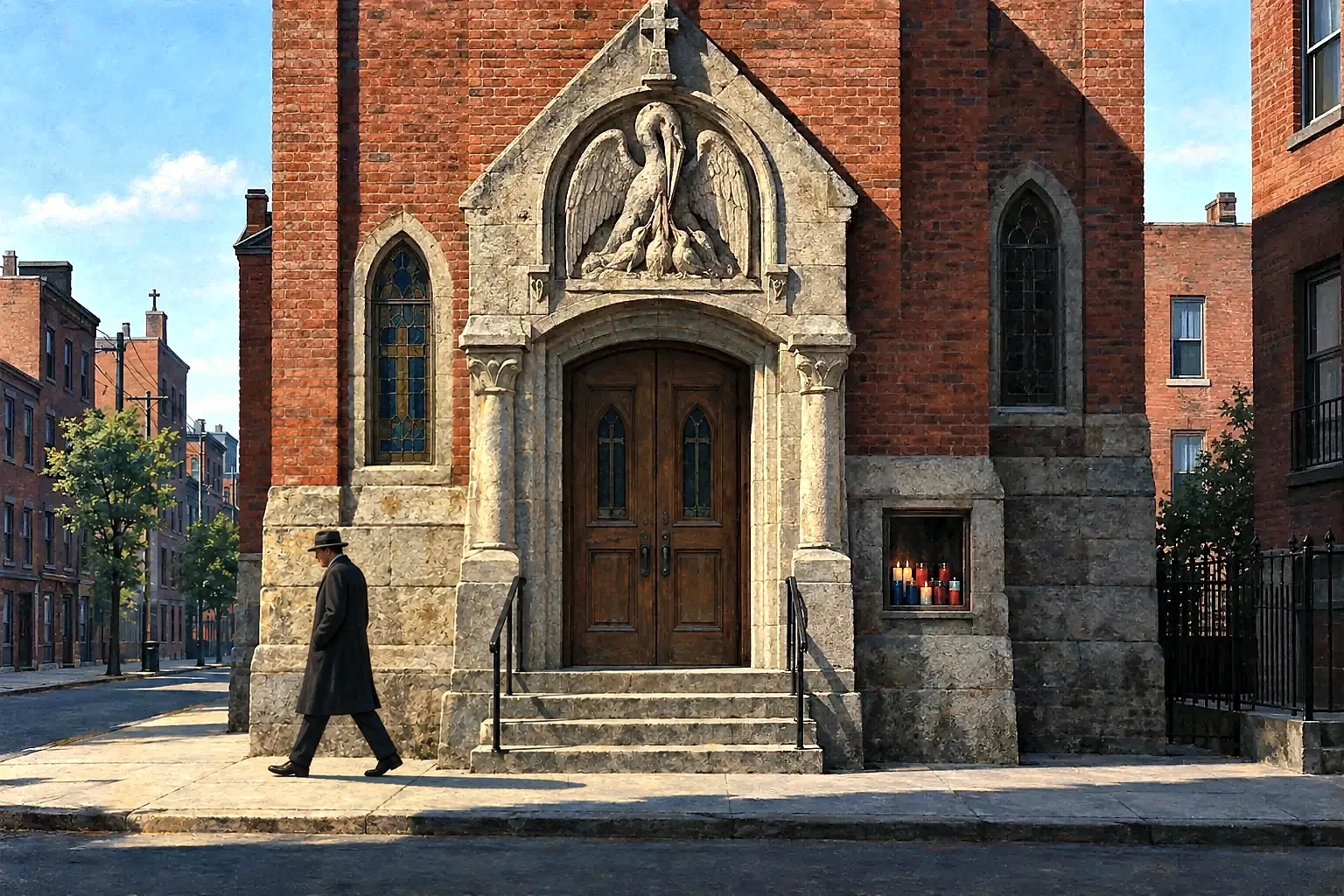
The dedication to Crossings states the inheritance in six lines about a woman:
Helen—Your crooked toes from shoespassed house to house,your rosary and Daily Missalthat sit on my desk,your accord with all that life brought,your devotion to God—
Poverty, devotional objects, temperament, and belief stand together, and the rosary and missal are kept not in a church but on a writer’s desk. Devotion is inherited as an object, kept where work happens, and honored by paying attention, whether or not anyone believes. The book’s introduction compresses the same practice into a chiasmus: “My family members are my prayers. My poems are my prayers. My family members are my poems.” A poem for the dead neither proves redemption nor substitutes for a rite. It continues attention where speech and ordinary repair have ended.
The collection that names this most plainly is also the most skeptical. In Useless Things the cross is dismissed as “A useless thing,” and the paradox that the useless is where the sacred hides is left open inside the fiction. It is resolved only in the back-cover copy: “the belief that tenderness, however rough its shape, is never useless.” The reader, not the narrator, must carry the recognition across the gap, and the gap was made by revision. The same story appeared earlier as “A Prayer for Home,” and there the narrator glossed it herself: “She had created her own Assumption,” and, near the close, “prayers for home, wherever we believed we were going, would never be answered.” Useless Things keeps the middle of that story nearly word for word and cuts both its opening and everything after the cross, so that the last words are “A useless thing.” The title moves from a petition that goes unanswered to a holy object that is refused, and the explanation the narrator once supplied is handed to the reader.
Naming is another of these lay sacraments. In The Weight of Small Mercies the grandmother gives her daughter her own mother’s name “to be respectful,” and then refuses it: “That was my mother’s name, her formal name. I’ve told you a thousand times to call her Laura.” A name is an inheritance that can curse or bless, a baptism she both performed and tried to undo. In the same collection a single star, “A star shone in the twilit sky,” appears at both tellings of the hospital release, joining the December star and the star inside a reproduced painting into one small, unremarked light at each moment of tenderness or rescue. That it is one star already encodes the title’s logic, in which small and singular things accumulate weight.
Who speaks this language is itself worth noting. Sacred speech is not evenly shared. It belongs largely to the old, and to women: a grandmother whose nightly intention is offered for the pope’s, an Italian grandmother who keeps the oaths and the Marian dialect while declining the belief. Younger characters use the vocabulary differently. One calls teaching a vocation, and another reads the Prologue of John closely while professing no faith at all. A New Age healer runs the same devotions as a sales pitch. The ministry itself is distributed the same way. In The Weight of Small Mercies, women and family members perform most of the continuing pastoral work: intercession, touch, washing, anointing, feeding, rescue, practical care, and protective silence. Ordained men are present. They bless, heal, read scripture, and lead acclamation. But their ceremonial acts do not carry the family’s daily burden of care, and no system of healing, clerical, medical, folk, or domestic, yields a final guarantee. Bathing, lifting, rubbing ointment into a heel, feeding, making a safe path, phoning, and asking another person to speak from the work’s actual care catalogue. None of them makes a lasting cure. Attention creates value. It does not reverse decline.
What Makes a Thing Useless
Catholicism is a religion of things. Medals, scapulars, holy water, ashes, relics under altar stones, and a rosary worn smooth at the decades all show a faith that has never been embarrassed by matter. A story collection with a Catholic substructure and a title like Useless Things therefore raises an obvious question. Which of its objects are holy, and how do they get that way? The stories’ answer is stricter, and stranger, than a reader might expect. Nothing in the collection is holy on its own account. Not one object.
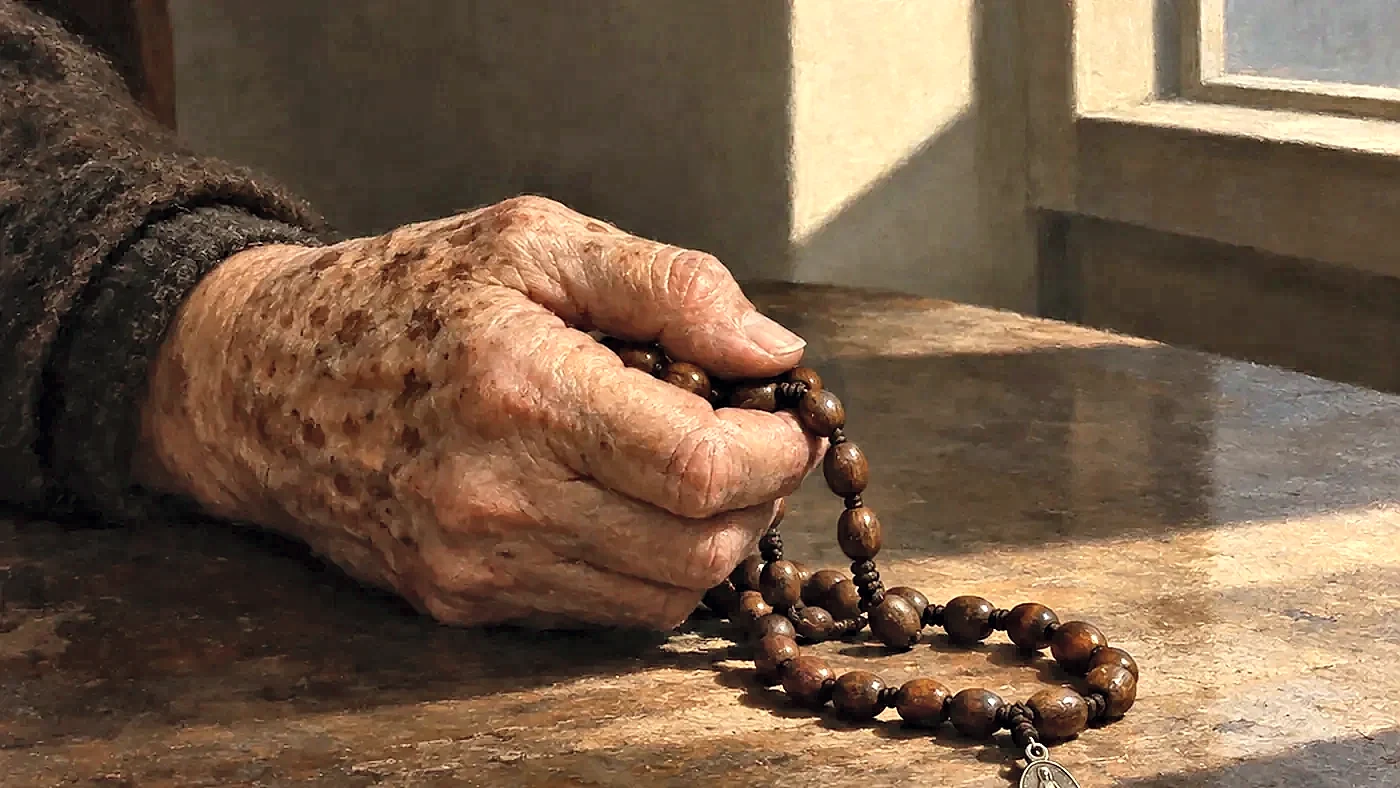
Consider the objects that matter most. A piano in a knotty pine basement makes grief audible, but it is a piano, and it does no work when nobody is playing it for anyone. A mint comes out of a handbag and consoles for exactly as long as a mint can console. What these share is not sanctity. It is relation. A photograph is hidden when someone comes into the room, and later a hand rests on the glass. The sentence that carries that hand is exact: “‘I was quite the looker. Not like now.’ She glanced at her obese body. I noticed age spots on her chubby fingers when she touched the glass.” Three bodies share the moment: the young woman in the image, the aging woman looking, and the hand between them. The relic is not the photograph. It is the touch. The glass is all that keeps the two selves apart, and the narrator notices the hand, not the picture. An object becomes charged at the point where somebody reaches for it.
Set against this is a shop whose window holds “a display of crystals and gemstones, silver and pewter jewelry, chalices, glass skulls, and crystal balls.” A chalice, the vessel of the Eucharist, is listed fourth, between the jewelry and the skulls, with no more emphasis than either. That flattening is the judgment. The sentence does not attack the shop. It declines to rank its contents, and in declining it shows that the shop has already declined to. Inside, a gift is pressed on a customer in the language of pastoral care: “It’s good for healing grief. Please take it.” Every devotional gesture is present in that room, and nobody is served by any of it. A relic carries a person’s presence. A fetish stands in for the person and lets you stop attending to them. The difference is never the object. It is whether anybody is on the other end of it.
One photograph is told twice, which is the clearest evidence that the object carries nothing until someone reaches for it. A prose story opens on a grandmother caught mid-visit: “My grandmother quickly hid her donut behind an old photograph.” A poem returns to the same afternoon and the same gesture: “When we arrived, you hid the donut behind the picture.” Nothing about the photograph changes between the tellings except the distance the writing keeps from it. The revisions bear this out. When Mulhern changes an ending, he moves it toward the object and away from the verdict. One elegy, printed in journals, ended on the survivor’s own consciousness, “When I wake, I find that he has gone.” The reading copy cuts that line for three short ones about a garment: “By dawn, he’d gone. / His robe, folded, / on the table by the door.” A second poem drops its stated conclusion, “Proof that we had closeness for a moment, / and that is enough,” and leaves only the picture beside the casket: “One moment, framed.” In both cases a sentence that told the reader what to feel is replaced by a thing the reader must look at. The folded cloth beside a doorway is also, without saying so, the detail on which the empty tomb turns in John 20: the body gone, the linen folded, absence read off a garment. The connection is in the structure, never quoted, and that matters. In this work the sacramental reading depends on what the writing ends on. It does not depend on anything the writing claims.
The same rule governs bodies, which the stories handle with more nerve than objects. A daughter reaches for her mother’s face: “I touched her face and smeared the colored powder. She winced. ‘I’m sorry, Mom.’” The gesture is tender and also an exposure. The cosmetic comes away, the bruise it was hiding does not, and the apology is for the touching, not the injury. Nothing is healed. The moment establishes only that the body under the powder is still owed the truth, and that telling it costs something. Elsewhere there are dentures in a street, urine, decomposition, and the ordinary indignity of being old and needing help. If the idea of the body as a temple is being tested, the result is qualified. The flesh in these stories is not inviolable, and it is repeatedly violated. What it never becomes is disposable. Degradation does not cancel a person’s claim on someone else’s attention, and that claim is the nearest thing to a doctrine the book has.
The care that answers the claim is unglamorous and always compromised, and the prose will not dress it up. When a corridor is littered with glass, the response is this: “All business, Ms. Jackson finds no humor in the situation. She squats down to pick up a big piece of glass.” The narration withholds every word that would make the act beautiful and lets her squat down anyway. The gesture has to be worth something without decoration, or it is worth nothing. Elsewhere a man puts the wipers on high and clears a windshield before he apologizes. Neither gesture cures anything. The gestures matter because they will not treat another body as rubbish, which in these stories is the whole of what a person can actually do. What keeps this from sentimentality is how much the collection declines to redeem. Spoiled cream is disposed of in one flat movement: “‘Mary, the cream’s gone bad.’ She poured it down the sink and ran hot water. ‘We’ll just have to have our coffee black.’” Meatloaf on a floor stays meatloaf. An empty pill bottle beside the pale rectangle where a photograph used to hang is residue, not revelation. Ornaments carried out of a house are stolen, whatever reverence goes with them. Almost nothing in this book is resurrected.
That is what makes the title honest. “Useless” is a transactional word, a verdict about function and resale. The stories keep setting that verdict beside another one and letting the reader watch them disagree. Worth here is not price, rarity, or religious packaging. It is relation, and relation is perishable. A piano makes grief audible while someone is listening. A mint helps for a minute. A carer protects an exposed body until she cannot.
The Kitchen Table

If relation is what charges an object, food is the relation the family uses most. The introduction to All We Ever Needed lists the collection’s ordinary acts of care, “a bath drawn for an aging parent, a ride to the beach, a call answered, a gift misunderstood,” gestures that “do not erase suffering” but “reveal the stubborn human wish to be known and cared for despite everything.”1 Food works through a sacramental analogy. Something prepared by one person is consumed by another and carries care, obligation, or intention. The test of the analogy is what happens when the intention changes.
The basic form is a grandmother feeding a grandchild. When Agnella sends Molly to college in “Mia Bambina,” she sends cookies with a note that mixes nutrition, threat, and blessing:
Here are some cookies for the sweetest cookie in my life. You must swear to eat them all yourself! . . . A curse on you if you don’t eat every last one of these cookies yourself. I want you to be fatter the next time I see you . . . Agnella loves mia bambina.2
The swing from endearment to curse and back shows that feeding a child is, for Agnella, an obligation with real stakes. The demand that Molly eat them “yourself,” excluding the roommate, marks the cookies as a private exchange.
The story’s horror is structural. It introduces no new, sinister object for the murder. It reuses the vessel of tenderness already established and adds an ingredient. When Molly wants to be rid of her roommate, she goes to the same grandmother and asks the same kind of family favor: “Getting the cyanide from Mr. Scarfone, a mobster friend of my grandmother’s, was easy. She was always saying she would do anything for her ‘precious granddaughter,’ so when I asked her to bake the special cookies, she said, ‘Sure, mia bambina. What’s one more ingredient? Not a problem.’”2 The horror is in the syntax. “What’s one more ingredient” treats poison as continuous with flour and sugar, one more thing added in the kitchen. Agnella is not persuaded to kill. She is asked to bake, and baking is what she has always done for this granddaughter. The close borrows the vocabulary of atonement outright: Agnella “would be happy to know that Ashley had died for her sins and that her cookies were a perfect hit.”2 A poisoning is recast as a liturgical justice administered through food.
“Peppermint Candy” performs the same operation in miniature. A teacher retaliating against a student prepares the weapon with almost priestly care: “I thought of the care I had taken to lightly rub Visine onto the candy before rewrapping it.”3 The rewrapping, which restores the candy’s innocent appearance, is part of the ritual’s completion. The last line returns the candy at once to its ordinary communal function: “I retrieved the peppermints from my desk drawer and placed them in my satchel. I would share them again another day.”3 The peppermint does not stop being a treat because it has also been a poison. It remains a small gift passed from an authority to a dependent, whatever has been added to it. “Assumptions” has already trained the reader to receive it as tenderness, two children “enjoying the deliciousness of peppermint candy, swinging our legs together,” which is why its later use does more than shock.
Most food exchanges in the work do not curdle, and the argument depends on that. The poisoned ones read as the same gift gone wrong. In “Assumptions,” Peggy Fleming passes the grieving boy a sugar cube “that she kept in her pocketbook in case her insulin dropped suddenly,” with reassurance about a lost dog: “We saved Scruffy’s life, sweetheart . . . Sometimes that’s the way it has to be, my love.”4 A diabetic woman’s emergency supply becomes a token of comfort. The boy is taught in turn to pour her whiskey sours, his grandmother supervising the dose (“Not too much, sweetheart”).4 Sugar, whiskey, peppermint, and poison move from hand to hand between generations, each transfer carrying both practical risk and emotional intention. Read across the work, food is the family’s native grammar: prepare, offer, insist, receive. Love, obligation, grief, and murder can all be spoken in it. The cookies and the peppermints do not overturn the pattern of care. They show that a family’s care and its capacity for harm can come from the same kitchen and the same familiar hands.
Where the Liturgy Does Not Arrive
The crisis scenes are the most telling evidence of all. When someone actually dies in these stories, the liturgy tends not to arrive. A collapse in a corridor gets CPR and panic, and one formal gesture that no character makes. The only two sentences in the story that begin with the word “Doors” bracket the death. “Doors opened up and down the hall” as the compressions begin, and “Doors shut all around” once the body is on the stretcher. Seven words, then four, with the same subject, opposite verbs, and nothing in between that acknowledges what has happened. That this is the versicle-and-response shape of an office is inference, not quotation, since the story names no rite. But the shape is there, and the building performs it because no one present will. In another story the rite is improvised from a pop song. A nurse tells a frightened bystander to keep time by singing, the crowd takes up the chant, “You can do it, Evy! You can do it, Evy!” and then “The tall black guy stepped forward and sang the lyrics. The crowd joined in.” The form is a responsory, cantor and congregation over a body, and the liturgical book is a disco single. A woman nobody liked is sung over anyway. At a quieter turning point, a song arrives as a car idles at a light: “The light changes to green. Bob Dylan sings,” just as a character works up to an apologetic phone call. Each time a secular song holds the place liturgy would occupy.
Whatever consolation is available comes afterward and in plainer form. The last story of Useless Things ends not with a prayer but with an apology answered by a woman who says she is also responsible, which in this collection’s terms is the more dependable article. Even plain consolation is not guaranteed to land. In “A Prayer for Home” the grandmother supplies the sentence and the embrace the scene calls for, and the narrator strips both of their office in a single clause: “I would like to say that I was comforted, but I wasn’t.” The lay sacrament is performed correctly and does not take. That refusal is the counterweight to the ascent of the title story, and it keeps the collection’s tenderness from becoming a mechanism.
Genre seems to govern where the devotional material appears more than length does. A comic-horror story of about two thousand words, opening on a teacher reading Poe aloud, “literally swarming with rats,” carries no religious material at all. A poem of two dozen short lines, “Brother Mike,” moves from Communion to adulthood in one gesture, a brother who offers no advice and simply “crossed yourself / in the dashboard light.” In the short forms, sacramental material appears readily in the elegiac mode and not at all in the comic one, which suggests the habit is tied more closely to grief than to doctrine. Revision does not always run toward restraint, either. The magazine ending of “Arise and Go Now” reports only that “people throughout the world were helping one another.” The collection has the world “saving one another” and adds a sentence the earlier text never had, “I realized that helping others is our most sacred obligation, the source of all hope and goodness,” before closing, “I felt peace.” The lay sacrament is named outright, and named as the highest duty. Readers may differ on whether the stated obligation deepens the ending or says aloud what the earlier text had trusted the reader to infer.
The supernatural receives the same restraint. In The Weight of Small Mercies the most frightening moment available, the possibility that a dead man is standing in the kitchen, is handed over in a hedged subordinate clause and the flattest diction the prose has: “She looked behind her for a second, as if someone might be there.” The lyric is spent instead on a boy in the back of a car: “I lay back and listened to the low sound of the car on the pavement.” That inversion is the method in one sentence. The supernatural is treated as furniture, and the cadence is reserved for the pavement. Give Them Unquiet Dreams extends the restraint across a novel, letting Catholic consolation and Irish folk belief coexist without collapsing them into one system, as the comprehensive study of that book shows.
The Creed Behind the Method

Criticism usually has to infer a writer’s philosophy from pattern. Here it does not. In “An Artistic Creed,” printed as a companion to the “Note from the Author” in The Collected Stories and Poems of James Mulhern, Mulhern names his lineage directly:
I write as a Transcendentalist—in sensibility and in spirit. I came to this not as a doctrine to be argued but as a way of seeing I could not put down. Emerson taught me to trust the inner light and to call the great current of things the Oversoul. Thoreau taught me to look long and closely at the near and the small until they open. Whitman taught me that a single life, honestly told, contains multitudes and belongs to everyone. I am in their debt, and I do not pretend otherwise.5
The creed then states, as considered belief, a position that would be heretical in a strictly doctrinal Catholic frame:
I believe the sacred is not far off but here—in a kitchen, a sickroom, a stretch of shoreline, the face of someone loved and lost. I believe the soul is not sealed within us but joined, through the Oversoul, to every other soul that has been or will be.5
That sentence is the theory of everything this essay has described. The sacred is in the kitchen because there is nowhere else for it to be. The companion note extends the theory to the work’s recurrences: “What looks like repetition is recurrence, and recurrence is how the spirit comes to know itself . . . This is resurrection—the same old truths rising again and again . . . And it is the Oversoul’s work as much as mine.”6
The fiction stages that tradition being taught, misheard, and half understood in an American public-school classroom, which is itself a Transcendentalist joke about Concord surviving its domestication into curriculum. In “Drenched to the Bone,” a Florida English teacher named Jack reads “Civil Disobedience” to a restless class and reaches for Emerson:
“Thoreau is talking about an individual’s conscience as being the most important aspect of who we are. You remember Emerson? ‘Nothing is at last sacred but the integrity of your own mind’ and his other quote, ‘What have I to do with the sacredness of traditions, if I live wholly from within?’”7
The students mishear nearly everything. One asks, “Isn’t he the guy that invented electricity?” Another turns Marx’s opium into the “oxycodone of the masses.” Yet the scene does not simply mock them. When black roofing dust begins falling from a vent, two students arrive on their own at a lay version of the lesson. “This school is like a prison,” Amelia says, and soon after, “This is a type of injustice. We should break a law or something . . . We should stage some kinda civil obedience . . . Make a big statement.” The malapropism is allowed to stand, a small Emersonian joke about trusting one’s own garbled formulation over the received one.7 The scene’s last adversary is Mary Grace, a devout student who denounces Thoreau: “You can read all you want but it won’t make you a better person. You need to act in the world, not retire from it like Thoreau. Helping others is what God wants us to do.”7 Her objection lands with force because the story does not resolve it. Her later breakdown neither vindicates nor refutes it, and the tension stays where the collected volume’s introduction places the author’s whole outlook, with faith and Transcendentalist self-trust “held in the same hand, neither one permitted to win outright.”8
Whitman’s part of the creed, the single life that “belongs to everyone,” appears in vernacular dress. In “A Bath,” a working-class Irish grandmother who has never, as far as the text records, read Emerson or Whitman confesses that her own husband hit her and tells her daughter:
“You’re not that horrible word, Gracie. You’re opinionated and strong. I wish I could have been more like you when I was a young woman. I followed the mold. Too afraid to do what I really wanted . . . To be a competitive swimmer. But we were poor, and poor women had little chance of pursuing such a dream.”9
She recognizes that her daughter’s strength may fulfill a thwarted part of her own life. The daughter is part of the multitude she contains, the joined soul of the creed put into a language of whiskey and stepladders. The most direct Whitman allusion closes “The Wrong Way.” After the shovels are leaned against the house, the narrator notices “the beating of my heart and the passing of air into my lungs,” then watches “the smoke of my breath” rise and dissolve “like eddies in a careless sky.”10 The phrasing reworks the second section of “Song of Myself,” with its “smoke of my own breath” and “the beating of my heart, the passing of blood and air through my lungs,” and the poem’s closing “I effuse my flesh in eddies.”11 The borrowing is revisionary. Whitman makes bodily dissolution an ecstatic merging with the world. Mulhern reduces that confidence to a winter breath visible for an instant. The narrator does not become air. He watches the evidence of his breath disappear into it, acknowledging the debt in the act of declining its consolation.
The Seam: Oversoul and Sacrament
The creed raises a question it does not answer. Is an Emersonian Oversoul, which joins each soul to “every other soul that has been or will be,” compatible with the Catholic sacramental theology (confession, communion, the Assumption) that shapes the same body of work? Mulhern’s own formulation suggests he sees no contradiction: “In art, as in faith, what is laid down is taken up—and it becomes life eternal.”6 The sentence borrows the movement of the offertory and the elevation to describe an Emersonian process of recurrence. But the seam shows in the fiction, even where the creed smooths it over. Emerson’s is a philosophy of the sovereign individual conscience, distrustful of “the sacredness of traditions.”7 The Catholicism of Mulhern’s Irish and Italian grandmothers is a religion of inherited institution almost by definition, its authority residing in tradition’s unbroken transmission. The unlicensed confessors of the stories, grandmothers who hear confession with no priestly warrant, can be read as one response to the seam: a Catholic form filled with Transcendentalist content, an institutional sacrament performed by an individual, uncredentialed conscience. The Boston and Philadelphia interiors become sites of negotiation between two American religious inheritances that rarely speak to each other, the immigrant Church and the native dissent of Concord, and the characters conduct the negotiation without naming it.
The Marian material gives the seam a language. It does not close it. The Visitation, the feast on which Molly’s mother is born, is the occasion of the Magnificat, whose logic is reversal: “He has cast down the mighty from their thrones, and has lifted up the lowly” (Luke 1:52).12 That is also the shape of Molly Bonamici’s vertical axis. Agnella dies watching “two planes . . . one ascending, one descending, a metaphor for life,” falling “through her universe of lies to the descent of her end,” and the orphaned granddaughter rises out of the sea unaided at the close. Read through the Magnificat, the axis stops being geometry and becomes justice. Then, characteristically, the novel withholds the verdict justice would require. Molly feels “great peace” at a deathbed she does nothing to change, and the book ends not on judgment but on a disposition, “Believing in possibility.” The sacramental calendar supplies the pattern of casting down and lifting up. The Emersonian temperament declines to say which of us is which. Whether that is a synthesis or an open seam is a question the fiction prefers to keep open.
A Modest Spirituality
The work acts on its reader the way its characters act on one another, and that is where its moral force lives. Each story first invites a verdict and then withdraws it. A grandson asks the question the reader has been silently forming: “If you knew my grandmother was lying, why did you let it happen?” A fraud is stated flatly as technique: “Make people feel bad so we can get what we want.” A ghost pronounces the judgment the plot has earned, “Tis an awful thing to do,” and the story still will not let the sentence stand. Even the one unambiguous wrong, a father abandoning his son, is softened by the boy’s own mercy: “You don’t hate me, Aiden. You’re angry,” and by the boy’s decision to shield his mother from the news. The reader is never allowed to condemn without complication. Every verdict is forced back through need, touch, grief, or rescue until it comes out ambivalent. That is the work’s real theology, and it happens to the reader; no character states it.
It is a modest spirituality, and deliberately so: lay, bodily, and temporary. Attention without guarantee. The sacred turns up among shabby things, in a mint, a squat to pick up glass, a cookie, a folded robe, a song sung over a woman nobody liked, and the narrator never once points at it. On the evidence of these stories, it is the only kind of spirituality that survives contact with an actual life.
Notes
- 1. James Mulhern, “Introduction,” in All We Ever Needed (Silver Current Press, 2026). ↩
- 2. James Mulhern, “Mia Bambina,” in All We Ever Needed (Silver Current Press, 2026). ↩ ↩ ↩
- 3. James Mulhern, “Peppermint Candy,” in All We Ever Needed (Silver Current Press, 2026). ↩ ↩
- 4. James Mulhern, “Assumptions,” in All We Ever Needed (Silver Current Press, 2026). ↩ ↩
- 5. James Mulhern, “An Artistic Creed,” in The Collected Stories and Poems of James Mulhern (Silver Current Press, forthcoming). ↩ ↩
- 6. James Mulhern, “A Note from the Author,” in The Collected Stories and Poems of James Mulhern (Silver Current Press, forthcoming). ↩ ↩
- 7. James Mulhern, “Drenched to the Bone,” in The Collected Stories and Poems of James Mulhern (Silver Current Press, forthcoming). ↩ ↩ ↩ ↩
- 8. Introduction, The Collected Stories and Poems of James Mulhern (Silver Current Press, forthcoming). ↩
- 9. James Mulhern, “A Bath,” in The Collected Stories and Poems of James Mulhern (Silver Current Press, forthcoming). ↩
- 10. James Mulhern, “The Wrong Way,” in The Collected Stories and Poems of James Mulhern (Silver Current Press, forthcoming). ↩
- 11. Walt Whitman, “Song of Myself,” sections 2 and 52, in Leaves of Grass (1891–92). ↩
- 12. Luke 1:46–55; on the Visitation and the Magnificat see Vatican News, “Feast of the Visitation of the Blessed Virgin Mary,” vaticannews.va. ↩
Works Quoted
Quotations are drawn from “An Artistic Creed,” “A Note from the Author,” the Introduction, “Drenched to the Bone,” “A Bath,” and “The Wrong Way,” all collected in The Collected Stories and Poems of James Mulhern (Silver Current Press, forthcoming). Passages from Molly Bonamici (Silver Current Press) are quoted from the novel’s published interior. Whitman is quoted from “Song of Myself” in the 1891–92 edition of Leaves of Grass.
Further quotations are drawn from “Teaching at Fifty-Six” (on this site); from the dedication and introduction of Crossings; from Useless Things and Other Stories, All We Ever Needed (Silver Current Press, 2026), and The Weight of Small Mercies (Silver Current Press); and from Luke 1:46–55.
Related essays on this site: “Credo” gathers the author’s own statements of belief; “What Is Laid Down Is Taken Up” treats recurrence as resurrection; “Teaching as Vocation and Trap” reads “Drenched to the Bone” as a classroom story.