An Essay · On the Governing Method
The Confessor Archetype and the Ethics of Listening
In the Fiction of James Mulhern — on grandmothers, children, and ghosts who hear what cannot otherwise be said, and hold no institutional warrant for doing so.
Listen while you read
J. S. Bach, Goldberg Variations, Variatio 10, Fughetta. Kimiko Ishizaka, piano. Public-domain recording, Internet Archive.
I. The Sacrament Without the Sacrament
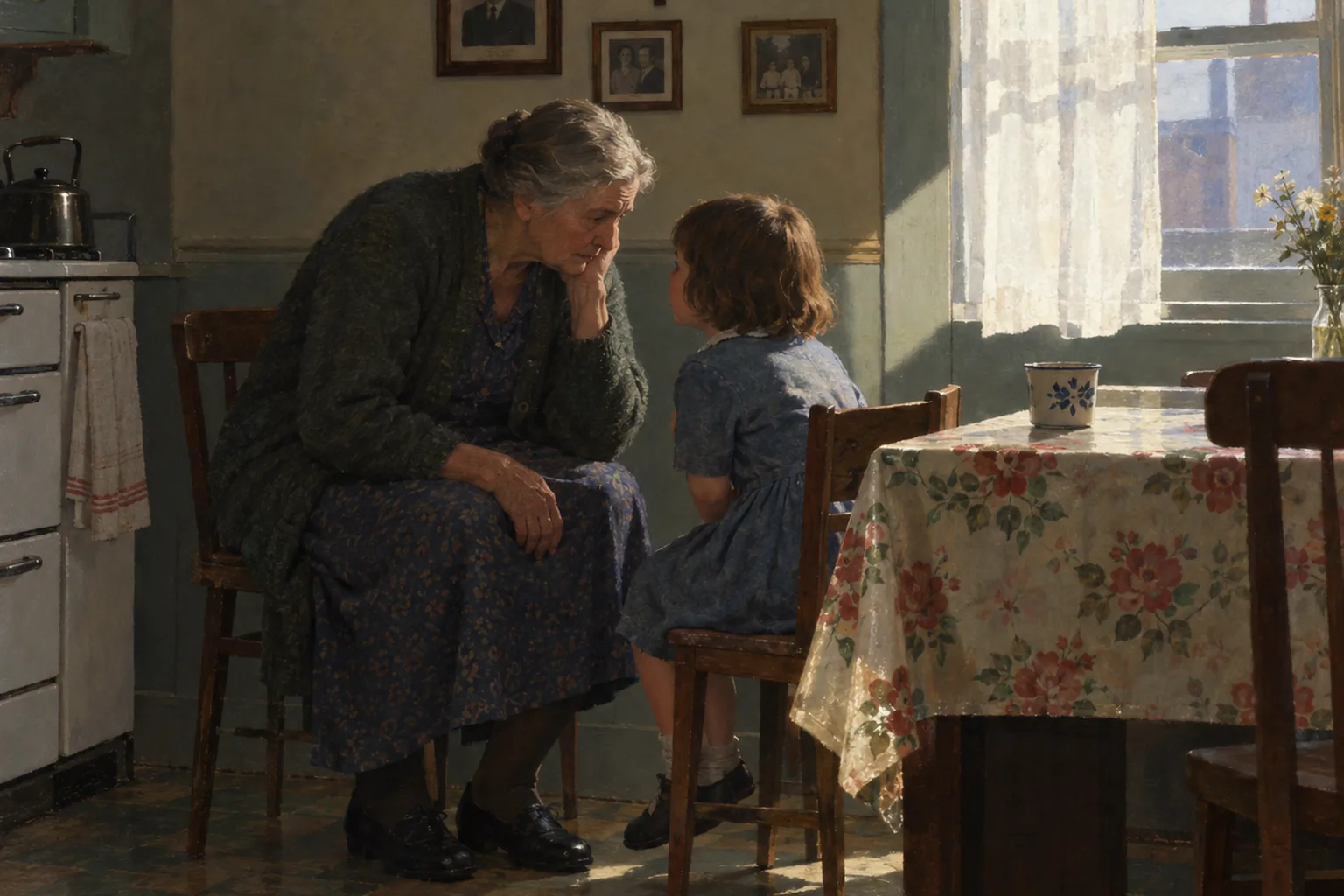
Catholic fiction has a long tradition of confessional scenes that take place nowhere near a confessional box. James Mulhern’s short stories and his novel Give Them Unquiet Dreams are populated by figures who perform the priest’s oldest function — hearing what cannot otherwise be said, and deciding what to do with it — while standing at kitchen sinks, sitting in recliners with a cat on their lap, or scraping saltwater vegetation from a boulder in County Mayo. This essay argues that Mulhern’s fiction returns obsessively to a specific structure: an unauthorized confessor, usually a grandmother or grandmother-adjacent woman, who extracts a confidence from a child or a wounded adult, and who must then choose between absolution, indictment, and silence. Unlike an ordained priest, these women hold no institutional warrant for the power they exercise — which is precisely what makes their exercise of it a subject worth reading closely. The essay examines three scenes in particular: the bath-time confession in “A Bath,” the confidences shared with Peggy Fleming in “Assumptions,” and the Public Garden confession-by-proxy in Give Them Unquiet Dreams, in which one dead woman’s guilt is absolved by a living woman decades after the fact.
II. “Promise Me You’ll Never Lie to Your Grandmother Again”: A Bath as Confessional Structure
“A Bath” stages its confession with an almost liturgical rigor. Sixteen-year-old Billy and his mother Grace arrive at Nana’s apartment to help her bathe; Grace has hidden a beating from an abusive boyfriend behind a cover story — “I fell off a stepladder when I was hanging a curtain” — and has extracted a promise from her son to corroborate it: “Promise me you’ll stick to the story.” “I promise,” Billy says.1 The scene thus opens with a false confession already rehearsed, a script Billy has agreed to perform for Nana. What follows is Nana’s dismantling of that script through an interrogation that borrows directly from the sacrament of penance: she demands to see what has been concealed (“I want to see. I’m your mother”), she examines the wound with her hands (“She gently placed her palms on my mother’s face and scanned closely”), and she presses for the true account beneath the story offered (“This is the second fall you’ve had in three months. I don’t understand it, Gracie”).1
The confession, when it finally comes, is not extracted by Nana alone — it is offered because Nana has first confessed something herself, admitting under her daughter’s direct question that her own husband “hit” her “a few times. When he was drunk.”1 Mulhern constructs the scene as reciprocal rather than hierarchical: Nana’s admission of her own history of abuse is what licenses Grace’s admission of hers. This is a significant departure from the sacramental model it otherwise resembles. In the Catholic confessional, the priest’s authority to absolve depends on his freedom from the penitent’s specific sin; Mulhern’s grandmother instead earns the confession by revealing that she shares the sin’s inheritance. The absolution that follows — “Forget about that bastard O’Toole. I didn’t like him… He’s out of your life, I hope?”1 — reads less like priestly pardon than like matrilineal complicity, women closing ranks around a shared history of violence that the men in the family will never be made to answer for.
Billy’s own confession is folded into the scene almost as an afterthought, and it is worth noting how casually Nana handles it: “So you lied about the curtains?” “Yes.” “Promise me you’ll never lie to your grandmother again.” “I promise.”1 The symmetry is exact — Billy has now made and broken and remade the same kind of promise twice within a few pages, once to his mother and once to his grandmother, and the story does nothing to suggest that either promise carries binding weight. Mulhern is quietly building an argument here about what a “secret” actually is in this family system: not information that stays hidden, but information that is passed hand to hand under the condition that it stay verbally denied. The final line of the story — “For a few moments, the three of us had all we ever needed”1 — retroactively frames the entire confessional apparatus of the story as a mode of intimacy rather than a mode of truth-telling. What the family needs, Mulhern suggests, is not disclosure but the ritual occasion for disclosure; the content of the confession matters less than the fact that it was heard by someone who did not flinch.
III. Peggy Fleming as Confessor-in-Reverse
“Assumptions” complicates the archetype by making the child, rather than the elder, the nominal confessor. Peggy Fleming, alcoholic, diabetic, widowed, treats the young narrator, Jimmy, as her confidant across a series of scenes that mimic confession’s intimacy without any of its institutional gravity. She tells him about a girl who mocked her in childhood, embeds a violent fantasy inside the story (“I think that’s who pushed Margaret Mary Fawny off the cliff… What must she have thought as she fell through that cloudy air?”), and then immediately retracts the confession’s truth-value: “I’m just codding ya, Jimmy, just an old story is all. A fib, my love.”2 The retraction is itself a kind of absolution granted backward in time — Peg confesses to a cruelty, then un-confesses it, leaving the boy (and the reader) unable to determine which version, the vindictive fantasy or its disavowal, constitutes her real feeling.
What makes Peg a confessor rather than merely a confider is that Jimmy is explicitly placed in the position of judge and comforter: “You’re not ugly,” he tells her, unprompted, after her insistence that she is.2 The child absolves the adult of the very shame she has just confessed, and Peg receives this absolution with visible relief, “You’re a charmer, you are.”2 The story never lets us forget that Jimmy is also the one entrusted to pour her whiskey sours and to keep his grandmother’s “not too much, sweetheart” a working fiction between them.2 He is confessor, bartender, and eventually eulogist — the story ends by Jimmy imagining Peg’s soul rising “altogether beautiful,” an explicit echo of the Song of Solomon epigraph that opens the story: “You are altogether beautiful, my love; there is no flaw in you.”2 The child’s final act of listening is thus retroactively canonized: the confessor’s judgment on the confessant, delivered posthumously, is unconditional acquittal.
IV. Rita, Catherine, and Absolution Deferred Across a Generation
Give Them Unquiet Dreams stages its most explicit confessional scene in the Public Garden, when Rita — the woman who had an affair with Aiden’s grandfather — finally meets Aiden to learn what his dying grandmother, Catherine, wanted to tell her. The scene is saturated with confessional apparatus even before any confession occurs: Rita has avoided this meeting for months, “she had an excuse — lunch with friends, an art class, a meeting of her book club, a lecture,”3 the classic penitent’s procrastination. When she finally asks what message Catherine left, and hears it is only gratitude — “She wanted to thank you for listening when she talked about her mother” — Rita weeps, and delivers her own confession unprompted: “My relationship with your grandfather was wrong. I betrayed a friend and I will live with that for the rest of my life.”3
Aiden’s response — “She forgave you, Rita” — is a twelve-year-old boy pronouncing absolution on behalf of a dead woman, a transfer of sacramental authority that the text does not treat as strange. It is instead consistent with everything the novel has established about Aiden’s role in the family: he is the one soul permitted to move between the visible world and the dead, and this scene simply extends his second sight into the register of moral accounting. What Rita cannot receive, however, is peace: “I know she did, but I could never erase her pain.”3 Mulhern is careful here to distinguish between forgiveness granted and guilt discharged — the two do not track together, and Rita’s confession changes nothing about how she carries it. This is underlined a few pages later when Rita explains that Catherine herself could never accept the very same distinction: “She confessed her feelings to me and repented many times. I told her she was absolved. But it was fruitless. She would tell me the story again and again, always seeking absolution and forgiveness.”3 The chain of confessors in this scene — Catherine confessing to Rita, Rita now confessing to Aiden, Aiden pronouncing forgiveness on Catherine’s behalf — forms a closed loop with no exit. Guilt in Mulhern’s fictional world is not dissolved by confession; it is merely relayed to the next available listener, a structure the grandfather’s ghost names outright a few chapters earlier when he tells Aiden, “we all carry needless feelings inside, and they can hurt us to the core.”3
V. The Ethics of an Unlicensed Sacrament
Read together, these three scenes suggest that Mulhern is less interested in whether confession “works” — whether it produces genuine absolution — than in who is granted the authority to hear it, and what that authority costs the listener. None of his confessors are priests. Nana in “A Bath” absolves her daughter only after implicating herself; Jimmy in “Assumptions” absolves an adult he is too young to actually judge; Aiden in Give Them Unquiet Dreams absolves on behalf of the dead, a proxy sacrament that leaves the living penitent, Rita, no less burdened than before. In each case the listener bears something away from the exchange — Billy inherits a family script of denial; Jimmy inherits the first “throb of death’s glower” that enters his consciousness while listening to Peg sing of her dead husband;2 Aiden inherits knowledge of a guilt that predates his birth and will outlive his ability to resolve it.
Mulhern’s fiction thus proposes an ethics of listening that has almost nothing to do with the ecclesiastical machinery it borrows its form from. To be a confessor in this body of work is not to hold power over sin but to accept custody of another person’s unresolved feeling — custody that is never returned, only passed on. It is a domestic, matrilineal, largely female inheritance, distinct from and often working in the shadow of a Church that Mulhern’s families still nominally practice but do not fully trust to do this particular work. The recurring image across all three scenes is of a private ritual performed in defiance of, or indifference to, the sacrament it resembles: a bathtub instead of a confessional box, a basement piano instead of an altar, a park bench under a weeping willow instead of a rectory. Grace is found not through the Church’s authorized channel but through the improvised confessional booths of kitchens, cellars, and public gardens — spaces Mulhern’s characters build for themselves because the official one has, for reasons the fiction never fully states, become unavailable to them.
— Silver Current Press
Notes
- 1. James Mulhern, “A Bath,” in The Collected Stories and Poems of James Mulhern (Silver Current Press, forthcoming). ↩
- 2. James Mulhern, “Assumptions,” in Assumptions and Other Stories / The Collected Stories and Poems of James Mulhern (Silver Current Press, forthcoming). ↩
- 3. James Mulhern, Give Them Unquiet Dreams (Silver Current Press, 2019). ↩
Works Quoted
Quotations are drawn from “A Bath” and “Assumptions,” both collected in The Collected Stories and Poems of James Mulhern (Silver Current Press, forthcoming), and from Give Them Unquiet Dreams (Silver Current Press, 2019).
Related essays on this site: Altogether Beautiful reads “Assumptions” against the Assumption of Mary; Communion in the Work follows the related sacrament of communion across the fiction and poems; Revision as Theology traces “A Bath” back to its origins in a Mulhern poem; and Domestic Violence and Silence gives “A Bath” a fuller reading against the family elegy tradition.
Every passage quoted here has been checked verbatim against its published source. Where the connection is inference rather than direct quotation, that is said plainly rather than implied.