An Essay · On Genre and Tone
The Comic-Grotesque Tradition
Mulhern, O’Connor, and Synge — on the tonal hairpin turn from comedy to violence, and what it costs a reader to laugh at the wrong moment.
Listen while you read
J. S. Bach, The Well-Tempered Clavier, Book I: Fugue No. 2 in C minor, BWV 847. Kimiko Ishizaka, piano. Public-domain recording, Internet Archive.
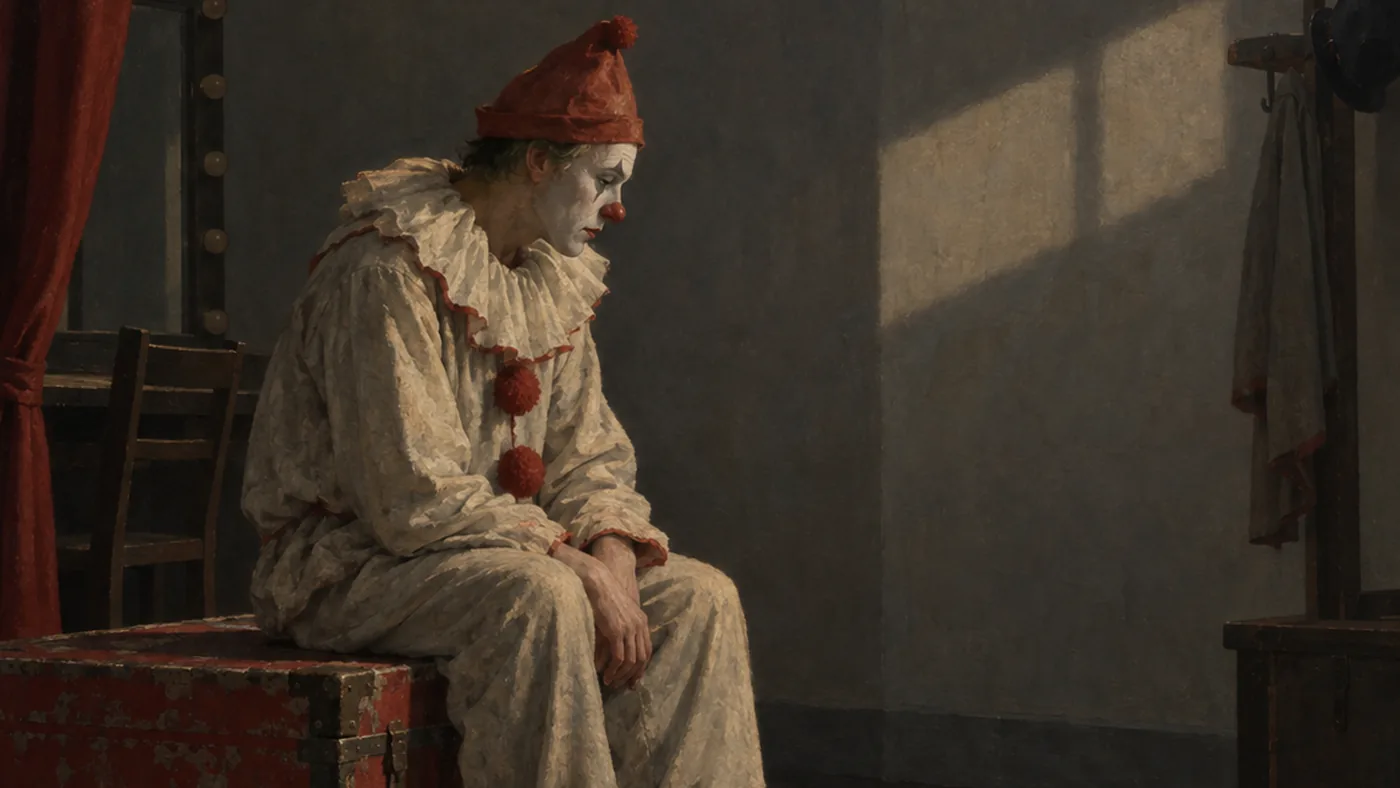
I. A Genre Without a Warning Label
The comic grotesque names a specific and uncomfortable reading experience: material that is legibly, even broadly, funny — a pratfall, a malapropism, a scene of farce — abruptly reveals itself to be describing cruelty, death, or degradation, and the text declines to tell the reader which register was the real one. Flannery O’Connor built a career on this refusal. The grandmother in “A Good Man Is Hard to Find” delivers her fussy, faintly ridiculous complaints about Georgia geography and her cat right up until the moment the Misfit’s men walk her family into the woods; O’Connor never rings a bell to announce the shift.1 J. M. Synge’s The Playboy of the Western World performs the same maneuver from the opposite direction: a young man’s claim to have murdered his father is initially received by an entire Mayo village as delightful, admirable news — comedy built directly on top of a corpse that may or may not exist.2 Both writers understood that the grotesque is not simply comedy with dark subject matter; it is comedy that refuses to signal, through authorial tone, that darkness has arrived. The reader supplies the horror herself, usually a beat too late, and the guilty half-second of continued laughter is the point.
Mulhern’s work draws on elements of this tradition: its comic-grotesque moments recall O’Connor’s American Gothic and, in dialect and communal complicity, Synge’s Irish black comedy. The introduction to The Collected Stories and Poems of James Mulhern (forthcoming) observes that the volume’s Italian-American section looks “to Flannery O’Connor’s sense that grace arrives, when it arrives at all, dressed as violence or humiliation,” and that in these stories “comedy and menace share a kitchen table.”3 This essay takes that observation as a starting point and asks how, mechanically, the turn is built — what specific sentences do the work of switching registers, and what the reader is left holding once the switch has occurred.
II. The Faith Healer’s Parlor: Farce as Camouflage
“Useless Things” stages its comic-grotesque turn inside a single scene: Agnella, Mrs. Muldoon, and the narrator Molly visit a Boston storefront faith healer named Lady Jane. The scene is, for most of its length, pure farce — a set piece built from stock comic material: an invented illness (Agnella claims Molly has terminal leukemia to cut the line), a fraudulent mystic with “a fake British accent with a hint of Georgia twang,” and Agnella’s own profane commentary on the proceedings (“How ‘bout you make my tits perky like yours?”).4 Molly performs her own farce inside the farce, faking symptoms with real craft: “I managed to create a string of saliva that dropped like the thread of a spider’s web hanging off my chin.”4 Even the language of Lady Jane’s incantation is played for laughs — Molly and Agnella both hear the word “pussy” buried in the healer’s ostensibly sacred murmuring, a detail so absurd it borders on slapstick.4
The turn arrives without any change in register at all — which is precisely the technique’s cruelty. Lady Jane, still in the same fraudulent, twangy voice that has supplied every joke in the scene, tells the twelve-year-old Molly: “I hate to tell people things like this. But I see gruesome deaths in your future… You have the unlucky fortune of being someone who will either find dead people or be with them when they die, sometimes in violent situations. I guess you might say, ‘You’re an Angel of Death.’”4 Lady Jane then “started giggling like a little girl,” still performing the same comic idiom that has organized the whole scene.4 Mulhern gives the reader no cue — no shift in sentence rhythm, no authorial aside — to distinguish this pronouncement from the healer’s earlier nonsense about perky breasts. Agnella’s response, “Ffangul’!” followed by Molly mouthing “Fuck you” on the way out the door, keeps the scene’s comic surface fully intact even as the family flees a prophecy the story will not let the reader dismiss so easily — the reader who has met this same narrator elsewhere in the volume, poisoning a roommate’s cookies with cocaine, already suspects the fraud has stumbled onto something true.4 The comedy has not stopped; it has simply become load-bearing for a different kind of weight.
III. Myra Bocca and the Con Artist as Comic Engine
“Myra Bocca” extends the same technique across a longer arc, using a New Age shop owner’s shameless patter as its comic engine. Myra’s dialogue is constructed almost entirely out of the stock devices of stage comedy — running gags (she cannot get Molly’s name right, calling her “Myrtle” is corrected to “Molly’s” own mispronunciation of Myra), bawdy non sequitur (“keep it in your pocket near your genital chakra. Does wonders for your vagina”), and self-deprecating physical comedy (“Just look at the size of this toosh… but in this town I’m outa luck”).5 The scene plays, almost to its final page, as a comedy of manners about a lovable con artist too shameless to be truly threatening.
Then the story converts Myra’s comic shamelessness into a genuine violation without ever changing key: she steals Molly’s credit card at dinner and charges “a television and some pornographic DVDs” to it.5 The theft is reported in the same deadpan, comic register that has carried every earlier joke — Molly’s outraged phone call to Gabe (“The bitch stole my card”) and Gabe’s laughing reply (“She’s up to her old tricks”) treat felony fraud as simply Myra’s latest bit, confirmed rather than undercut by Mr. Michaelis’s earlier warning that Myra is “a lying greedy bitch” who “’d sell her sister if she could.”5 The comic grotesque here works by a kind of narrative bait-and-switch: every piece of foreshadowing (Myra’s shamelessness, her greed, Michaelis’s warning) was delivered as comedy, and comedy is what it turns out to have been telling the truth about. O’Connor’s grotesque often resolves into violence that exposes false grace; here the result is a pettier, more contemporary crime, while the comic surface still supplies accurate information.
IV. Peggy Fleming and the Synge Inheritance: Communal Comedy at a Victim’s Expense
“Assumptions” opens with a passage that owes more to Synge’s village comedy than to O’Connor’s solitary menace: an entire family’s collective, affectionate cruelty toward a disfigured neighbor, narrated by a child who has absorbed the family’s comic register without yet absorbing its cruelty. Peggy Fleming is introduced as “the ‘homeliest damn woman’” the narrator’s grandfather “had ever seen,” her face described in a baroque simile — broken capillaries “like some dreary river and its tributaries eking over a delta of nasolabial folds to terminate in the red seas of two droopy cheeks” — whose sheer rhetorical extravagance is itself a comic device, the narrator performing an almost show-offy cruelty of description.6 The family’s card-game commentary on Peggy’s tragic marriage plays exactly as village gossip plays in Synge — delivered for entertainment, punctuated by cigarettes and whiskey and poker chips, with no acknowledgment that the subject is a real woman’s devastated life: “how in God’s name could Jim stand to look at that puss day in and day out?”6
The turn in “Assumptions” is slower than in the two Agnella stories, because it does not arrive in a single sentence but accumulates until the reader realizes the comic material was, the entire time, describing a woman being destroyed by grief, alcoholism, and poverty in full view of a family that found her entertaining. Peg’s own comic performance — badly singing “When Your Old Wedding Ring Was New” for a drunk grandmother’s amusement — is where the narrator first registers the turn from the inside: “Peg was horrible, of course… but her pain was so real. I knew that she was dreaming… and I think it was then that the first throb of death’s glower entered my consciousness.”6 The scene shows the comic-grotesque maneuver in slow motion: a scene that might remain simply comic when told from a distance becomes, through the child’s attention, an encounter with mortality. Mulhern leaves the comedy in place and asks the reader to hold both readings simultaneously, an approach that recalls O’Connor and Synge without making the comparison a claim of equivalence.
V. What the Refusal to Signal Costs the Reader
Across these three texts, the work does not provide the customary genre signal — the tonal throat-clearing that tells a reader when to stop laughing. This formal choice has an ethical dimension. A writer who clearly demarcates comedy from tragedy protects the reader from complicity: laugh here, the text says, and grieve there, and the two responses will never touch. These stories withhold that protection. The reader who laughed at Agnella’s crude joke about Lady Jane’s breasts is the same reader absorbing, two sentences later, a prophecy of violent death delivered to a child; the reader charmed by Myra’s shameless patter is the same reader who must reckon with having been charmed by a thief; the reader amused by a card game’s gossip about an ugly woman’s ugly marriage is the same reader who must recognize, a few pages on, that the joke’s subject was dying of the very grief the joke made light of. The comic grotesque can implicate its audience in the cruelty it depicts. Here, that effect offers one way of reading the stories in relation to work by Synge and O’Connor, rather than placing them on the same plane.
— Silver Current Press
Notes
- 1. Flannery O’Connor, “A Good Man Is Hard to Find,” in A Good Man Is Hard to Find and Other Stories (Harcourt, Brace, 1955). ↩
- 2. J. M. Synge, The Playboy of the Western World (Maunsel & Co., 1907). ↩
- 3. Introduction, The Collected Stories and Poems of James Mulhern (Silver Current Press, forthcoming). ↩
- 4. James Mulhern, “Useless Things,” in The Collected Stories and Poems of James Mulhern (Silver Current Press, forthcoming). ↩
- 5. James Mulhern, “Myra Bocca,” in The Collected Stories and Poems of James Mulhern (Silver Current Press, forthcoming). ↩
- 6. James Mulhern, “Assumptions,” in Assumptions and Other Stories / The Collected Stories and Poems of James Mulhern (Silver Current Press, forthcoming). ↩
Works Quoted
Quotations are drawn from “Useless Things,” “Myra Bocca,” and “Assumptions,” all collected in The Collected Stories and Poems of James Mulhern (Silver Current Press, forthcoming); from Flannery O’Connor’s “A Good Man Is Hard to Find” (Harcourt, Brace, 1955); and from J. M. Synge’s The Playboy of the Western World (Maunsel & Co., 1907).
Related essays on this site: The Confessor Archetype and the Ethics of Listening examines several of the same grandmother-figures in a different register; Women Who Perform Belief studies Lady Jane and Myra Bocca as a single American literary type; One Habit, Two Theologies correlates the same craft with the doctrine of O’Connor’s Mystery and Manners; and The Quiet Cartographer of Irish-American Memory situates this tonal range within the corpus as a whole.
All Essays Women Who Perform Belief → The Confessor Archetype
Every passage quoted here has been checked verbatim against its published source. Where the connection is inference rather than direct quotation, that is said plainly rather than implied.