A Close Reading · On the Novel
Molly Bonamici
A full-length study of the Kirkus-reviewed novel—its Angel of Death premise, its Defoe inheritance, its deadpan comedy, and the year of overwhelming loss that produced it.

Listen while you read
Ludwig van Beethoven, Piano Sonata No. 13 in E-flat major, Op. 27 No. 1, Adagio con espressione. Daniel Veesey, piano. Public-domain recording, Internet Archive.
Contents
I. The Angel of Death
Molly Bonamici states its conceit early and plainly. A local faith healer meets the teenage Molly and declares her an “Angel of Death.” The novel reports the designation in the same flat, unalarmed voice it uses for everything else. The prophecy would be unsettling if Molly were not so thoroughly unmoved by it. Kirkus Reviews caught the effect exactly: “a gleefully and wonderfully odd protagonist eases readers into a bare-bones plot,” and “Molly’s apathy toward death isn’t as strange as other characters think, more a curiosity than an obsession.” The same, the review added, holds for “her religious views; Molly doesn’t reject religion but continually (and interestingly) questions it.”
The premise does structural work. It licenses death to follow Molly through adolescence and adulthood: a smashed toad, a neighbor’s decomposed body, and later the poisoning told in the related story “Mia Bambina.” None of these needs to be explained as coincidence or contrivance. Once the reader accepts the framing, recurrence reads as coherence. The premise also sets the novel’s real question. A girl who is told she will be “surrounded by death,” and who seems not to mind, has to learn what death costs. The book is the story of that learning, and of the strange, borrowed languages that teach it.
The opening page shows the method at once. Sixteen-year-old Molly has just watched her father choke her mother in the kitchen. She goes out to the backyard and turns her attention to a sick toad:
I searched the backyard for several minutes until I found a large rock. I walked over to where the toad sat, lifted the lid of the trashcan until he fell onto the cement pad, where he continued to croak and shake. To put him out of his misery, I smashed the rock against him a few times and watched his guts smear across the concrete. Then I sat on the bottom step for at least twenty minutes.
The prose withholds shock, interpretation, and any causal link between the violence indoors and the violence in the yard. It sets the two acts side by side with equal flatness and leaves the connecting to the reader. The next paragraph confirms that the tone will not change: “I added some vodka from my stash hidden in the closet, and took a few sips.”
II. Seeing Without Feeling
The unreliable narrator is usually treated as a problem of concealment. Either she knows more than she tells, or she tells what she believes while the text arranges evidence against her. Child narrators add a third condition. A child may report accurately without yet having the frame needed to understand what she reports. Molly is not naïve in the sentimental sense. She is more perceptive, more articulate, and more guarded than most of the adults around her. What she lacks is not perception but consequence. She sees accurately and feels, or claims to feel, strangely little. The unreliability lies in the gap between accurate seeing and absent feeling.
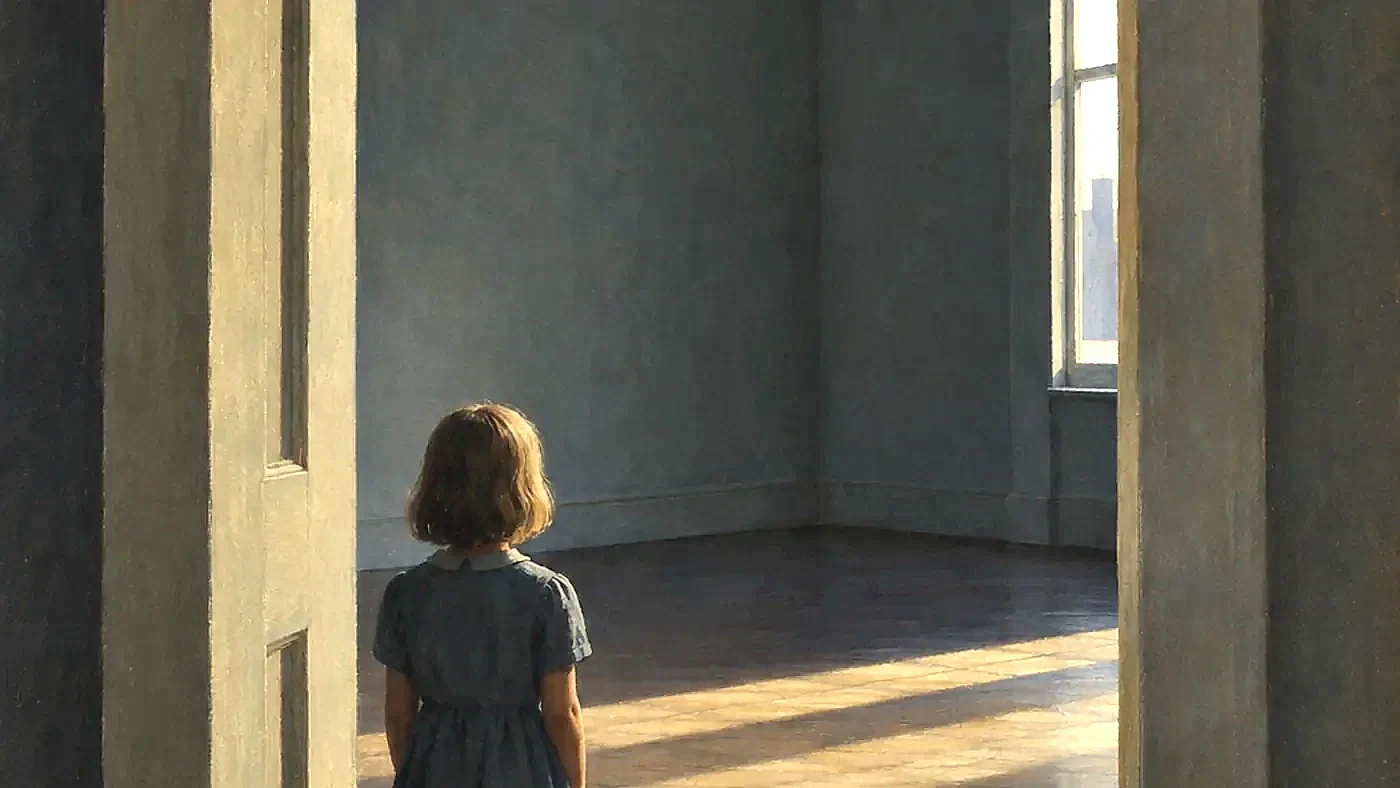
The novel names that gap through another character, not through Molly’s self-awareness. The choice keeps the diagnosis external and open to dispute. Watching Molly’s unmoved reaction to a kitchen accident, Aunt Bianca says: “The girl doesn’t seem human sometimes. It’s like she doesn’t feel things . . . Always so cool, so cold . . . It’s not normal. I tell you it ain’t right.” Molly does not refute the charge. She escalates it into a joke, delivered, the narration specifies, “completely straight-faced”: “I come from another galaxy. I am an alien . . . My people are planning an invasion.” The joke performs the very detachment Bianca has just named. Molly does not answer the charge of inhumanity by showing warmth. She answers it by being stranger still.
The book is narrated from adulthood, and it measures the distance between the narrating woman and the remembered girl. It does so not to show growth away from the child’s coldness but to confirm that the coldness lasted. The first chapter is dated with documentary precision: “I was sixteen, a senior in high school; the year was 1980.” Later, on public fascination with a neighbor’s death, the adult narrator writes: “I found it a strange paradox then, as I still do now, that most of us don’t want to think about death, our own mortality . . . Yet, when we hear about someone else’s death . . .” The clause “then, as I still do now” may be the most important in the novel. It closes the gap between girl and woman. The detachment Bianca diagnosed was not a phase. A reader who expects the coldness to soften with age, as a trauma response might, is told plainly that it did not. That refusal removes the comfortable redemptive reading and leaves a harder, more interesting one.
The child Aiden of Give Them Unquiet Dreams shares the technique. Neither narrator obviously lies. Both report a strangled mother, a smashed toad, or a ghost at the foot of a bed without the emotional and moral scaffolding an adult narrator might supply. In Mulhern’s fiction, innocent narrators see everything; what they lack is the understanding. These narrators see clearly and do not tell, or cannot tell, what the seeing costs them. The cost has to be inferred from displaced acts, such as a toad or a joke about aliens. Much of the moral judgment stays with the reader.
III. Comedy as Defense
The novel’s comedy grows out of the same flatness. Discussing a dead body with a store clerk, Molly asks, without transition, “Maggots are a good source of protein . . . Do you sell word processors?” The macabre and the mundane collide in one breath. The horror of death is deflated by the errands of the afternoon. The mode recalls Flannery O’Connor, in whom grotesque physical reality and ordinary aspiration share a sentence and characters keep, against the odds, some claim to grace. The difference is tone. O’Connor’s grotesque usually arrives freighted with impending violence. Molly’s arrives as plain non sequitur: a mind moving without a pause from the fact of death to the next task. That movement is both the joke and the diagnosis.
A reader may take the comedy as proof of Bianca’s charge, evidence that something in Molly does not work the way grief is supposed to work. The rest of the novel complicates that verdict without overturning it. The jokes keep feeling at a distance, and the distance has a purpose. What the purpose was becomes clear only at the end. Before then the novel goes to work on Molly by other means. It surrounds her with names she did not choose and texts she does not believe, and it waits.
IV. Names Held in Trust
The first of those names is her own. In an interview with Shelf Unbound, Mulhern stated that “Molly is a derivative of Moll, from Daniel Defoe’s Moll Flanders. . . I was inspired by her character.” The novel never announces the allusion internally, which is why it rewards attention. The inheritance is structural. Both Mollys survive through a hard self-sufficiency learned in deprivation. Both narrate their own lives in retrospect without much self-pity. Both ask the reader to weigh their moral standing against a society that failed them before either did wrong.
Defoe’s title survives whole in the family, divided between two generations. Molly carries the Moll; her grandmother carries the Flanders. The novel says so twice, once in Molly’s report and once in Agnella’s own voice. “Nonna had been married once,” Molly tells us, “to a man from the Flanders section of Belgium.” Later, when a doctor calls her “Mrs. Janssen,” Agnella corrects him: “Don’t call me that. Call me Agnella. Janssen is my married name. My husband died a long time ago. Julien was from Belgium. I’m Italian.” Janssen, with its variant Janssens, is among the commonest surnames of Flanders, where Janssens ranks second (Statbel). The novel never names Defoe. It does name Flanders, and it fastens that word to the woman who raises Molly in cunning.
The doctor’s scene restages Defoe’s own account of the name. “Moll Flanders” is an alias. Moll’s “true name,” she says, is too well known in the records of Newgate to be printed, and the name her envious fellow thieves gave her had, in her words, “no more of affinity with my real name . . . than black is of kin to white.” She first wears the Flanders name as a widow: “dressed up in the habit of a widow, and called myself Mrs. Flanders” (Defoe, Moll Flanders, Project Gutenberg). Agnella is a widow, and “Mrs. Janssen” is what the world calls her. Like Moll, she refuses it. “Don’t call me that” is Moll’s black and white compressed into five words: a Flanders name given from outside, set against an identity claimed from within, “I’m Italian.” Nearly three centuries apart, both women answer to Flanders and disown it.
The marriage behind the name is a Defoe plot as well. Moll, “tricked once by that cheat called love,” resolves “to be well married or not at all,” and she measures husbands by their estates. Agnella “admitted to me that she had married him for his money.” Julien’s family owned a textile company in Belgium, and his death left her his fortune, stock in the firm, and “a hefty life insurance policy.” The trade is exact. Flanders was for centuries the cloth-making heart of northern Europe (Britannica), and Moll’s life is lived among cloth. She is courted by a linen-draper, marries a draper, steals silk and damask from mercers’ shops, and is paid for informing on “a good quantity of Flanders lace” hidden from the customs. The Janssen money is woven from the goods Moll steals. The manner of Julien’s death inverts another of her episodes. Moll’s governess “disguised me like a man” for a season of thieving, and the disguise saves her. Julien, discovered in his wife’s underwear, is the man in a woman’s clothes; he speeds off and is killed when a train hits his car. Defoe’s disguise is an instrument of survival. In this novel it is the punch line of a widowhood, and Agnella tells it as one: “Maybe it runs in Belgian families.”
The deepest correspondence is the governess. Moll’s thieving is directed by an older woman who plans the jobs, fences the goods, and takes “a good share of the booty.” Agnella is that figure for Molly. She stages the fall at the bank, and afterward she sits on the bed, blows smoke rings, slaps the girl’s face, and explains the lesson: “What we did isn’t going to hurt a soul. That big bank is gonna settle once we threaten a lawsuit. And you need money for college.” The first-person plural makes Molly an accomplice. In Defoe the governess is a stranger Moll finds in London; here she is family, and the tutor in larceny is also the one who loves her. The Flanders half of the title teaches the Moll half her trade.
The name carries its own meanings. Janssen is a patronymic, “son of Jan,” the Low Countries’ form of Johnson; Jan descends from Johannes and the Hebrew Yohanan, “God is gracious” (Janssen (surname)). The name is a man’s, passed from father to son, and Agnella holds it only as the legal residue of a marriage made for money. A name meaning grace reaches her as an inheritance and an insurance check. That irony suits a book in which sacred language keeps passing through the hands of people who spend it. But the inheritance is also blood. Julien is Molly’s grandfather (“And because of him, I got you,” Agnella says), so Molly is Moll by name and Flanders by descent, the whole of Defoe’s title gathered in one girl. Agnella weighs the two legacies, the fortune and the granddaughter, and her verdict is the novel’s comedy in miniature: Molly is “more precious to me than all that money.” Then she adds, “Well, almost.”
One more echo comes from Defoe, not from the novel itself, and it is offered only as that. Defoe knew the name. In his Tour thro’ the Whole Island of Great Britain he records the Wimbledon estate of “Sir Theodore Janssen another South-Sea Forfeiture.” Janssen, a Flemish merchant and financier and a director of the South Sea Company, lost his fortune when Parliament confiscated the directors’ estates after the Bubble of 1720 (Review of English Studies). In the England of Moll Flanders, published two years later, the name stood for a fortune made by speculation and forfeited for a breach of trust. Nothing suggests the novel intends the echo. It fits a section on names held in trust, and a grandmother whose fortune rests on a husband’s life insurance and a bank’s fear of a lawsuit.
The surname supplies the central irony. “Bonamici” is Italian for “good friends,” a name promising fellowship worn by a girl whose defining trait, in Bianca’s diagnosis, is the opposite. It is the same device as Poe’s Fortunato in “The Cask of Amontillado,” a name of good fortune hung over a betrayal. Felicity, the freshman roommate who dies in a dormitory prank, carries the same reversed logic: a name meaning happiness, borne by a girl who does not live to earn it. A census of the novel’s proper names shows how selective this pressure is. Mulhern does not run a moral code through his naming. Sacred names are not reserved for the devout, nor secular ones for the cruel. He loads a few hinge-names, usually against their bearers, and leaves the walk-ons semantically ordinary. Agnella carries the Italian and Latin sense of lamb, chosen by a woman it does not describe. Gabriel, the messenger, belongs to a former priest. His surname, Callaghan, carries a threefold gloss from the Irish Ó Ceallacháin: “strife” or “contention,” “bright-headed,” and, by way of ceall, church, “frequenter of churches.” Each reading names Gabe. He contends with Molly’s fatalism, he is the bright counterweight to her darkness, and he is the man of faith she has laid aside. Hulga arrives straight from Flannery O’Connor, and Dr. Diver from Fitzgerald. Names carry meaning only where the novel wants pressure applied.
“Molly” itself belongs to a long lineage of names that descend, by one route or another, from Mary, and ultimately from the Hebrew Miriam, variously glossed as “beloved,” “bitter,” or “rebellious.” Moll and Mollie are the same diminutive in different dress, historically interchangeable with Polly and Poll. Maureen comes down through the Irish Máirín, a diminutive of Máire. Myra, coined by Fulke Greville, is widely read as an anagram of Mary. Maria, Marie, Marion, Mara, Mamie, and Mayme fill out the family. That so many women, across so many centuries and languages, have carried a version of the same name is itself a kind of argument. The name is held in trust and passed from hand to hand, the way devotion is passed, long after its bearers have been forgotten by everyone but the family that kept saying it. The novel builds its theology on exactly that passing.
V. The Marys

A novel that opens with the dedication “For my father, for my mother, and for Mary” has already told the reader how to read it.1 Mary stands third and alone, uncoupled from the parental pair, with no surname or relation. She is not a person in the story. She is the name the story keeps arriving at, and it arrives more than once. There is Maria, Molly’s mother, born on the feast of the Visitation. There is Mrs. Margaret Mary Muldoon, the Irish widow next door, who dies with the feast of the Assumption forged on the back of her wedding photograph. Mary Jane Callaghan sings at a Christmas piano in West Roxbury, and Mary Grace, a student, throws a book and speaks a truth. Molly herself has a name that, as a taxi driver named Beatrice will explain, “is a nickname for both Margaret and Mary.”2 Behind them all stands the Blessed Mother: a statuette in a keepsake box, a stained-glass Assumption in a funeral church, and the reflexive oath in Agnella’s mouth, “Jesus, Mary, and Joseph!” The novel repeats that oath until profanity and prayer become the same sound.3 The holy name is most often spoken in exasperation, by an unbeliever who turns out to be the book’s murderer. The novel does not treat this as blasphemy. It treats it as the ordinary condition of a divine name in human mouths: worn, misused, and still working.
The Marys do not divide into the sacred and the profane. Each carries a light for the length of a scene, hands it on, and goes dark.
Maria: the mother as Visitation
Molly’s mother is the faintest character in the book and the most heavily loaded. Aunt Bianca introduces her by contrast: “She’s not at all like her mother. Maria always gives us hugs and kisses when she sees us.” Aunt Helena defends her as “a gentle, kind girl. Not everybody is ‘in charge’ like you.”4 Agnella dismisses her: “Maria was a weak girl. She went along with whatever your father said.”5 Maria is defined entirely by other women talking about her. She is a report, and her one intimate fact reaches Molly the same way. Sorting keepsakes after Agnella’s death, Helena hands over “a small framed picture of the Sacred Heart of Jesus, and a quartz locket with the same image on the outside and a timepiece inside,” together with “a small statuette of the Blessed Mother.” She says: “Those belonged to your mother. Maria loved the Blessed Mother. She was so proud to be born on May 31st, the feast of the Visitation.” Molly asks what the Visitation is. Helena’s answer is imperfect and lovely: “Something about when Mary visited her cousin Elizabeth who told her she was pregnant with Jesus.”6
The feast recalls Luke 1:39–56. Mary, newly pregnant, goes “with haste” into the hill country to her elderly cousin. At her greeting the unborn John leaps for joy, and Elizabeth names her “the mother of my Lord.” Mary answers with the Magnificat, the canticle in which the proud are scattered and the lowly lifted up. Catholic tradition calls her here the Ark of the New Covenant, the one who carries divine presence into another household, where joy breaks out.7 That is the shape of Maria’s presence in the novel. She arrives in someone else’s house, secondhand, as news, and something leaps. Molly, who has insisted she felt nothing for her parents, receives her mother at last through an older woman’s speech and a box of objects. Helena adds the irony: “Agnella used to brag that her daughter was born on that day. I would get disgusted when she did that. She wasn’t even a believer.”6 The reader meets the Visitation only after Molly has watched a stained-glass Assumption at Maria’s funeral, “arms folded against her chest, a blue shawl over her white robe, sunlight behind her, surrounded by a sphere of purple clouds,” and rejected it: “Home was six feet under the ground in an expensive shiny brown box.”8 The novel gives the mother’s end before her beginning, and lets the beginning console.
Margaret Mary Muldoon: the woman who rose from the sea
If Maria is the Visitation, Mrs. Muldoon is the Assumption, and she is the figure the novel develops most fully. She begins as a gin-soaked grotesque. “Mary is so far gone. She has squash rot,” Bianca says.9 Yet she is the only adult who offers Molly a metaphysics. At Molly’s graduation party, sober and gentle for once, she sings “Moon River” in the voice of a woman who once played nightclubs on Beacon Street. Then she asks: “Are you romantic, Molly? Do you believe that anything is possible? . . . I mean, do you believe in things beyond the obvious.” She leaves Molly a proverb, “Your feet will take you where your heart is,” and a role: “We were two drifters off to see the world, searching for our rainbow’s end. And I was her huckleberry friend.”10
The beach chapter is built like a liturgy. The date is August 15. The saltwater, Mrs. Muldoon insists, has “a cure in it” because it is the feast of “the Blessed Mother’s Assumption into Heaven,” and she wants to “purify” herself before going home to Ireland. Agnella, irritated, supplies the theology of the practical: “How you gonna get the Blessed Mother’s cure if you don’t get wet?” Molly, seventeen and imperious, refuses the premise. “What do you mean raised? She just flew up into the air?” “Darling, you got to have faith.”11 Then the novel does what argument cannot. Mrs. Muldoon strips to a black-and-white swimsuit, and Molly notices “what a round hard belly she had. She almost looked pregnant. For a second, I imagined she was going to demonstrate the Assumption and fly into the sky.” A mourning dove startles from the rocks, whistling “as it rose,” and the waves “glimmered like sparks from an unquenchable fire.” A breaker knocks both old women down. They laugh until they cry. In the plainest sentence in the book, the miracle passes to a seventeen-year-old: “Now raise me quickly, Molly, before the next wave.” Molly raises her. “At last she rose from the sea.” “Molly, you’re an angel.”12
The Assumption is acted out, not believed. It goes sideways, not up, and it is done with two arms and a laugh. The Angel of Death has been called an angel of another kind, and she feels the pull of it despite herself: “mesmerized by the wet silvery scalp that showed through her hair. I resisted the urge to touch the crown of her head.”12 A week later Molly finds the woman decomposing in a purple chair. She reads the scene as a chosen death on a wedding anniversary: “I think it’s kind of sweet and perfect.”13 She is wrong twice over. Years later Officer Connolly corrects the record. The woman’s name was Margaret, “Mary was her middle name.” She was married in May, not August, the photograph’s inscription was forged, and the suicide was staged.14 Molly built a private religion of dignified self-ending on a forged caption. The full name, though, holds a consolation. Saint Margaret Mary Alacoque was the visionary whose devotion to the Sacred Heart sits in Maria’s keepsake box, in a quartz locket with a clock inside it. The murdered neighbor and the dead mother turn out to be devotees of the same heart.
Mary Jane: the voice at the piano
The Christmas dinner in West Roxbury is the novel’s Joycean set piece, and it hands the Marian office to a musician. She is introduced in a single line, “My sister Mary Jane. She plays in a band,” and she sits at a mahogany Steinway, closes her eyes, and plays the opening of “Moon River.”15 The reader recognizes the song before Molly can explain it. Later, weeping in the car, she can only say its title: “‘Moon River.’ I laughed, crumpling the tissue he had given me.” Then: “I told Gabe everything. The words gushed out of me.”16 Structurally the scene is “The Dead,” with a Mary Jane at the piano, a Lily pouring drinks, a dead father whose ugly navy chair still holds the room, a song that opens a wound, and snow. Thematically it is a resurrection: a dead woman’s song returns through a living woman’s hands, in a stranger’s house, at Christmas. Mary Jane does not know whose song she has played. Noticing Molly’s face, she simply moves on to “The Christmas Song.” The messenger does not need to understand the message. Mrs. Muldoon’s song is the child leaping in the womb, arriving years late and by another hand.
Mary Grace: the annunciation as assault
The most audacious Mary sits in Molly’s Florida classroom, and readers of O’Connor will recognize her before she speaks. Mary Grace is “a pimple-faced obese white girl from Georgia,” lately consumed with the Bible, with O’Connor’s Wise Blood on her desk. She contradicts the lesson on Thoreau: “You can read all you want but it won’t make you a better person. You need to act in the world, not retire from it . . . Helping others is what God wants us to do.” Mocked by a boy named Leo Turpin, whom the class calls Turd, she throws her psychology textbook at him, charges him, and chokes him. Afterward she kneels and prays, and leaves with “a strange smile on her face.”17 In O’Connor’s “Revelation,” a girl named Mary Grace hurls a book at the self-satisfied Mrs. Turpin, seizes her throat, and says: “Go back to hell where you came from, you old wart hog.”18 Mulhern keeps the animal (“You are all a bunch of pigs, especially you, Turd”) and moves the target. The book is thrown at Turpin, but the revelation lands on the teacher: “And you’re no better than Turd, Ms. Bonamici. I know you think that because you’re a teacher you know everything, but you don’t!”17
Alone in the empty classroom, Molly becomes Mrs. Turpin at the pig parlor: “Mary Grace, as deranged as she had acted, uttered a truth about me. I did think I knew a lot about everything.” Driving home through thunder, she asks, “And what exactly was the way? Who would show us? Had Mary Grace been trying to show me?” Gabe names the office outright: “Maybe Mary Grace was the universe trying to speak to you. A sign of sorts. . . . Your redemption is near, Molly.”19 The novel does not make the messenger admirable. It only lets the message be true. This is the book’s hardest and most Catholic proposition: no one is disqualified from carrying light by the ugliness of the hand that holds the lantern.
Molly at the lectern
Molly refuses every Marian role she is handed and plays each of them anyway. As a schoolgirl she is cast as Mary in Jesus Christ Superstar, and she loves the song about not knowing how to love him: “He’s a man, he’s just a man.”20 At her parents’ funeral she stands at the lectern and reads from Mark. She begins with Christ’s cry of abandonment, “Eloi, Eloi, lama sabachthani?” (“My God, my God, why have you forsaken me?”), and ends with the announcement at the empty tomb: “Don’t be alarmed . . . You are looking for Jesus the Nazarene, who was crucified. He has risen! He is not here. See the place where they laid him.”8 She reads the words correctly and solemnly, as the appointed reading. Only after she returns to the pew, after “The Gospel of the Lord,” the congregation’s “Praise to you, Lord Jesus Christ,” and Agnella’s praise for her reading, does she answer inwardly: “Fuck you, Lord Jesus Christ, and fuck your mother, father, and the Holy Ghost too.” That evening she tears up the copy of the Gospel Agnella gave her and flushes the pieces away.
In Mark these words belong to the young man in the tomb, spoken to the women who have come to anoint a body. Molly occupies both positions. She gives the messenger’s announcement a voice, and she stands, within the pattern the novel is building, among the women who face the emptied place of burial. She proclaims a resurrection with her mouth while denying it with her mind. Her inward curse shows how deep her resistance runs, but it does not cancel the pattern. It makes it more paradoxical. The words come before belief. She is the resistant Mary, the woman who voices what she cannot yet receive, and the novel will spend its remaining chapters bringing her to the place where the name can close on her.8
VI. Pastiche and Undertow
The Marys are the novel’s most visible inheritance, but not its only one. The book declares its literary debts before the first chapter begins. Two epigraphs stand at its head. One is from Hamlet, whose “more things in heaven and earth” names what no orderly philosophy can contain. The other is from Dante’s Paradiso, where Beatrice tells the pilgrim to “open your mind to what I shall disclose, and hold it fast within you,” warning that “he who hears, but does not hold what he has heard, learns nothing.” Shakespeare asks what exceeds a system, and Dante asks what a reader is willing to hold. The novel never names the speaker of its second epigraph. It brings her back at the close in the least ceremonious form it can find, a cab driver who says, “I’m Bea. Short for Beatrice,” and then discloses the feast behind Molly’s name. The book opens with Beatrice promising a disclosure and ends with a Beatrice delivering one. The title of this section names the two currents that run between those points: a pastiche of inherited texts on the surface, and an undertow of devotional meaning beneath.
The Dante material keeps coming back; it is not decoration. A policeman is named Virgil, Molly speaks of dark woods and a steep ascent, and the last movement runs toward sea, light, and home. But the Comedy is a frame here, set inside a realist, comic, often violent life. The novel does not copy it point for point. It does not make Molly’s crimes harmless or promise a tidy conversion. It sets an imaginative scale against which her coldness, skepticism, and eventual receptivity can be measured.
Poe supplies the novel’s darkest material, and the mannequin scene is its most nearly verbatim homage. When the store dummy is dressed for the prank that kills Felicity, the Chaplin derby is missing. In its place goes “one of those conical jester caps with bells,” Fortunato’s costume exactly, the “conical cap and bells” whose bells “jingled as he strode.” After Felicity collapses, “every so often there was a jingling of bells,” the very sound on which “The Cask of Amontillado” ends: “only a jingling of the bells.” Mark’s cry over the body, “For the love of God, let her be OK!” turns Montresor’s “For the love of God, Montresor!” inside out. The murderer’s taunt becomes a bystander’s plea, and the walling-up of a living victim becomes a prank that kills the wrong girl. The scene’s detached mannequin hand and Molly’s clinical calm beside a death she privately feels complicit in rework the guilty closeness to a body that drives “The Tell-Tale Heart.”
That tone came through revision, and the evidence survives in print. The scene first appeared as a short story, in which the narrator’s elevator ride after the death brought self-congratulation: “I thought about what I had accomplished.” It closed on a flourish of sacred parody: “Like Eve, she had eaten the forbidden fruit. Nonna would be happy to know that Ashley had died for her sins and was now resting in peace.” The novel deletes every word of that and puts remorse in its place: “I was sure that others would have done the same thing given the situation, but I felt remorse for the first time. At that young age, I had no idea of the guilt I would feel in later years.” The story’s paragraph beginning “One of the perks of being a sociopath” is cut entirely, and in the novel the word is applied only to Myra, never to Molly. Diagnosis and self-satisfaction leave. Moral and theological vocabulary comes in. The revision moves toward guilt. It is the clearest single piece of evidence that the novel’s coldness was meant to be read as a wound, not a temperament.
Eugene O’Neill supplies the comic-gothic setting for the same scene. Shelton Hall, Molly’s dormitory, is said to be haunted by the playwright, who died there, as David reports, muttering “born in a hotel room and goddammit, died in a hotel room.” The dummy is dressed as Oona, O’Neill’s estranged daughter, who at eighteen married Charlie Chaplin, hence the cane and the missing derby. The ghost story is treated as a joke until the joke turns lethal, the way the novel’s inherited texts keep turning from homage toward consequence.
Fitzgerald and O’Connor supply its other deaths. Myra Bocca, a grifter run down by a yellow car, is a near-anagram and an echo of Myrtle Wilson, and the color brings Fitzgerald’s counterfeit wealth into a Florida strip mall. The Greek coffee-shop owner who warns Molly against her, Alexander Michaelis, carries the name of Fitzgerald’s “the young Greek, Michaelis, who ran the coffee joint beside the ash-heaps,” who witnessed Myrtle’s death, so the borrowing brings the bystander along with the victim. Agnella’s superstition, her manipulations dressed as piety, and her part in setting Felicity’s death in motion descend from the grandmother of “A Good Man Is Hard to Find,” whose hypocrisy gets her family killed. Molly’s eventual refusal of the Angel of Death role answers the Misfit’s theology that people behave decently only under threat of death. She declines both the grandmother’s hypocrisy and the Misfit’s fatalism, and finds release in water instead of violence.
The New England inheritance is as deliberate as the Catholic one, and it gives the narrator her classroom. Emerson’s “To be great is to be misunderstood” is quoted to Felicity. “Nothing is at last sacred but the integrity of your own mind” appears years later beside Thoreau’s “Civil Disobedience” and the counsel to “make the most of your regrets . . . to regret deeply is to live afresh.” Whitman surfaces in one knowing sentence, the “barbaric yawp” of the bear subculture. Melville is present in the novel’s smallest joke: the policeman who says “Call me Virgil” echoes “Call me Ishmael” even as he takes the name of Dante’s guide. Dickinson gives Agnella her instruction to tell truth “slant,” and then gives Molly “There’s a certain Slant of light,” read on the Christmas night that begins her turn. The streetlight that “crossed his eyes” on Gabe’s face the night before has already made the poem’s light literal, so that Molly opens the book and finds in it the very light she has just seen.
Philosophy furnishes her shelf in the same eclectic way. Kierkegaard’s Fear and Trembling supplies Gabe’s “there are two ways to be fooled.” Jung’s synchronicity is named when Molly opens to Dickinson by “coincidence.” Marx’s “religion is the opium of the people” is quoted to her students, and Hunter S. Thompson’s “we are all alone, born alone, die alone” is the secular creed she carries into the deaths that follow. In a therapist’s office, Munch’s The Scream and Van Gogh’s Starry Night hang where Molly is asked to name what she feels. One canvas externalizes the panic she keeps flat in her narration, and the other offers a turbulent, spiritually charged sky as its unspoken alternative. Smaller debts fill out the room. Gabe courts her with Marlowe’s “Come live with me and be my love,” which she dryly corrects as “not exactly Fort Lauderdale terrain.” She teaches Langston Hughes’s “Salvation,” a child’s crisis of belief set beside her own. T. S. Eliot’s “In my beginning is my end” sounds as she returns to the hospital where Agnella once staged a fall. The result is not name-dropping but a mind assembled from what it has read, in which belief and unbelief both arrive as quotation. She is a narrator who has read everything and believed almost none of it.
VII. The Furniture of Belief
Beneath the literary surface runs scripture, set down without comment. Her mother’s Bible opens to Matthew 7:15, “beware of false prophets . . . ravenous wolves,” a verse that reads in retrospect as a warning against Agnella. Mary Grace prays Matthew 7:6, “do not throw your pearls before pigs.” John’s “In the beginning was the Word” is quoted in defense of language itself. The fish on the diner wallpaper is named “the symbol of Christ,” and the Florida house is “our own private Eden,” to which Gabe adds, “All we need is a snake,” and Adam answers that there are “lots of snakes in South Florida.” The final chapter is the densest. Two sisters are named Martha and Miriam, the Gospels’ Martha and Mary of Bethany with the second sister given her Hebrew name. A child repeats the parable of the lost lamb. The cab driver wears an earring patterned after the sun, a crescent moon, and twin stars, echoing the woman “clothed with the sun” of Revelation 12:1.
The natural world is prepared in the same way. A gecko watches the novel’s one sustained theological dispute. A cardinal arrives as Gabe asks for a sign. A Bleeding Heart vine droops and revives with Molly’s changing state before the Sacred Heart is ever named, the devotion of Margaret Mary Alacoque rehearsed in botanical form. None of these is an argument. The novel does not argue for belief. It keeps setting belief’s furniture down in the room until the reader notices how much of it is there.
The same discipline governs what the reader is asked to believe. The novel never demands literal assent. Its first supernatural claim, the prophecy that Molly will be “surrounded by death,” is explained away in Molly’s own voice almost as soon as it is spoken: “I think she was just making things up to frighten us.” When providence is finally put directly, it is put by a character, in Gabe’s “Question our certitudes and assumptions,” and the novel gives its protagonist the cleanest secular reply: “I believe we see what we want to see.” Every sign and coincidence has a worked-out rational alternative. Molly’s voice keeps the same discipline. She does not turn scriptural at sacred moments. Her domestic prose moves between sensuous catalogue and flat inventory. Violence contracts into terse Anglo-Saxon, death expands into clinical Latinate observation, and the funeral Mass turns formal because she is examining its claim, not agreeing to it. What raises her diction is interpretation itself, the moment she consciously reads an event through a rite, a literary memory, or water. Belief, in this novel, is a late act of reading.
The contrast between the novel’s first and last pages makes the point. It opens in domestic violence, with no seed of the sacred anywhere: “I opened the front door, I heard them arguing in the kitchen . . . my father was pressed against my mother, who leaned back over the stove; he was choking her.” The religious meaning is not planted early and paid off by the plot. It is gathered, late, onto a childhood the first page shows as simply violent. Mulhern has described the practice plainly. The allusions, he has said, are first an homage, a way of honoring the writers he most admires by letting their voices sound beneath his own. The religious element grows out of an Irish Catholic upbringing and a spirituality still finding its shape. Only occasionally is it set down deliberately to enrich a passage. Where it appears unbidden, it appears because it is simply part of him, the expression of a man trying, in Emerson’s sense, to live an authentic life. It is a modest claim, and it suits a novel that never pushes its meanings.
VIII. The Novella Behind the Novel

Molly first speaks in A Prayer for Home (Silver Current Press, 2016), a novella narrated by the teenage Molly and built around Mrs. Muldoon, the widowed, alcoholic neighbor who plans a trip “home” to Ireland and instead dies of a deliberate overdose timed to her wedding anniversary. Read beside the novel, it shows which elements came first. Its title sounds devotional, but its epigraph is the music-hall song “Show Me the Way to Go Home,” sung by a drunk after “a little drink about an hour ago.”25 The novella works in the distance between those registers, the prayer the title implies and the undignified ways the adults around Molly actually seek home. Mrs. Muldoon enters “drunk as a skunk,” wandering the street “looking for her husband Jim.”26
The designation the novel states early and plainly has its origin here, in a storefront psychic’s parlor on Tremont Street. Agnella jumps the line by telling strangers that Molly “had leukemia ‘very bad’ and the doctors gave me three months at most,” and Molly plays the part: “I started shaking a little and drooled.”27 The healer, Lady Jane, then delivers the verdict: “I see gruesome deaths in your future . . . I guess you might say, ‘You’re an Angel of Death.’” She giggles “like a little girl” as she says it, and in the car the family trades theories: police officer, doctor, murderer.28 The designation is contested from its first appearance. Agnella has already supplied the lesson underneath it. Asked whether she believes the Bible is the literal word of God, she says, “Of course I don’t . . . But that’s not the point. Most people do. And you gotta fit in.”29 Belief as social performance over private skepticism is the habit the novel will later examine in Molly herself.
The novella also stages the Assumption the novel builds toward. On the feast day Agnella drives Mrs. Muldoon to the beach for “the Blessed Mother’s cure.” Molly asks, “What do you mean raised? She just flew into the air?” and, as the widow strips to her swimsuit, “imagined she was going to demonstrate the Assumption and fly away.”30 Agnella turns the doctrine into her own creed: “Who gives a damn if Mary flew into the sky or not? . . . You have the good fortune . . . of being a lion in a world full of sheep.”31 The novella then inverts the image. Mrs. Muldoon’s home turns out to be the grave, and Molly, recalling Poe’s “The Conqueror Worm” in the patrol car, names the substitution herself: “She had created her own Assumption and I thought, ironically, consumption.”32
The two books part most clearly at the end. The novella closes on “Moon River,” the song Mrs. Muldoon sang at the graduation party, with its promise withdrawn: “But there was no rainbow’s end for her.” Agnella’s “Everything will be all right, Molly” brings no comfort: “prayers for home, wherever we believed we were going, would never be answered . . . The moon was too high, the river was too wide, and our hearts would be broken after all.”33 The novel keeps the song, the beach, and the dead neighbor, but it does not keep that verdict. Its closing pages send Molly back into the water and bring her out again, “grateful to be home at last.” The novella supplies the early versions of the designation, the family’s habits of theft and faked illness, and Molly’s calm before the dead; the novel takes them up and gives them a different end.
IX. Home at Last
Everything the novel has set down converges in a taxi. The driver says, “I’m Bea. Short for Beatrice,” a retired professor of “Linguistics and Theology.” Then she says: “Molly is a nickname for both Margaret and Mary. And today is October 17th, the Feast of Saint Margaret Mary.” Asked why the woman is a saint, Bea answers: “She was a sickly young girl for many years but when she recovered, she began experiencing visions of Christ. She claimed that Christ chose her as an instrument to spread devotion to His Sacred Heart.”2 The dead neighbor’s legal name, the mother’s locket, the saint’s feast, and Molly’s nickname meet in a single speech by a woman named for Dante’s guide. Molly’s guides have been named all along. Virgil, the officer who took her down into the truth about her family, is named not for the poet but for an Irish saint who believed the world was round when “it wasn’t kosher to think so.” Beatrice drives her to the water.14 Descent, then ascent. “I felt my pulse race. This was all too strange. So many coincidences.” Then: “Can you take me to the beach?”
Three feast days now stand revealed as the novel’s calendar. May 31, the Visitation, is Maria’s birthday and the book’s image of arrival. August 15, the Assumption, is Mrs. Muldoon’s day at the beach and the date forged on her photograph. October 17, the feast of Saint Margaret Mary, is the day Molly learns her own name and walks into the water. Arrival, ascent, recognition: in each case an unlikely woman administers the sacrament without knowing she is administering anything. The novel names the feasts but never explains the pattern. Reading the Marys as one office is an inference from the text; the author has not said so.

The ending repeats the Assumption with the roles reversed. Molly strips, as Mrs. Muldoon stripped. She swims out and floats on her back under “a scintillating blue” sky. She thinks of the dead woman’s eyes and “their impregnable beauty,” knowing now “that behind them was sheer compassion.” The faith healer, the day at the beach, the emerald cross, and the song were all “acts of pure love.” She hears her father’s voice and “a faint hum, like bees,” smells stargazer lilies, and sees Venus. Then: “Believing in possibility, I spread my arms wide and swam slowly to the shore. Where the water became shallow and frothy, I rose and walked onto the beach, grateful to be home at last.”21 No one raises her. She rises. The swim closely reworks the ending of Kate Chopin’s The Awakening, with its sensory pressure and solitary movement into water, and reverses its direction. Edna Pontellier swims out and does not return. Molly walks back to shore. The gesture is Dickinson’s, from the poem printed as the novel’s coda, “The spreading wide my narrow Hands / To gather Paradise,” in a house “Impregnable of eye.”22
Why so many Marys, and why let a murderer’s oath, a mother’s feast day, and a schoolgirl’s violence all wear the same name? Because the novel is following an office, not a person. Each Mary carries the flame for one scene: Mrs. Muldoon at the beach, Mary Jane at the piano, Mary Grace in the classroom, Maria in a keepsake box, Bea in a taxi. Then the light sinks to an ember, and each is again only a drunk widow, a sister in a band, a troubled girl, a weak daughter, or a stranger driving north on Federal Highway. The author has stated the premise elsewhere: the soul is “joined, through the Oversoul, to every other soul that has been or will be.”23 If that is so, no single self can hold the whole flame, and no self is excluded from carrying it. Agnella marks the doctrine’s hardest edge. The grandmother finally exposed as the killer of her friend, her daughter, and her son-in-law is also the woman who drives an old neighbor to the ocean for a cure she does not believe in, because “I’m not gonna deny an old friend a last request,” and who lies laughing in the surf while her granddaughter pulls her up.11 The novel does not resolve that. It watches her die beside a hospital window where two planes cross, “one ascending, one descending, a metaphor for life,” and reports Molly’s response without apology: “my soul swooned, and I felt great peace.”24
Judgment keeps failing in this book. Every verdict Molly renders is overturned. The suicide was a murder, and the beloved grandmother was the killer. The ridiculous believer was the guide, the lunatic student was the prophet, and the neglected mother was a feast day. What survives the collapse of her certainties is a habit of mind, “Believing in possibility,” and the recognition that love was there the whole time, in forms she was too intelligent to see. Her last gestures are small and freely given. On a plane she gives a watch and a Sacred Heart locket to two Jewish girls, carrying Catholic iconography across a religious line without asking anyone to convert. That is the generosity the novel extends to Mary herself: devotion offered without argument to whoever is in the next seat.
That returns the reader to the comedy. Mulhern disclosed the novel’s origin in the same Shelf Unbound interview that confirms the Defoe allusion: “the true genesis of Molly is the fact that five important people in my own life died in less than a year.” Read against that fact, the toad, the vodka, the maggots and the word processor, and the adult narrator’s unsoftened voice look less like coldness for its own sake than like a way of surviving loss too large to look at directly. The comedy does not deny grief. It holds grief off until the novel’s borrowed languages (the Marys, the feasts, the poems, the songs) can carry what Molly cannot yet say for herself. She does not become warmer by the end. She remains strange and funny. But she has learned to receive what the book has kept handing her, and the dedication turns out not to have been a courtesy. “For my father, for my mother, and for Mary” names the book’s three altars, and the third is plural. Mary is whoever shows up.
Notes
- 1. James Mulhern, Molly Bonamici (Silver Current Press, 2016), dedication. ↩
- 2. James Mulhern, Molly Bonamici (Silver Current Press, 2016), final chapter (Bea, the cab driver, on October 17 and Saint Margaret Mary). ↩ ↩
- 3. James Mulhern, Molly Bonamici (Silver Current Press, 2016). The oath is Agnella’s throughout; it recurs at the faith healer, in the car, and at the funeral procession. ↩
- 4. James Mulhern, Molly Bonamici (Silver Current Press, 2016), chapter one (Bianca and Helena on Maria). ↩
- 5. James Mulhern, Molly Bonamici (Silver Current Press, 2016), Agnella after the deaths of Molly’s parents. ↩
- 6. James Mulhern, Molly Bonamici (Silver Current Press, 2016), Aunt Helena and the keepsakes, after Agnella’s death. The 2020 printing reads “Mary 31st”; the intended “May 31st” is given here and is logged as an erratum for the Silver Current Press reissue. ↩ ↩
- 7. Luke 1:39–56. On the feast, the Magnificat, and the Ark-of-the-Covenant typology, see Vatican News, “Feast of the Visitation of the Blessed Virgin Mary,” vaticannews.va; Franciscan Media, “Visitation of the Blessed Virgin Mary,” franciscanmedia.org; Diocese of Victoria, “May 31: The Visitation of the Blessed Virgin Mary,” rcdvictoria.org. ↩
- 8. James Mulhern, Molly Bonamici (Silver Current Press, 2016), the funeral of Molly’s parents (the stained-glass Assumption; the Gospel reading from Mark 15–16). ↩ ↩ ↩
- 9. James Mulhern, Molly Bonamici (Silver Current Press, 2016), chapter one (Bianca on Mrs. Muldoon). ↩
- 10. James Mulhern, Molly Bonamici (Silver Current Press, 2016), Molly’s graduation party. ↩
- 11. James Mulhern, Molly Bonamici (Silver Current Press, 2016), the Revere Beach chapter (Agnella’s call; the conversation on the sand). ↩ ↩
- 12. James Mulhern, Molly Bonamici (Silver Current Press, 2016), the Revere Beach chapter (the dove, the breaker, “Now raise me quickly”). ↩ ↩
- 13. James Mulhern, Molly Bonamici (Silver Current Press, 2016), the discovery of Mrs. Muldoon’s body and the conversation in the patrol car. ↩
- 14. James Mulhern, Molly Bonamici (Silver Current Press, 2016), Molly’s later meeting with Officer Connolly (“Virg”) at the airport bar. ↩ ↩
- 15. James Mulhern, Molly Bonamici (Silver Current Press, 2016), Christmas at Mrs. Callaghan’s house in West Roxbury. ↩
- 16. James Mulhern, Molly Bonamici (Silver Current Press, 2016), the drive home from West Roxbury. ↩
- 17. James Mulhern, Molly Bonamici (Silver Current Press, 2016), the classroom chapter (Mary Grace, Leo Turpin, Thoreau). ↩ ↩
- 18. Flannery O’Connor, “Revelation” (1964), in Everything That Rises Must Converge (1965) and The Complete Stories (1971). The parallel is structural; the novel names O’Connor only by placing Wise Blood on the student’s desk. ↩
- 19. James Mulhern, Molly Bonamici (Silver Current Press, 2016), the drive home in the storm and the conversation with Gabe that evening. ↩
- 20. James Mulhern, Molly Bonamici (Silver Current Press, 2016), Molly’s account of her school years (West Side Story, Jesus Christ Superstar). ↩
- 21. James Mulhern, Molly Bonamici (Silver Current Press, 2016), closing pages. ↩
- 22. Emily Dickinson, “I dwell in Possibility” (Fr466), printed as the novel’s coda; text at the Poetry Foundation. ↩
- 23. James Mulhern, “An Artistic Creed,” in The Collected Stories and Poems of James Mulhern (Silver Current Press, forthcoming); discussed in “The Sacred in the Shabby” on this site. ↩
- 24. James Mulhern, Molly Bonamici (Silver Current Press, 2016), Agnella’s death in the hospital. ↩
- 25. James Mulhern, A Prayer for Home (Silver Current Press, 2016), epigraph. ↩
- 26. James Mulhern, A Prayer for Home (Silver Current Press, 2016). ↩
- 27. James Mulhern, A Prayer for Home (Silver Current Press, 2016), the faith healer’s parlor on Tremont Street. ↩
- 28. James Mulhern, A Prayer for Home (Silver Current Press, 2016), Lady Jane’s reading and the drive home. ↩
- 29. James Mulhern, A Prayer for Home (Silver Current Press, 2016), Agnella on the Bible. ↩
- 30. James Mulhern, A Prayer for Home (Silver Current Press, 2016), the beach on the feast of the Assumption. ↩
- 31. James Mulhern, A Prayer for Home (Silver Current Press, 2016), Agnella at the beach. ↩
- 32. James Mulhern, A Prayer for Home (Silver Current Press, 2016), the patrol car, quoting Edgar Allan Poe, “The Conqueror Worm” (1843). ↩
- 33. James Mulhern, A Prayer for Home (Silver Current Press, 2016), closing pages, alluding to “Moon River” (Johnny Mercer and Henry Mancini, 1961). ↩
Works Quoted
Passages from James Mulhern, Molly Bonamici (Silver Current Press, 2016), are quoted from the novel’s published interior; passages from A Prayer for Home (Silver Current Press, 2016), the novella in which Molly first appears, are quoted from its published text, with Edgar Allan Poe’s “The Conqueror Worm” (1843) and “Moon River” (Johnny Mercer and Henry Mancini, 1961) as the novella quotes them; the earlier version of the dormitory scene is quoted from its first publication as a short story, and the poisoning is told in the related story “Mia Bambina.” Reviewer quotations are from Kirkus Reviews on Molly Bonamici. The author’s statements on the Defoe allusion and the novel’s origin are from his interview with Shelf Unbound.
Scripture is cited from Luke 1:39–56, Mark 15–16, Matthew 7, and Revelation 12. Flannery O’Connor’s “Revelation” is cited from The Complete Stories; Emily Dickinson’s “I dwell in Possibility” from the Franklin reading edition; James Mulhern’s “An Artistic Creed” from The Collected Stories and Poems of James Mulhern (forthcoming). Defoe, Daniel. Moll Flanders. 1722. Statbel, the Belgian statistical office, “Peeters, Janssens and Maes are the most common surnames,” https://statbel.fgov.be/en/news/peeters-janssens-and-maes-are-most-common-surnames-0. F. Scott Fitzgerald, The Great Gatsby (Scribner, 1925), quoted from the Project Gutenberg text, https://www.gutenberg.org/ebooks/64317.
Related essays on this site: The Allusive Mulhern catalogues the novel’s allusions entry by entry; “Altogether Beautiful” reads the Assumption imagery of the story “Assumptions.”
Quotations have been checked word for word against the published texts. Where a connection is inferred, the essay says so.