A statement of belief and working philosophy in nine sections: the sacred in ordinary life, mercy as method, attention, the classroom, comedy and reverence, writing as communion, and a fire that returns by changing.
Read the essayFor Deeper Reading
The Archive
A carefully organized record of the philosophy, methods, experiments, and discoveries behind the books. A reader who wants a novel or a poem needs none of it first; the archive is here for students, writers, and readers who want to stay longer.
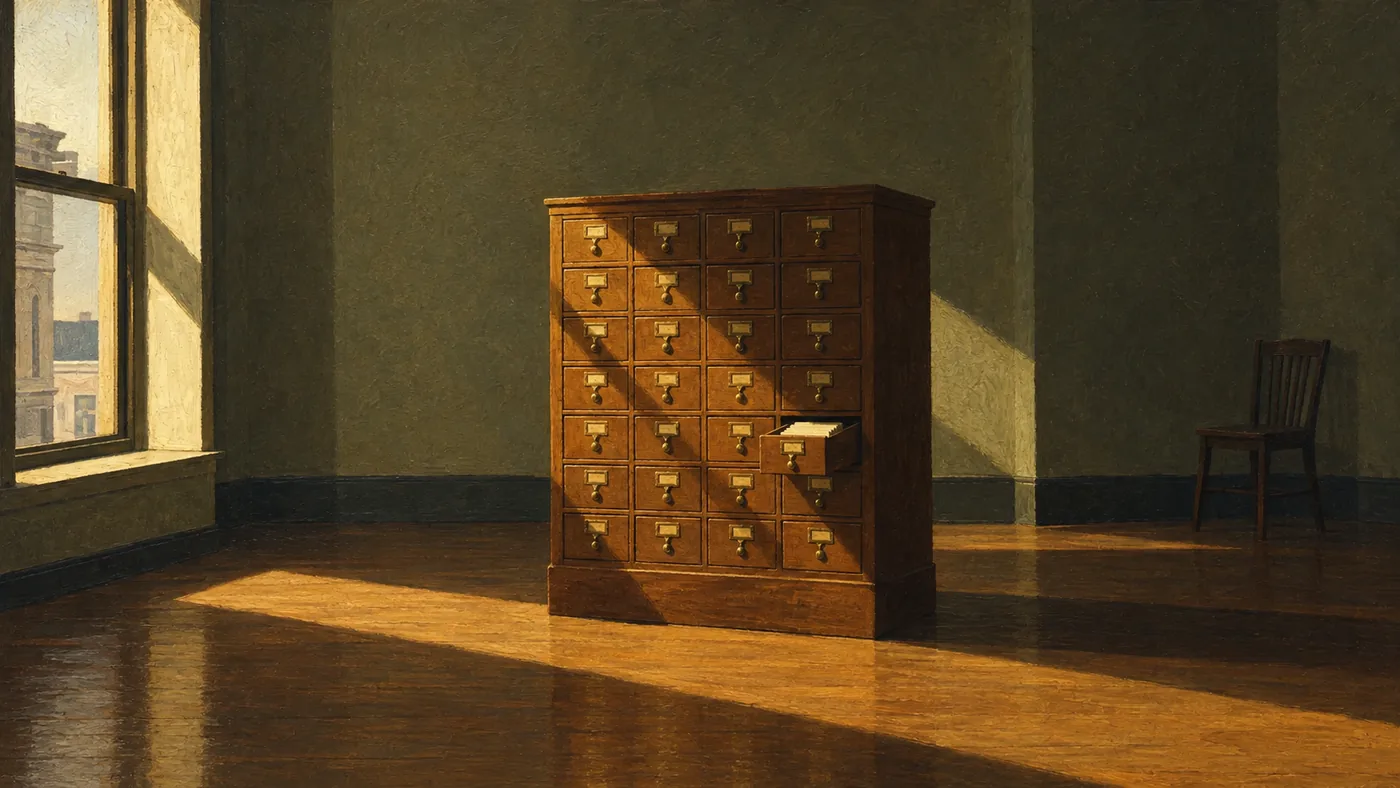
How the archive is arranged
Four rooms
Philosophy holds what the work believes. Method shows how it is made. Experiments gathers the forms tried in public—a series, a notebook, a gallery, a concordance you can search. Discoveries collects what close reading has found in the novels, stories, and poems.
The books themselves live on the Books page and the reading path; nothing here needs to be read before them.
Three ways to spend time here
- A first sitting “Credo,” then “The Room Kept Ready,” then any entry in From the Work.
- A longer afternoon “What Is Laid Down Is Taken Up,” The Recurring Image, and “The Allusive Method.”
- A sustained study One of the comprehensive studies of the novels, then The Religious Architecture of James Mulhern’s Work, with the Downloadable Studies for print.
I · Philosophy
What the Work Believes
Statements of belief and personal essays: attention, mercy, the classroom, and writing as communion.
Why the paintings in the manner of Edward Hopper belong to the work’s beliefs: light as attention, the shabby detail held in light, and the empty chair as offered company.
Read the essayOn curiosity, imagination, and permeable boundaries, and the poets and psychologists who noticed the same thing.
Read the essay
II · Method
How the Work Is Made
Recurrence, allusion, voice, dialect, and prosody—the techniques underneath the fiction and poetry, with notes for writers.
Recurrence as resurrection: repeated motifs, the scenes the fiction tells twice, one Steinway in a poem and a story, and the case for reading the catalog as one book.
Read the essayThe allusion that is literally true first, names as citations, re-addressing in “Teaching at Fifty-Six,” recurrence across the books, and democratic sources.
Read the essayThe adult cadence and the child’s uncorrected eye, sentence texture, white space, and the mechanics of dialogue in the short fiction, with notes for writers.
Read the essayDialect, malaprop, and profanity as inherited registers of trust, set against the polished grammar of institutional authority.
Read the essayEnjambment, metrical substitution, caesura, and stanza in the poems, with examples bridging verse and prose for advanced students.
Read the studyAt the writer’s workbench: A Glossary of Literary and Writing Terms and The Shape of a Story, a word-count and beat-map tool.
III · Experiments
Forms Tried in Public
A recurring series, a notebook, a searchable concordance, a gallery, and a reader’s notes on other writers.
One passage from the published fiction or poetry per entry, followed by the craft and the belief doing the work in it.
Read the seriesShort reflections on teaching, writing, and reading—the notebook fragments that grow into the longer essays.
Read the musingsThe threshold, the hand, water, the slant of light, the domestic object, the unasked question, and fire, each traced across the poems and stories where it appears.
Explore the motifsEvery painting on the site in the manner of Edward Hopper, each with the note that explains why it stands where it does.
Visit the gallery The Hopper Suite index (PDF)Writers who may come to mind alongside the poems and stories, each paired with a short passage and a modest note—not a claim of influence or equal standing.
Read the notes
IV · Discoveries
What Close Reading Has Found
Full studies of the novels, close readings of single stories and poems, and two concordances of allusion.
The Novels
Second sight as narrative technology, who gets believed, the well, the pooka’s revenge and the Yeatsian frame, and Martin and the Christ pattern.
Read the studyThe Angel of Death premise, a narrator who withholds affect, the Defoe inheritance, deadpan comedy, and A Prayer for Home, the novella in which Molly first appears.
Read the studyThe Stories
The Marian antiphon of the feast, conversion without erasure, the unquenchable fire over the sea, the sacred vocabulary the story never uses, and its published texts.
Read the essayThemes, motifs, character archetypes, allusions, and craft in the story collection, with close readings and direct quotation.
Read the essayCommunion in the classroom, the women who carry the ministry, useless objects, food as sacrament and poison, and the Transcendentalist creed beneath it.
Read the essayUnlicensed confessors who hear what cannot otherwise be said, and the reasonable criminal narrators of “Peppermint Candy” and “Mia Bambina.”
Read the essayThe faith healer’s parlor, the confidence woman, the benign mafioso, the grandmothers as matriarchs of larceny, and bathos as a tragic hinge.
Read the essay“Peppermint Candy” and “Drenched to the Bone” read as a diptych about burnout in the classroom.
Read the essayThe Poems
The collection read whole: grief carried by objects rather than named, the sequence from emigration to unresolved loss, and second-person address.
Read the essayA close reading of every poem: threshold, the objective correlative, touch, domestic objects, elegy and apostrophe, prosody, and ethical witness.
Read the studyThe collection’s architecture, its recurring image systems, and its formal choices.
Read the close readingConcordances
A catalogue of religious and literary allusion across the collected fiction—the fullest scholarly treatment on the site.
Read the studyAllusive moments read twice, literally and allusively, across the stories, the Aiden cycle, both novels, the poems, and the essays.
Read the concordance
Also in the archive
Indexes, print editions, and the press
The Essays page lists every essay in one place. Downloadable Studies offers typeset PDF editions of the longer studies, free to download. “Silver Current Press and the Independent Press Movement” places the imprint within the history of the small press.